
How Long Does a Fridge Stay Cold Without Power? 4-Hour Fridge, 48-Hour Freezer, and Thermometer Keep-or-Discard Chart
An unopened refrigerator holds 40°F or below for 4 hours, while a full freezer holds 48 hours (24 hours half-full) before power failure wastes perishable food.
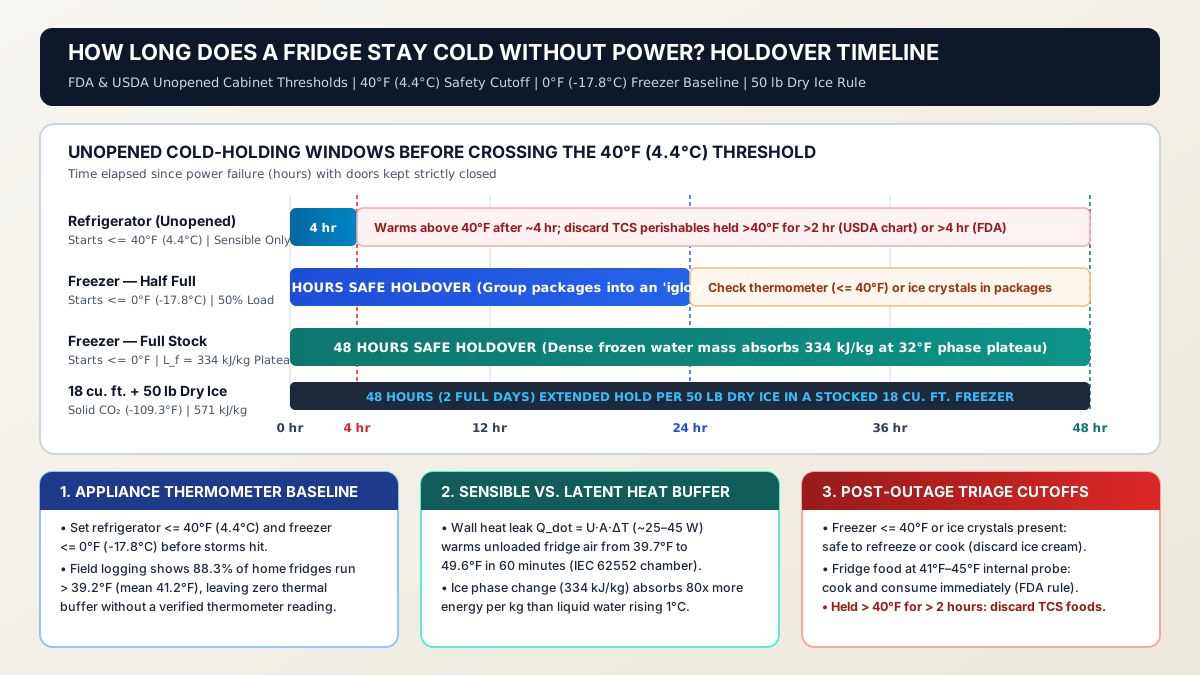
An unopened refrigerator keeps food safely at or below 40°F (4.4°C) for about 4 hours without power, while an unopened freezer holds safe temperatures for 48 hours when full and 24 hours when half-full. Opening the cabinet door during a blackout or starting from an unverified warm baseline leaks cold air, accelerates warming past 40°F, and wastes perishable meat, dairy, and cooked meals.
Knowing how long does a fridge stay cold without power requires separating two distinct physical regimes: sensible-only warming in the fresh-food refrigerator compartment versus latent phase-change arrest in the freezer compartment. Under U.S. Food and Drug Administration (FDA) and USDA Food Safety and Inspection Service (USDA FSIS) emergency protocols, clock time alone is your fallback estimate while the doors stay shut; once electricity returns, an appliance thermometer check or food probe thermometer reading against the 40°F (4.4°C) threshold governs what you keep, cook immediately, or discard.
Scroll horizontally to see all columns.
| Compartment & Stocking State | Baseline Target Before Outage | Unopened Safe Holdover Window | Dominant Thermal Buffer Mechanism | Post-Outage Thermometer & Disposition Rule |
|---|---|---|---|---|
| Refrigerator — Stocked & Unopened | <= 40°F (4.4°C) |
~4 hours |
Sensible heat of liquid water and food (c_p = 4.184 kJ/kg·K) absorbing ~25–45 W wall conduction; no ice phase plateau |
Safe if outage <= 4 hr with doors closed, or if thermometer reads <= 40°F. At 41°F–45°F internal food probe, cook and consume immediately (FDA). Discard TCS foods held > 40°F for > 2 hours (FoodSafety.gov). |
| Refrigerator — Empty / Lightly Loaded Air Cavity | <= 40°F (4.4°C) |
< 1 to 2 hours |
Dry air (c_p = 1.005 kJ/kg·K, density 1.25 kg/m³) holds negligible thermal mass (~0.63 kJ per 100 L over a 5°C rise) |
In IEC 62552 chamber testing (PMC13018613), unloaded fridge air rose from 39.7°F (4.3°C) to 49.6°F (9.8°C) in 60 minutes. Add top-shelf ice packs or move perishables to an ice chest immediately. |
| Freezer — Half-Full & Unopened | <= 0°F (-17.8°C) |
~24 hours |
Reduced frozen water mass with 50% air void space reaches and exhausts the 32°F (0°C) melting plateau twice as fast as a full cabinet |
Group packages tightly together into an 'igloo' cluster (FDA). Safe to refreeze or cook if appliance thermometer reads <= 40°F or packages still contain ice crystals. |
| Freezer — Fully Stocked & Unopened | <= 0°F (-17.8°C) |
~48 hours |
High latent heat of fusion of ice (L_f = 333–334 kJ/kg or 144 BTU/lb at 32°F) absorbs 80x more heat per kg than liquid water warming 1°C |
Safe to refreeze or cook if freezer thermometer reads <= 40°F or packages contain ice crystals (except softened ice cream and frozen yogurt, which FoodSafety.gov instructs to discard). |
18 cu. ft. Full Freezer + 50 lb Dry Ice |
<= 0°F (-17.8°C) |
~48 hours (2 days) per 50 lb block |
Solid CO₂ sublimates at -109.3°F (-78.5°C) with latent heat of sublimation L_sub = 571 kJ/kg (246 BTU/lb), sinking cold gas across all shelves |
Place heavy cardboard between dry ice and glass shelves or food packages; wear insulated gloves; verify cabinet stays <= 40°F when power returns (FDA / USDA FSIS). |
Why a full freezer stays cold 12 times longer than a refrigerator
Takeaway: A refrigerator relies entirely on small sensible temperature rises in chilled liquids, whereas a freezer arrests warming at 32°F (0°C) using the massive latent heat of fusion of ice (334 kJ/kg) before any package can climb toward 40°F.
Even when unplugged with the magnetic door gaskets sealed, every household refrigerator and freezer absorbs ambient room heat through its polyurethane foam walls and perimeter door seals. In experimental heat-transfer characterizations of insulated cold cavities conducted by the INRAE FRISE research unit (PMC9679728), steady-state wall conduction follows the overall heat transmission equation:
Q_dot = U * A * (T_ambient - T_cabinet)
where U (or K) is the overall wall heat transmission coefficient—measured at 0.61 to 0.71 W/(m²·K) in insulated polymer/foam test cavities and typically 0.40 to 0.65 W/(m²·K) across modern residential cabinets—A is the exterior cabinet surface area, and (T_ambient - T_cabinet) is the temperature difference between the kitchen (75°F–90°F / 24°C–32°C) and the interior compartment. Across a standard domestic refrigerator-freezer, continuous conductive and gasket heat leakage (Q_dot) puts 25 W to 45 W (90 to 162 kJ/hr) of thermal power into the cabinet.
How fast that 25–45 W heat leak pushes internal temperatures past the 40°F (4.4°C) safety line depends on three thermodynamic equations:
- Dry air cavity sensible heat (
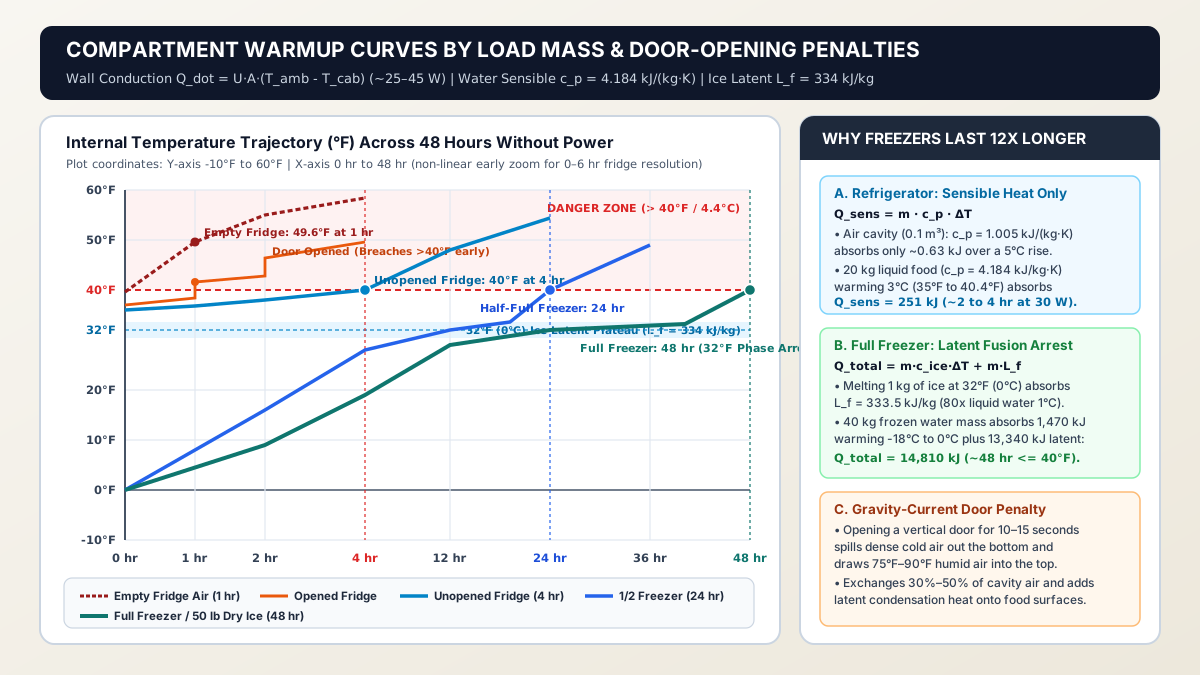
c_p = 1.005 kJ/kg·K): Air has a density of only1.25 kg/m³. In a100 L(0.10 m³) open refrigerator air volume, warming the air itself by5°C(9°F) absorbsQ_air = 0.125 kg * 1.005 kJ/(kg·K) * 5 K = 0.63 kJ—less than25 secondsof wall heat ingress. In controlledIEC 62552chamber experiments at32°C(89.6°F) ambient (PMC13018613), an unloaded289 Lrefrigerator-freezer lost power at39.7°F(4.3°C) and its fresh-food air temperature spiked to49.6°F(9.8°C) within60 minutes. - Refrigerated food sensible heat (
c_p = 4.184 kJ/kg·K): Liquid water and high-moisture foods (milk, soup, produce, meat) store sensible heat proportional to mass and temperature change (Q_sensible = m * c_p * Delta_T). If a refrigerator starts an outage at35.0°F(1.7°C) holding20 kg(44 lb) of high-moisture food and beverages, warming that load by3.0°C(5.4°F) to the40.4°F(4.4°C) boundary absorbs:Q_sensible = 20 kg * 4.184 kJ/(kg·K) * 3.0 K = 251 kJAgainst a20–30 W(72–108 kJ/hr) fresh-food compartment heat leak (plus cabinet wall heat capacity), that251 kJsensible buffer is exhausted in2.5 to 4 hours—matching theFDAandUSDA4-hour unopened refrigerator rule. - Frozen food latent heat of fusion (
L_f = 333.5 kJ/kgat32°F / 0°C): A freezer starting at0°F(-17.8°C) first absorbs sensible heat as ice warms from-17.8°Cto0°C(c_ice = 2.09 kJ/kg·K), and then hits a massive isothermal phase-change plateau at32°F(0°C). Melting1 kgof ice at32°Fwithout raising its temperature by a single degree requires333to334 kJ/kg(144 BTU/lb,PMC13018613)—nearly 80 times more thermal energy than warming1 kgof liquid water by1°C. For a full freezer holding40 kg(88 lb) of frozen water content across meat, soup, and meal packages:Q_total = (40 kg * 2.09 kJ/kg·K * 17.8 K) + (40 kg * 333.5 kJ/kg) = 1,488 kJ + 13,340 kJ = 14,828 kJEven at a35 W(126 kJ/hr) freezer wall heat leak, melting half of that ice mass takes over58 hours, holding the surrounding package surfaces at or below40°F(4.4°C) for the full 48-hour FDA/USDA window.
Why you cannot assume your fridge started the outage at 37°F
The 4-hour refrigerator holdover rule assumes your compartment was actually operating at or below 40°F (4.4°C) when electricity failed. In a continuous data-logger survey of 77 domestic refrigerators using calibrated LogTag TRIX-8 recorders (PMC9957224), the mean household operating temperature was 41.2°F (5.1°C ± 2.8°C), and 88.31% of surveyed refrigerators averaged above 39.2°F (4.0°C), with 49.35% exceeding 41.0°F (5.0°C).
Engineering threshold rule: If your refrigerator starts a blackout at 41°F (5.0°C) because the dial is set too warm, your sensible thermal buffer below 40°F is zero hours. Keep an independent appliance thermometer in both the refrigerator (<= 40°F) and freezer (<= 0°F) at all times, just as detailed in our food storage guide and freezer inventory guide.
The gravity-current penalty of opening the door
Every time a vertical refrigerator or freezer door swings open during a blackout, buoyancy drives a two-way gravity current: dense cold air (~1.29 kg/m³ at 32°F) spills out across the bottom sill toward the kitchen floor while warm, humid kitchen air (~1.18 kg/m³ at 80°F) rushes into the upper half of the cabinet. A 10-to-15-second search exchanges 30% to 50% of the open cavity air volume and deposits humid moisture that condenses directly onto cold containers, releasing 2,260 kJ/kg of latent heat of condensation onto food surfaces. Keeping a written freezer inventory posted outside the door and clear leftover date labels on every container prevents hunting through shelves when power is out or when transferring food to a cooler.
Where to place ice packs and 50 lb of dry ice during an outage
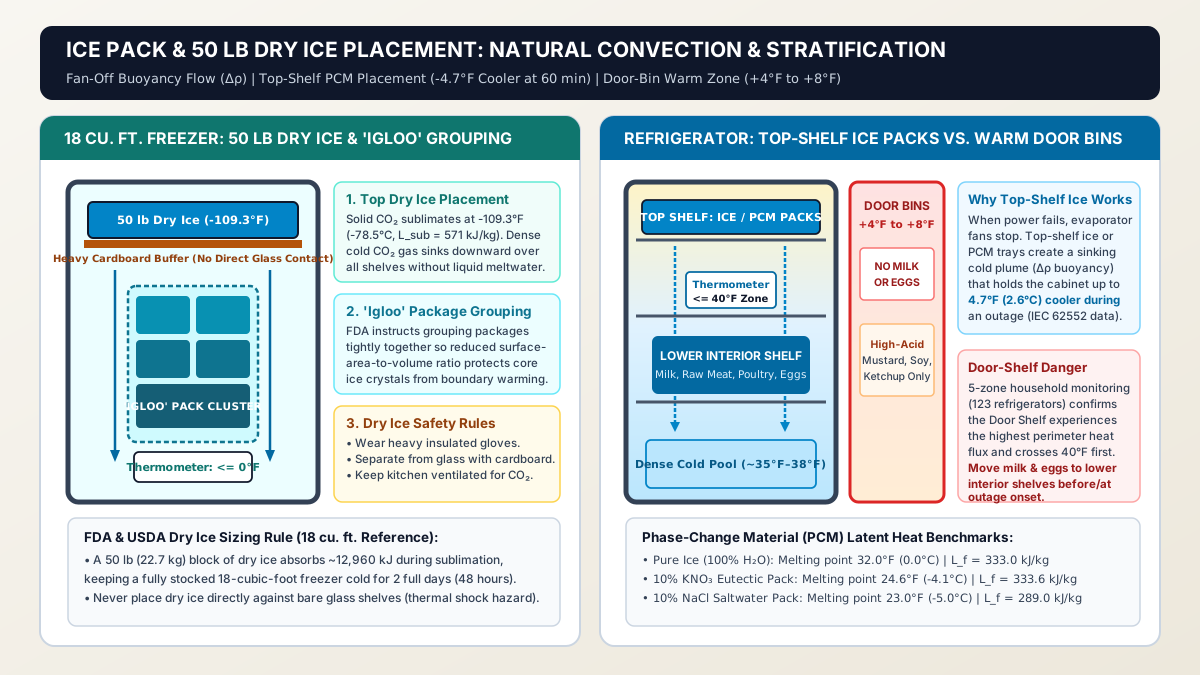
Takeaway: Always place frozen gel packs, water jugs, or dry ice on the top shelf of the compartment—and move milk, raw meat, and eggs off the door bins to the lower interior shelves—because fan-off cold air sinks by natural buoyancy convection.
During normal operation, an evaporator fan forces cold air throughout the cabinet. The instant power fails, forced convection stops and buoyancy-driven natural convection (Δρ) takes over (PMC13018613, PMC9679728):
- Top-shelf phase-change cooling (
-4.7°Fadvantage): InIEC 6255260-minute power-outage tests (PMC13018613), placing a1.0 Lto1.5 Lstainless-steel container of phase-change material (PCM) directly beneath the top evaporator held the refrigerator compartment at45.0°F–46.0°F(7.2°C–7.8°C) compared with49.6°F(9.8°C) in an unbuffered cabinet—a4.7°F(2.6°C) cooling advantage across the shelves below. Particle Image Velocimetry (PIV) airflow mapping by INRAE (PMC9679728) confirms why: a top-mounted3.5 kgice slab generates a continuous downward cold buoyancy plume that sweeps across middle and lower shelves and suppresses vertical thermal stratification. - Eutectic gel packs vs. plain water ice: Pure frozen water melts at
32.0°F(0.0°C) with a latent heat of333.0 kJ/kg. Commercial freezer gel packs formulated with dissolved salts—such as10%potassium nitrate (KNO₃, melting point24.6°F/-4.1°C,L_f = 333.6 kJ/kg) or10%sodium chloride (NaCl, melting point23.0°F/-5.0°C,L_f = 289.0 kJ/kg,PMC13018613)—change phase below25°F, creating a steeper temperature gradient (Delta_T) that absorbs heat faster when moved to the top shelf of a warming refrigerator. - Warm door-bin stratification (
+4°F to +8°Fpenalty): In 5-zone household monitoring across123refrigerators (PMC13264023), the Door Shelf (DS) and Top Shelf (TS) experienced the fastest warming spikes because perimeter door gaskets have higher thermal conductance than thick side walls. Never leave fluid milk, shell eggs, or raw meat in the door bins during an outage; move them to the lower-middle shelf or bottom interior shelf before or at the start of a planned outage.
How to use 50 lb of dry ice for prolonged outages (> 4 hours)
If utility restoration will take longer than 4 hours (for the refrigerator) or 24 to 48 hours (for the freezer), FDA and USDA FSIS advise purchasing dry ice (solid carbon dioxide, CO₂, at -109.3°F / -78.5°C, latent heat of sublimation 571 kJ/kg) or block ice:
- Sizing rule:
50 lb(22.7 kg) of dry ice keeps a fully stocked18-cubic-foot(510 L) freezer cold for2 full days(48 hours) (FDA,USDA FSIS). Divide that50 lbinto smaller wrapped slabs if splitting between a top-freezer and bottom-refrigerator compartment. - Placement and glass protection: Place heavy cardboard directly on top of the frozen food packages or shelf, and rest the dry ice on the cardboard at the top of the cavity so dense cold
CO₂gas sinks downward through the food stack. Never let-109.3°Fdry ice touch bare tempered or soda-lime glass shelves or glass jars directly, or thermal shock can fracture the glass—the same thermal-stress mechanism explained in our freezing food in Mason jars guide. - Gloves and room ventilation: Handle dry ice only with heavy leather or insulated gloves to prevent instant frostbite. Because sublimating
50 lbof solidCO₂releases roughly12.4 m³(438 cu. ft.) of carbon dioxide gas at room temperature, keep a kitchen window slightly cracked or the room ventilated and never breathe directly into the cabinet opening when unlatching the door.
How to run the post-outage appliance thermometer check
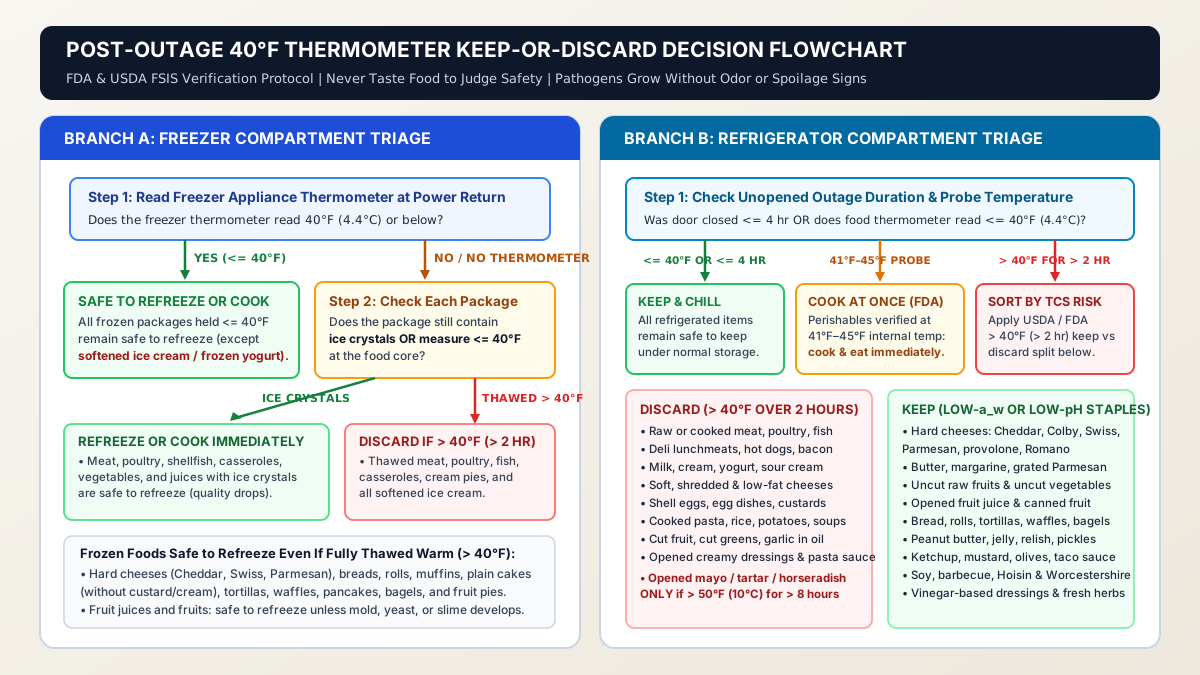
Takeaway: Never taste food or rely on odor or appearance to judge safety after a power failure; check the appliance thermometer or food core temperature against 40°F (4.4°C) and inspect frozen packages for ice crystals the moment electricity returns.
As FDA consumer food-safety guidance warns, spoilage bacteria (which produce sour odors, slime, and visible discoloration) are not the same as foodborne pathogenic bacteria (Salmonella, enterohemorrhagic Escherichia coli O157:H7, Listeria monocytogenes, Staphylococcus aureus, and Clostridium botulinum). Pathogens multiply rapidly above 40°F (4.4°C) without changing the smell, appearance, or flavor of meat, milk, or cooked leftovers.
Under the FDA Food Code 2022 (§3-501.16), foods requiring Time/Temperature Control for Safety (TCS) are high-moisture (water activity a_w > 0.88 to 0.92), low-acid (pH > 4.2 to 4.6) items that support rapid pathogen growth or heat-stable enterotoxin production. When power returns, run this two-branch appliance thermometer check:
Branch 1: Evaluating the Freezer Compartment
- Read the freezer appliance thermometer first: If the thermometer kept in the freezer reads
40°F(4.4°C) or below,FDAandUSDA FSISstate that the food is safe and can be safely refrozen (with the sole exception of softened ice cream and frozen yogurt, whichFoodSafety.govinstructs to discard). - If you had no appliance thermometer, inspect each package individually: Check the center and edges of every package without relying on smell or appearance. If a package still contains ice crystals or measures
40°F(4.4°C) or below on a food probe thermometer, it is safe to refreeze or cook immediately. Note that partial thawing and refreezing forms larger extracellular ice crystals that increase drip loss and soften texture, as covered in our cooked meals freezing guide and airtight vs. vacuum-sealed guide.
Branch 2: Evaluating the Refrigerator Compartment
- Check outage duration (
<= 4 hours) and cabinet thermometer (<= 40°F): If the power was out for no more than4 hourswith the door kept closed, or if the refrigerator thermometer reads40°F(4.4°C) or below, all refrigerated foods remain safe. - Apply the FDA
41°F–45°Finternal food-thermometer window:FDA’s power-outage protocol specifies that if you measure the internal core temperature of refrigerated perishable foods with a calibrated food probe thermometer and the food itself reads45°F(7.2°C) or below, the food is safe, provided you cook and consume it as soon as possible. Multi-zone refrigerator monitoring (PMC13264023) shows why: a dense200 gto1 kgfood mass on the middle shelf has high volumetric heat capacity (c_p = 3.5–4.8 kJ/kg·K) and lags behind air temperature spikes by30to90 minutes. - Apply the USDA / FoodSafety.gov
> 40°Ffor> 2 hoursdiscard rule: AnyTCSperishable food held at temperatures above40°F(4.4°C) for more than2 hours(or> 4 hourstotal in an unopened warming refrigerator without a thermometer check) must be discarded.
Power outage food safety chart: Refrigerated foods (held above 40°F for over 2 hours)
Use this power outage food safety chart—compiled directly from FoodSafety.gov, FDA, and USDA FSIS emergency tables—whenever your refrigerator has exceeded 40°F (4.4°C) for more than 2 hours (or when an unopened refrigerator has been without power for more than 4 hours).
Scroll horizontally to see all columns.
| Food Category | DISCARD (If Held Above 40°F for Over 2 Hours) |
KEEP (Safe Above 40°F Over 2 Hours Unless Noted) |
Food-Safety Mechanism (FDA Food Code a_w / pH) |
|---|---|---|---|
| Meat, Poultry & Seafood | Raw or leftover cooked beef, pork, lamb, poultry, fish, and shellfish; thawing meat or poultry; deli lunchmeats, hot dogs, bacon, sausage, and dried beef; meat, tuna, shrimp, chicken, or egg salads; gravy, stuffing, broth, soups, stews, and casseroles; pizza with any topping; opened canned meats/fish; canned hams labeled "Keep Refrigerated". |
Unopened shelf-stable canned meats and fish stored in cool compartments. | High water activity (a_w > 0.97) and near-neutral pH (5.5–6.5) support rapid growth of Salmonella, Listeria monocytogenes, and Staphylococcus aureus enterotoxins that reheating to 165°F will not destroy. |
| Cheeses (Soft vs. Hard) | Soft and semi-soft cheeses: Brie, Camembert, blue/bleu, Roquefort, cottage cheese, cream cheese, ricotta, mozzarella, Monterey Jack, Muenster, Edam, Neufchatel, queso blanco, and queso fresco; all shredded cheeses; all low-fat cheeses. | Hard aged cheeses: Cheddar, Colby, Swiss, Parmesan, provolone, and Romano; processed cheese slices/blocks; grated Parmesan or Romano in jars or cans. | Hard aged cheeses have lower moisture (a_w < 0.91), higher salt-in-moisture, and lactic fermentation acidity that inhibit pathogen multiplication during short warm excursions; shredded cheeses expose huge surface area to mold and bacterial growth. |
| Dairy, Milk & Eggs | Fluid milk, cream, sour cream, buttermilk, evaporated milk, yogurt, eggnog, and soy milk; opened baby formula; raw shell eggs, hard-cooked eggs (in shell or peeled), egg dishes, quiche, custards, and puddings. | Butter and margarine (stay safe unless rancid or melted into contaminated water). | Fluid dairy and eggs (a_w ~ 0.99, neutral pH) are prime growth media for Salmonella Enteritidis and Bacillus cereus; commercial butter is a water-in-fat emulsion (>= 80% lipid) where microscopic water droplets restrict bacterial spread. |
| Fruits & Vegetables | Cut fresh fruits (especially cut melons), cut vegetables, pre-cut / pre-washed / bagged leafy greens, cooked vegetables, baked potatoes (especially foil-wrapped), commercial garlic in oil, and sliced/shredded fresh coconut. | Uncut raw fruits and uncut raw vegetables; opened fruit juices; opened canned fruits; dried fruits, raisins, candied fruits, and dates. | Intact peel and epidermis block pathogen entry; cutting releases intracellular nutrients onto wet surfaces (FDA Food Code TCS rules for cut melons, cut tomatoes, and cut greens), while garlic-in-oil and foil-wrapped potatoes create anaerobic Clostridium botulinum risk above 40°F. |
| Breads, Pastries, Pasta & Rice | Cooked pasta, cooked rice, and cooked potatoes; pasta or potato salads with mayonnaise or vinaigrette; fresh (uncooked) refrigerated pasta; cheesecake; cream-, custard-, chiffon-, or cheese-filled pastries and pies; commercial or homemade refrigerated biscuit, roll, or cookie dough. | Bread, rolls, plain cakes, muffins, quick breads, tortillas, waffles, pancakes, bagels, and double-crust fruit pies. | Cooked starch gels (a_w > 0.98) germinate heat-resistant Bacillus cereus spores into emetic toxin above 40°F; baked bread and fruit pies have lower a_w (< 0.85–0.90) or high sugar/acid content. |
| Sauces, Spreads & Condiments | Opened creamy-based salad dressings and opened spaghetti / marinara sauce (> 40°F for > 2 hr). Special 50°F / 8-Hour Rule: Discard opened mayonnaise, tartar sauce, and creamy horseradish if held above 50°F (10°C) for over 8 hours. |
Peanut butter, jelly, jam, relish, taco sauce, mustard, ketchup, olives, pickles, Worcestershire sauce, soy sauce, barbecue sauce, Hoisin sauce, vinegar-based dressings, and fresh herbs/spices. | Commercial mayonnaise and vinegar condiments are acidified with acetic or citric acid (pH < 4.1–4.6) or high salt/sugar (low a_w), preventing pathogen growth until prolonged > 50°F exposure in lower-acid emulsified spreads. |
When discarding compromised batches of soup, stew, or meal-prep containers, wash and sanitize reusable glass and plastic dishes before refilling—following the material care limits in our food storage containers guide, Pyrex borosilicate vs. soda-lime glass guide, and soup portion freezing guide.
Power outage food safety chart: Frozen foods (when power returns)
Use this second FoodSafety.gov and USDA FSIS disposition table to sort items in your freezer compartment based on whether the package still contains ice crystals (or reads <= 40°F on a thermometer) versus having thawed and warmed above 40°F for over 2 hours.
Scroll horizontally to see all columns.
| Frozen Food Group | Still Contains Ice Crystals OR Reads <= 40°F (4.4°C) |
Thawed & Held Above 40°F (4.4°C) for Over 2 Hours |
Quality & Handling Notes After Refreezing |
|---|---|---|---|
| Beef, Veal, Lamb, Pork & Ground Meats | Refreeze or cook. | Discard. | Partial thawing increases myoglobin purge (drip loss); overwrap tightly to prevent freezer burn and update your leftover label. |
| Poultry (Whole, Pieces, Ground Turkey/Chicken) | Refreeze or cook. | Discard. | Ground poultry and organ meats (liver, giblets) warm fastest at package edges; check thin corners carefully for ice crystals. |
| Fish, Shellfish & Breaded Seafood | Refreeze or cook (expect noticeable texture and moisture loss). | Discard. | Lean and fatty fish proteins denature quickly during freeze-thaw cycling; cook promptly within 1–2 days rather than refreezing if quality is priority. |
| Casseroles, Soups, Stews & Frozen Meals | Refreeze or cook. | Discard. | If cooking immediately instead of refreezing, reheat soups and stews to a rolling boil (165°F core) per our cooked meals guide. |
| Milk, Eggs (Out of Shell) & Soft/Shredded Cheeses | Refreeze (milk and soft cheese may separate slightly; stir or use in cooking, similar to freezing yogurt for cooking). | Discard. | Never freeze shell eggs in the shell; blended whole eggs or whites in sealed containers with ice crystals can be refrozen or baked immediately. |
| Hard Cheeses (Cheddar, Swiss, Parmesan) | Refreeze. | Refreeze or keep refrigerated (safe even if fully thawed above 40°F). |
Moisture loss may make refrozen hard cheese crumbly; grate for baking or sauces. |
| Ice Cream & Frozen Yogurt | Discard if partially thawed or softened (FoodSafety.gov rule). |
Discard. | Melted and refrozen dairy foam loses overrun, forms coarse ice shards, and poses Listeria risk if the outer rim warmed. |
| Juices & Fruits | Refreeze. | Refreeze (discard only if fruit or juice bubbles, ferments, smells yeasty, or shows mold/slime). | High natural fruit acidity (pH 3.0–4.0) prevents bacterial pathogen growth during short thaws, though yeast fermentation can sour flavor. |
| Vegetables & Vegetable Juices | Refreeze or cook (blanched frozen vegetables soften when refrozen). | Discard if held > 40°F for > 6 hours (FoodSafety.gov vegetable juice rule: discard if > 40°F for > 6 hr; cooked/cut vegetables: discard > 2 hr). |
Low-acid vegetables (pH 5.2–6.5) lack the acid barrier of fruit and spoil rapidly once fully thawed above 40°F. |
| Breads, Rolls, Muffins, Plain Cakes, Waffles, Pancakes & Fruit Pies | Refreeze. | Refreeze or keep. | See our homemade bread storage guide and chocolate cake freezing guide for wrapping layers. Discard cream-, custard-, or cheese-filled pies/pastries held > 40°F for > 2 hr. |
How to remove spoiled food odors from a refrigerator or freezer after a prolonged blackout
If a multi-day hurricane, ice storm, or summer grid failure causes meat or dairy to spoil inside an unplugged unit, volatile amines, sulfur compounds, and short-chain fatty acids absorb into the interior ABS/polystyrene cabinet liner and silicone door gaskets. The National Center for Home Food Preservation (NCHFP, University of Georgia Cooperative Extension, So Easy to Preserve, 6th ed.) provides a tested three-step remediation protocol for restoring a cabinet after power failure spoilage:
- Unplug, strip, and wash with baking soda or vinegar solution: Remove all spoiled packages, detachable wire or glass shelves, crisper drawers, and ice bins. Wash the entire interior liner, door gaskets, and removable parts using either
1 tablespoon(15 g) of baking soda dissolved per1 quart(0.95 L) of warm tap water (mildly alkalinepH ~8.3to neutralize acidic volatile fatty acids) or1 cup(240 mL) of household white vinegar per1 gallon(3.79 L) of tap water, then allow all surfaces to dry completely. - Adsorb persistent odors in the unplugged cabinet with extra-dry activated charcoal: If putrid odors remain absorbed in the plastic liner after washing, keep the freezer or refrigerator unplugged and place extra-dry activated charcoal (available from pharmacy or pet-supply stores—never use charcoal briquettes treated with lighter fluid) in open shallow pans or spread on clean paper in the bottom of the compartment for several days. Activated carbon’s high microporous surface area (
500to1,500 m²/g) adsorbs non-polar organic odor molecules out of the enclosed air cavity. - Replace charcoal if needed, rinse, dry, and verify
0°F/40°Fbefore restocking: For severe spoilage, replace the saturated charcoal with a fresh charge after48–72 hours. Once the odor clears, wipe out any carbon dust, dry the interior, plug the unit in, and wait until your independent appliance thermometers confirm40°F(4.4°C) or below in the refrigerator and0°F(-17.8°C) or below in the freezer before restocking fresh groceries or pet food (and keep dry kibble in its own sealed bin as covered in dog food storage containers and bag liners).
Frequently asked questions
How long will food last in the refrigerator without power if the door stays closed?
An unopened refrigerator keeps food safely at or below 40°F (4.4°C) for about 4 hours during a power outage, provided the compartment was operating at or below 40°F before the power failed. Once a refrigerator remains without power for more than 4 hours, internal temperatures climb into the bacterial danger zone and time/temperature control for safety (TCS) perishables such as meat, poultry, fish, fluid milk, soft cheeses, shell eggs, and cooked leftovers must be evaluated with a thermometer or discarded.
How long does a freezer stay cold without power when half full versus full?
According to FDA and USDA FSIS emergency standards, a fully stocked, unopened freezer maintains safe temperatures (<= 40°F / 4.4°C) for approximately 48 hours (2 days), whereas a half-full unopened freezer holds safe temperatures for about 24 hours (1 day). A full freezer lasts twice as long because the water frozen inside dense packages absorbs 333 to 334 kJ/kg of latent heat of fusion at the 32°F (0°C) melting plateau, whereas empty air space provides almost zero thermal mass.
Can you refreeze frozen meat or meals that partially thawed during a power outage?
Yes, you can safely refreeze or cook partially thawed meat, poultry, seafood, vegetables, and cooked meals if the freezer appliance thermometer reads 40°F (4.4°C) or below, or if each individual package still contains physical ice crystals at its core (FDA / USDA FSIS). Partial thawing and refreezing causes moisture purge and softer texture, so cook seafood and delicate dishes promptly for best quality, and always discard softened ice cream or any meat package that has thawed completely and remained above 40°F for more than 2 hours.
Are condiments, butter, and hard cheese safe after an overnight power outage?
Yes, most high-acid condiments, butter, and aged hard cheeses remain safe even when a refrigerator stays above 40°F (4.4°C) for more than 2 hours overnight. Under FoodSafety.gov and USDA power-outage charts, you can keep butter, margarine, hard cheeses (Cheddar, Colby, Swiss, Parmesan, provolone, Romano), ketchup, mustard, relish, pickles, olives, peanut butter, jelly, soy sauce, barbecue sauce, and vinegar-based dressings. However, you must discard opened creamy salad dressings and opened pasta sauce held above 40°F for over 2 hours, and discard opened mayonnaise, tartar sauce, or horseradish if held above 50°F (10°C) for over 8 hours.
Where should you put ice packs or dry ice in a refrigerator during a power outage?
Place frozen gel packs, frozen water jugs, or dry ice on the highest shelf of the refrigerator or freezer compartment rather than on the bottom floor. When electricity fails, the internal circulation fan stops and cold air sinks by natural buoyancy convection; experimental cold-cavity tests (PMC13018613, PMC9679728) show that top-mounted phase-change ice generates a downward cold plume that keeps the shelves below up to 4.7°F (2.6°C) cooler while you move milk, raw meat, and eggs off the warm door bins down to the lower interior shelves.
Pre-storm cold-chain preparation
Takeaway: Verify 40°F (4.4°C) and 0°F (-17.8°C) on dedicated appliance thermometers, freeze water jugs in advance, and keep container labels and inventory sheets current so doors stay shut when the grid fails.
Before severe weather arrives, confirm that your refrigerator thermometer reads at or below 40°F (4.4°C) and your freezer thermometer reads at or below 0°F (-17.8°C), freeze potable water in sealed containers to build extra 334 kJ/kg latent ice mass, and group frozen packages tightly together using your freezer inventory and leftover date labels.
Explore more in Food Storage & Freezer Guides.
Official guidance and sources
Sources last checked October 25, 2026.
- Food and Water Safety During Power Outages and Floods , U.S. Food and Drug Administration (FDA) (accessed October 25, 2026) Establishes the 4-hour unopened refrigerator limit, 48-hour full freezer limit, 24-hour half-full freezer limit, 50 lb dry ice rule for an 18 cu. ft. freezer, and 40°F/45°F post-outage thermometer rules.
- Food Safety During Power Outage (Refrigerated and Frozen Food Charts) , FoodSafety.gov / U.S. Department of Health and Human Services & USDA (accessed October 25, 2026) Item-by-item keep-or-discard tables for refrigerated foods held above 40°F for over 2 hours (and 50°F for over 8 hours for mayonnaise, tartar sauce, and horseradish) and frozen foods with or without ice crystals.
- Keeping Food Safe During an Emergency , USDA Food Safety and Inspection Service (FSIS) (accessed October 25, 2026) Confirms the 4-hour, 24-hour, and 48-hour unopened appliance windows, dry ice handling precautions, and meat, poultry, and egg disposition rules.
- Are You Storing Food Safely? , U.S. Food and Drug Administration (FDA) (accessed October 25, 2026) Covers baseline 40°F refrigerator and 0°F freezer targets, the 2-hour room-temperature rule (1 hour above 90°F), and Listeria monocytogenes risks above 40°F.
- FDA Food Code 2022 (Time/Temperature Control for Safety Food Definition & Section 3-501.16) , U.S. Food and Drug Administration (FDA) (accessed October 25, 2026) Defines Time/Temperature Control for Safety (TCS) foods by water activity (aw > 0.88 to 0.92) and pH (pH > 4.2 to 4.6), explaining why high-moisture, low-acid perishables require strict <=40°F cold holding.
- Care of the Freezer (Including Power Failure Odor Removal) , National Center for Home Food Preservation (NCHFP), University of Georgia Cooperative Extension (accessed October 25, 2026) Extracted from So Easy to Preserve (6th ed., Bulletin 989); provides baking soda, vinegar, and activated charcoal protocols for removing post-outage spoilage odors from freezer cabinets.
- Freezer Management , National Center for Home Food Preservation (NCHFP), University of Georgia Cooperative Extension (accessed October 25, 2026) Recommends maintaining 0°F (-17.8°C) or lower with a dedicated thermometer and keeping a posted freezer inventory so doors are not held open while searching for packages.
- Thawing and Preparing Foods for Serving , National Center for Home Food Preservation (NCHFP), University of Georgia Cooperative Extension (accessed October 25, 2026) Explains surface-to-core thermal lag during defrosting and why outer package layers can enter the 40°F to 140°F bacterial growth zone while the core remains frozen.
- Utilizing of KNO3, KCl, and NaCl as phase change materials within the refrigerator for energy saving , Scientific Reports (Nature Portfolio / PubMed Central PMC13018613) (accessed October 25, 2026) IEC 62552 chamber experiments (32°C ambient) on a 289 L refrigerator-freezer during a 60-minute power outage, documenting latent heat of fusion benchmarks (333 to 333.6 kJ/kg) and top-mounted PCM cooling effects.
- Dataset of experimental study investigation of airflow and heat transfer in an insulated box equipped with a phase change material , Data in Brief (Elsevier / PubMed Central PMC9679728), INRAE FRISE Research Unit (accessed October 25, 2026) Quantifies wall heat transmission coefficients (K = 0.61 to 0.71 W/m²·K) and Particle Image Velocimetry (PIV) downward natural convection plumes from top-mounted ice slabs.
- Survey of Domestic Refrigerator Storage Temperatures in Poland for Use as a QMRA Tool for Exposure Assessment , International Journal of Environmental Research and Public Health (MDPI / PubMed Central PMC9957224) (accessed October 25, 2026) Continuous data-logger survey of 77 household refrigerators showing a mean operating temperature of 5.1°C (41.2°F), with 88.31% averaging above 4°C (39.2°F).
- Dataset of temperature and relative humidity measurements in domestic refrigerators in Bangkok Thailand , Data in Brief (Elsevier / PubMed Central PMC13264023), INRAE & King Mongkut's Institute of Technology Ladkrabang (accessed October 25, 2026) Five-zone temperature monitoring across 123 household refrigerators comparing Freezer, Top Shelf, Middle Shelf, Vegetable Drawer, and Door Shelf warmup against a 200 g middle-shelf food simulant core.