
Pyrex Glass Food Storage Containers: Borosilicate vs Soda-Lime
Broken glass can cost a meal. Compare borosilicate and soda-lime Pyrex glass food storage containers by the exact dish, lid and care instructions.
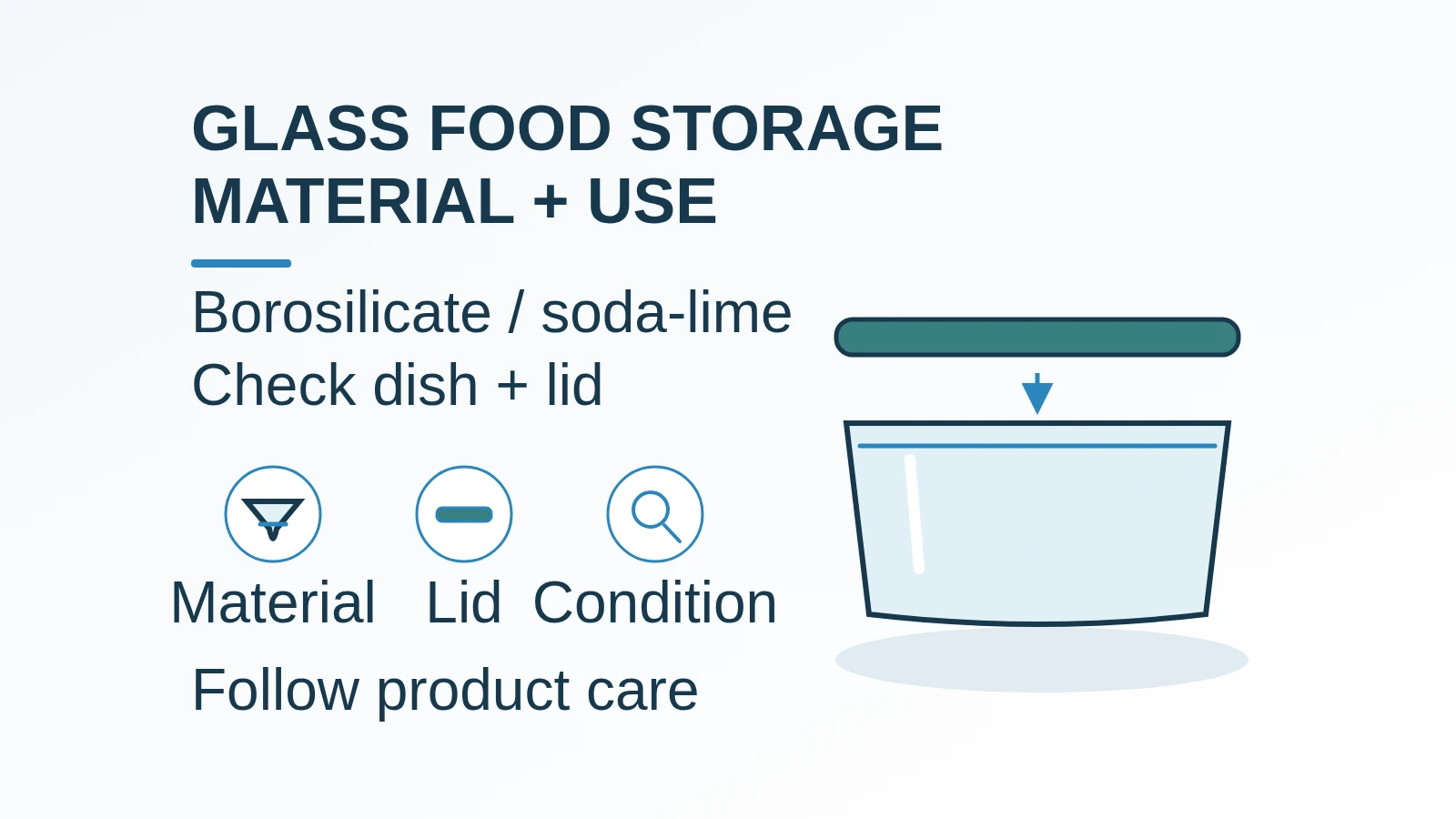
Broken glass can cost the food inside as well as the container. For Pyrex glass food storage containers, the borosilicate-vs-soda-lime comparison starts with the exact product and lid instructions, because neither a brand era nor a familiar logo identifies every dish.
Pyrex glass food storage containers cannot all be assigned to one glass family. The current U.S. manufacturer FAQ says Pyrex produces both soda-lime and borosilicate glass, with different relative resistance to impact and extreme temperature changes. Choose by documented composition and permitted use for the actual dish, then check the lid separately; a material name alone does not authorize a freezer-to-oven transfer. Source: Pyrex Home FAQ, retrieved October 19, 2026.
What does the material comparison actually tell you?
It describes relative resistance, not a universal safety ranking. The table separates the material comparison from the information actually given for an individual product.
Swipe the table sideways on a narrow screen.
Scroll horizontally to see all columns.
| Glass or product description | What the retrieved manufacturer page establishes | Dominant Failure Mode & Prevention |
|---|---|---|
| Soda-lime, where documented | U.S. FAQ gives it a relative impact-resistance advantage | Sudden temperature change remains a breakage risk → follow the exact dish’s heating and cooling instructions |
| Borosilicate, where documented | U.S. FAQ gives it a relative advantage under extreme thermal changes | Treating resistance as immunity → keep the product’s restrictions and damage checks |
| Simply Store 7-cup, SKU 6017397 | U.S. listing says tempered glass; it does not identify the glass family | Guessing composition from the word tempered → seek an explicit material statement for that item |
| UK Cook & Store page | Explicitly describes tempered borosilicate glass | Applying another range’s lid or transport rules → use this product’s own instructions |
The first two rows summarize the U.S. FAQ; the product rows refer to the U.S. Simply Store listing and UK Cook & Store listing. The examples establish scope, not a product ranking.
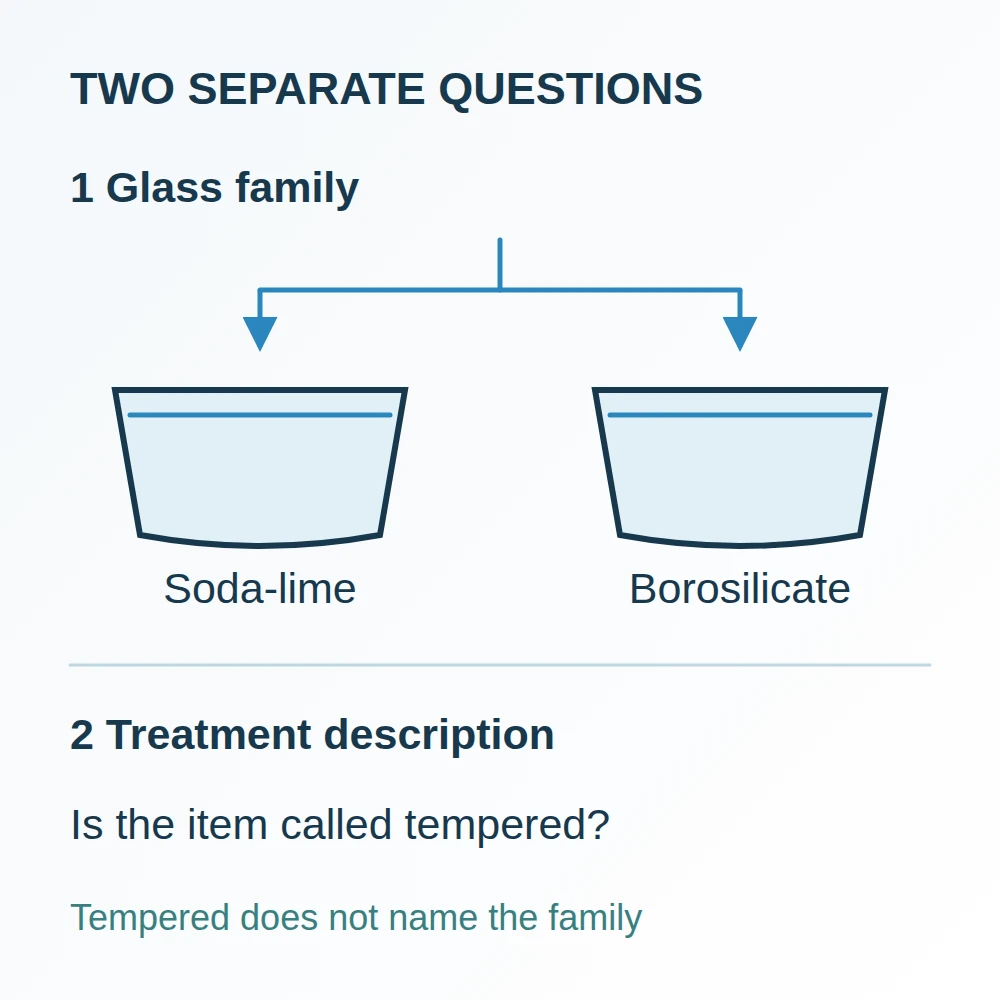
For an existing container, copy the identifying information from its base and match the manufacturer page or original instructions. Keep a photograph of that information with the instructions. If you cannot establish the permitted use, choose a vessel whose instructions you can verify for the intended task. Logo capitalization, tint and a seller’s approximate age are insufficient documentation for the decisions in this guide.
Why do the lid and the market matter?
The base and lid may have different permitted uses, and similar-looking regional products may have different instructions.
The U.S. Simply Store 7-cup page lists the glass container for the freezer, microwave and dishwasher, and its plastic lid for the freezer, microwave and top dishwasher rack. For this U.S. example, the Pyrex care instructions require removing the plastic lid or venting it at least 1/4 inch before microwaving, and opening any fitted vent. Its published capacity is 7 cups. Those statements apply to that listing; the capacity does not identify the material family. Simply Store product details.
The retrieved UK Cook & Store page explicitly identifies borosilicate glass, says the dish is not watertight for transporting liquid foods, and excludes its plastic cover from both conventional ovens and microwaves. Those restrictions matter if you are choosing a lunch container or reheating with a lid. UK Cook & Store usage tips.
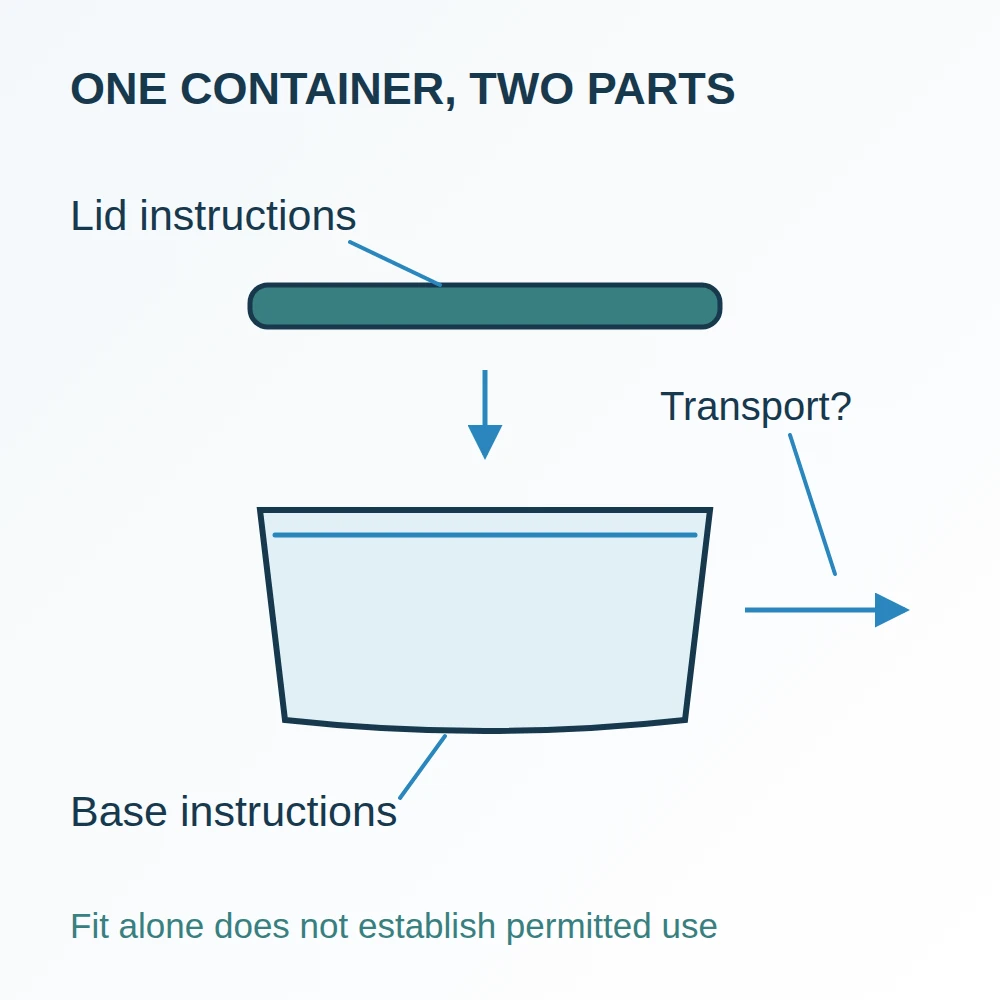
The UK listing’s claims do not establish what a U.S. Simply Store dish can do. Likewise, a U.S. microwave-lid permission should not be transferred to the UK example. Save the instructions for the actual product rather than mixing permissions across pages.
What physical condition means you should stop using it?
A chip or crack is enough to stop using the dish. The U.S. Pyrex safety and usage page also excludes broken or severely scratched glass from use and repair.
Physical threshold rule: If the visible chip or crack count is one or more, remove the dish from use. This is a condition-based rejection rule, not a home test of residual glass strength.
For U.S. Pyrex glassware covered by that safety page, avoid sudden temperature changes, do not transfer directly from the freezer to a hot oven, and let hot glass cool on a rack, dry potholder or dry cloth. Never use a guessed temperature difference as permission to override those instructions. Pyrex use and care.
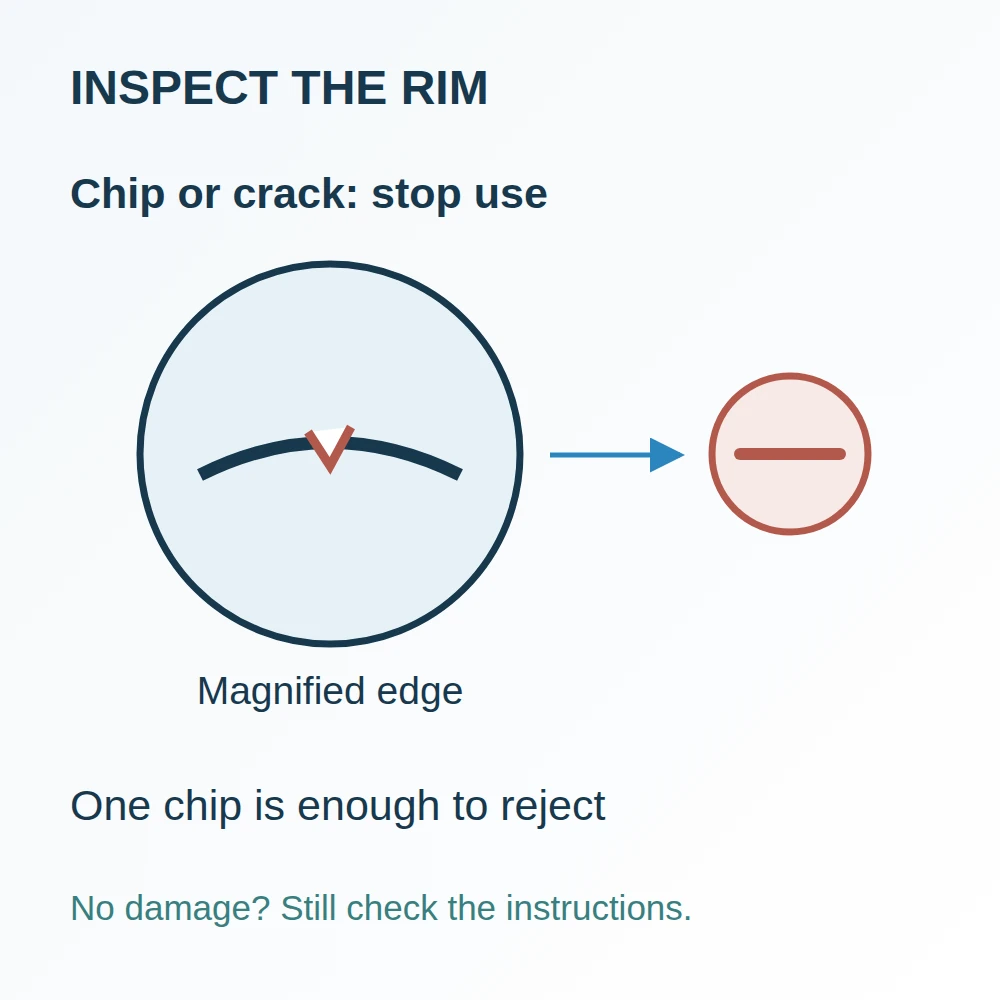
Inspect without running a finger over a damaged edge. Do not heat a questionable dish to see whether it survives. Treat the diagram as an inspection reminder; it cannot certify the condition of a container.
How many containers should you prepare?
Count the meal portions first, then choose containers with enough permitted fill space for that food and use. A labeled capacity does not mean you should fill to the brim, especially when freezing.
Containers needed = ceiling(total portions ÷ portions per container).
Worked example, hypothetical batch: ceiling(6 portions ÷ 2 portions per container) = 3 containers.
This calculation counts meals, not cooling performance or freezer headspace. Container capacity, the food’s volume and the manufacturer’s freezing directions are separate checks. Use the already-live soup portioning guide when planning that food’s cooling and packaging steps.
There is also a time cost to mismatched lids. If a household spends a hypothetical two minutes finding a lid on five packing days, that is 2 minutes × 5 = 10 minutes per week. Store each usable base with an identified matching lid, and keep the cooking and freezing dates distinct using the leftover-label guide. Neither a different glass family nor a better seal gives the food a new storage clock.
Method and sources
Manufacturer pages were retrieved October 19, 2026. Material comparisons above use the current U.S. FAQ; product permissions use the named U.S. and UK listings; the condition rule uses the U.S. safety page. No universal thermal-shock limit is assigned, and no historic Pyrex era is treated as the composition of every product. Portion and time calculations are hypothetical planning examples. The food-storage hub provides the next step for food-specific guidance.
Last updated: October 19, 2026.
Explore more in Food Storage & Freezer Guides.
Official guidance and sources
Sources last checked October 19, 2026.
- Frequently Asked Questions , Pyrex Home US (accessed October 19, 2026) States that both soda-lime and borosilicate glass are produced and describes relative impact and thermal-change resistance.
- Product Warranties, Safety and Usage , Pyrex Home US (accessed October 19, 2026) Pyrex use and care, damage exclusions from use, temperature-change precautions and separate lid instructions.
- Simply Store 7-cup Glass Food Storage Container with Blue Lid , Pyrex Home US (accessed October 19, 2026) SKU 6017397; describes tempered glass and separate glass-container and plastic-lid uses without specifying glass composition.
- Cook & Store Rectangular Glass Dish with Lid , Pyrex UK (accessed October 19, 2026) UK Cook & Store page identifies tempered borosilicate glass; warns that the product is not watertight and its plastic lid is neither oven nor microwave safe.