
Dog Food Storage Containers: Lipid Oxidation, Bag Liners, and 50 lb Bin Sizing
Pouring dry kibble straight into plastic bins lets surface fats sorb into container walls, turn rancid, and erase FDA recall lot numbers. Keep the clipped bag inside an airtight bin.
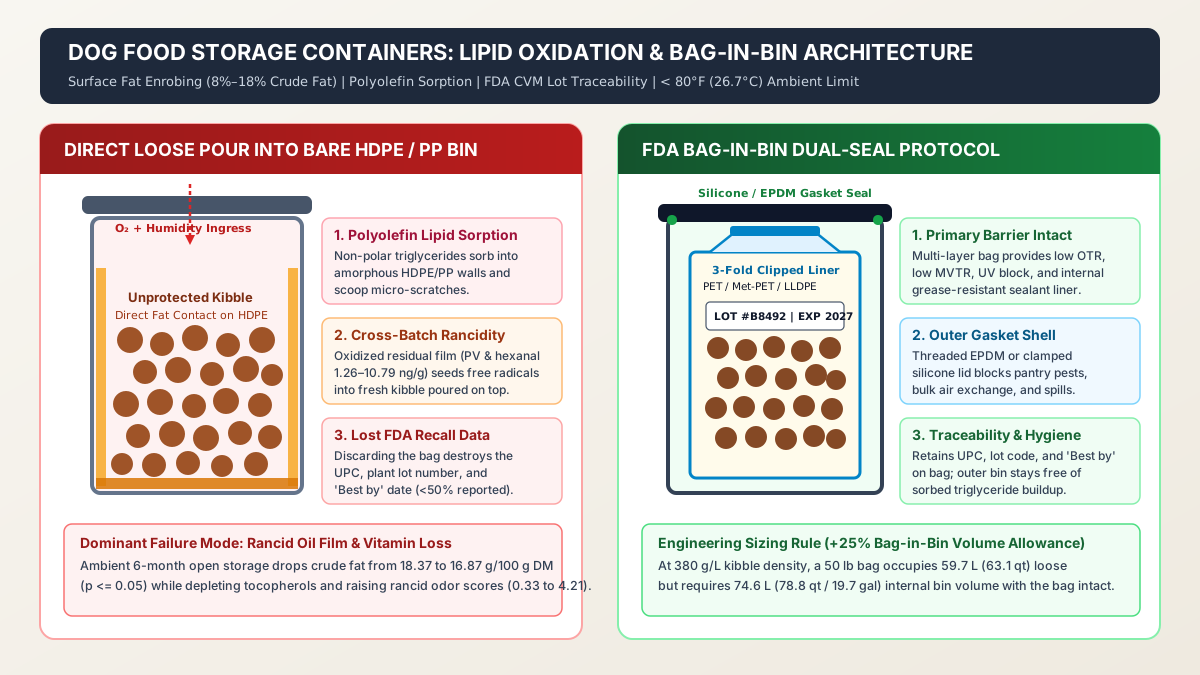
Pouring dry dog food directly into a bare plastic bin damages kibble freshness and wastes the oxygen-and-grease barrier built into the original manufacturer bag. Keeping the tightly folded, clipped retail bag inside an airtight outer container prevents surface fats from sorbing into plastic walls, slows lipid oxidation, and preserves the lot number required during an FDA recall.
Commercial dry dog kibble is not a dry, oil-free grain like white rice; after extrusion and drying, kibble is enrobed with topical animal fats and oils that sit directly on the exterior of each piece. When those lipid-coated granules rest against bare high-density polyethylene (HDPE) or polypropylene (PP), non-polar triglycerides migrate into microscopic scoop scratches and amorphous polymer chains, oxidizing into rancid aldehydes that contaminate the next bag poured on top. Selecting the right dog food storage containers requires pairing the multi-layer barrier of the original bag with a gasketed outer bin sized for the extra volume of a folded liner.
Scroll horizontally to see all columns.
| Storage Architecture | Primary Oxygen & Grease Barrier | Wall Oil Sorption Risk | FDA Lot & UPC Retention | Sizing Requirement | Dominant Failure Mode & Prevention |
|---|---|---|---|---|---|
| Bag-in-Bin Dual Seal (Clipped original bag inside gasketed HDPE or 304 steel bin) | Multi-layer retail bag (PET / Met-PET or Foil / LLDPE) + outer silicone or EPDM gasket |
Zero contact between kibble fat and outer bin walls | Printed on original bag in use | 1.25 x loose kibble volume (~75 L for a 50 lb bag) |
Bag corners catch in narrow bins → size up one container tier above nominal bag weight |
Direct Loose Pour in Bare Plastic (HDPE #2 or PP #5 bin without bag liner) |
Single-stage outer lid gasket only; full headspace air exchange on every opening | High lipophilic triglyceride sorption into polyolefin walls | Lost unless cut out and taped to the lid on every refill | 1.00 x loose volume (~60 L for a 50 lb bag at 380 g/L) |
Cross-batch free-radical rancidity → wash and dry bin with hot soapy water between every bag |
| Direct Loose Pour in 304 Stainless Steel (Seamless metal interior with clamped silicone lid) | Outer silicone compression gasket + opaque, non-porous metal wall | None on metal wall (note: models with removable PP buckets still contact plastic) | Lost unless photographed or taped to the exterior | 1.00 x loose volume (35 L holds 36–44 lb loose) |
Residual oil film in seam crevices → degrease interior and silicone gasket between bags |
| Un-Gasketed Snap Lid or Hardware Utility Bucket | Friction rim only; no elastomeric compression seal | High sorption; non-food buckets risk additive leaching into fat | None when bag is discarded | Varies by bucket geometry | Rim deflection leaks humid air, pantry moths, and odors → replace with FDA food-contact gasketed bin |
Why pouring kibble directly into bare plastic causes rancidity
Extruded canine diets leave the dryer as a porous starch-protein matrix and undergo external coating—often vacuum or spray enrobing—with poultry fat, choice white grease, vegetable oils, and liquid palatants to reach 8% to 18%+ crude fat on a dry-matter basis, as documented in canine extrusion studies at the University of Illinois (PMC8835640). Because this fat layer coats the outer surface of every piece, kibble behaves chemically like an oil-coated snack rather than a dry pantry flour.
Once a retail bag is opened, ambient oxygen initiates free-radical autoxidation across three progressive stages:
- Primary hydroperoxide formation: Molecular oxygen reacts with unsaturated fatty acids—particularly omega-6 linoleic acid (
C18:2 n-6) and omega-3 linolenic or marine fatty acids—depleting sacrificial antioxidants such as mixed tocopherols (Vitamin E) and forming primary lipid hydroperoxides measured analytically by Peroxide Value (PV). In a 2025 storage study of six commercial dry dog foods at West Pomeranian University of Technology (PMC12430719), opening the retail package and storing kibble at ambient conditions caused a statistically significant drop (p <= 0.05) in crude fat from18.37 g/100 gdry matter at opening to16.87 g/100 gdry matter after 6 months, accompanied by shifts in fatty acid profiles and declining radical-scavenging antioxidant capacity (DPPH,FRAP, andABTS). - Secondary beta-scission into volatile aldehydes: Primary hydroperoxides are tasteless and odorless, but they rapidly cleave into secondary volatile aldehydes and ketones. Headspace solid-phase microextraction gas chromatography-mass spectrometry (
SPME-GC/MS) analysis at the Kansas State University Sensory Analysis Center (PMC6270422) identified 54 volatile compounds in commercial dry dog foods, with hexanal (measured at1.26to10.79 ng/g), heptanal, octanal, nonanal, and2-heptenalserving as the primary breakdown markers of oxidized linoleic acid. In companion Kansas State shelf-life trials (PMC4997269), rancid aroma intensity scores in unpreserved poultry-meal diets climbed from0.33to4.21as secondary aldehydes accumulated, causing sharp painty, cardboard, and sour-fat off-odors that trigger food refusal in dogs. - Polyolefin oil sorption and cross-batch seeding: High-density polyethylene (HDPE, resin code
#2) and polypropylene (PP, resin code#5) are non-polar polyolefin polymers that sit above their glass transition temperature at room temperature. As food-packaging sorption research demonstrates (PMC5778199), non-polar hydrocarbons and long-chain lipophilic molecules partition into amorphous polyolefin regions via hydrophobic (“like dissolves like”) mass transfer. Every time a hard plastic scoop scrapes kibble against a bare container wall, it cuts microscopic grooves that trap liquid triglycerides. Petmate’s official care instructions for the Gamma2 Vittles Vault state this material limitation directly: “Over time, oils can absorb into the plastic, causing food to become rancid.” When a pet owner pours a fresh bag of kibble on top of an unwashed bin—or “tops off” the last few cups at the bottom—peroxyl radicals and hydroperoxides in the sorbed oil film immediately seed autoxidation in the fresh batch.
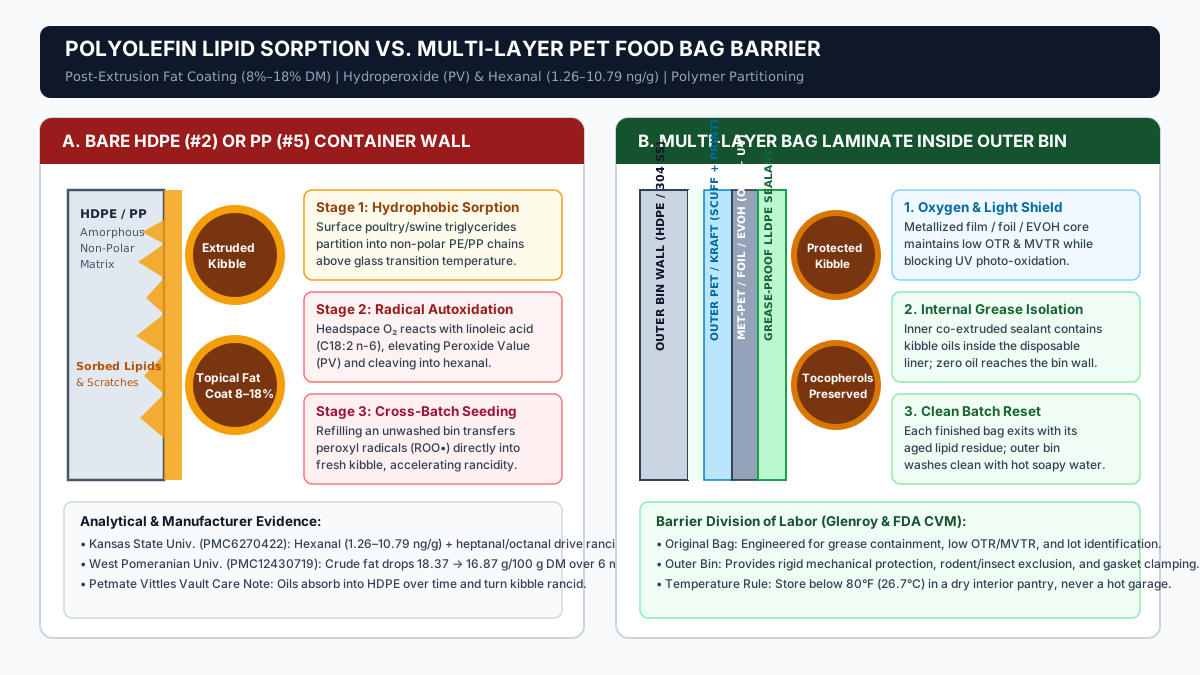
Takeaway: Never dump fresh kibble onto old kibble or against unwashed plastic walls; sorbed triglycerides in bare HDPE or PP act as a free-radical starter culture that accelerates rancidity in every subsequent bag.
How the original pet food bag works with an outer airtight bin
A rigid plastic or metal bin and a flexible commercial pet food bag are engineered to solve different packaging problems. As flexible barrier converter Glenroy explains, multi-layer pet food laminations combine an outer scuff-resistant polyester (PET) or kraft paper layer, a middle barrier core of metallized film (Met-PET), aluminum foil, or ethylene-vinyl alcohol (EVOH), and an inner heat-sealable, grease-resistant linear low-density polyethylene (LLDPE) or co-extruded sealant layer. That composite film delivers a low Oxygen Transmission Rate (OTR), a low Moisture Vapor Transmission Rate (MVTR), complete UV and visible light blocking, and internal grease containment—the same barrier principles examined in our food packaging guide and our breakdown of stand-up pouches for granola.
By contrast, when you unseal a retail bag without a resealable track, the folded bag top alone cannot stop pantry pests, mice, or humid room air from working past the crease. Conversely, a bare rigid bin has a massive headspace volume: every time you lift a 35 cm container lid to scoop breakfast, buoyant room air and humidity rush in to replace the displaced volume, much like the headspace exchange detailed in how to store coffee beans after opening and nitrogen flushing in coffee packaging.
Combining both layers in a bag-in-bin dual seal assigns each material its proper mechanical role:
- Inner barrier (the clipped original bag): Press excess headspace air out of the bag after each scooping session, fold the top flat three times, and secure it with a wide bag clip. Expelling air before clipping minimizes the oxygen volume trapped directly against the fat-enrobed kibble, preserving crunch and lipid stability just as tight headspace control protects homemade granola in storage and commercial snack laminations in how potato chip bags are sealed.
- Outer barrier (the gasketed bin): Place the entire clipped bag upright inside an FDA food-contact HDPE bin with a threaded double-gasket lid or a 304 stainless steel can with a clamped silicone lid. The outer container blocks rodents, ants, and Indian meal moths, shields the bag from punctures, and provides a secondary elastomeric seal against ambient humidity.
Container sizing math: why a 50 lb bag overflows a nominal 50 lb bin
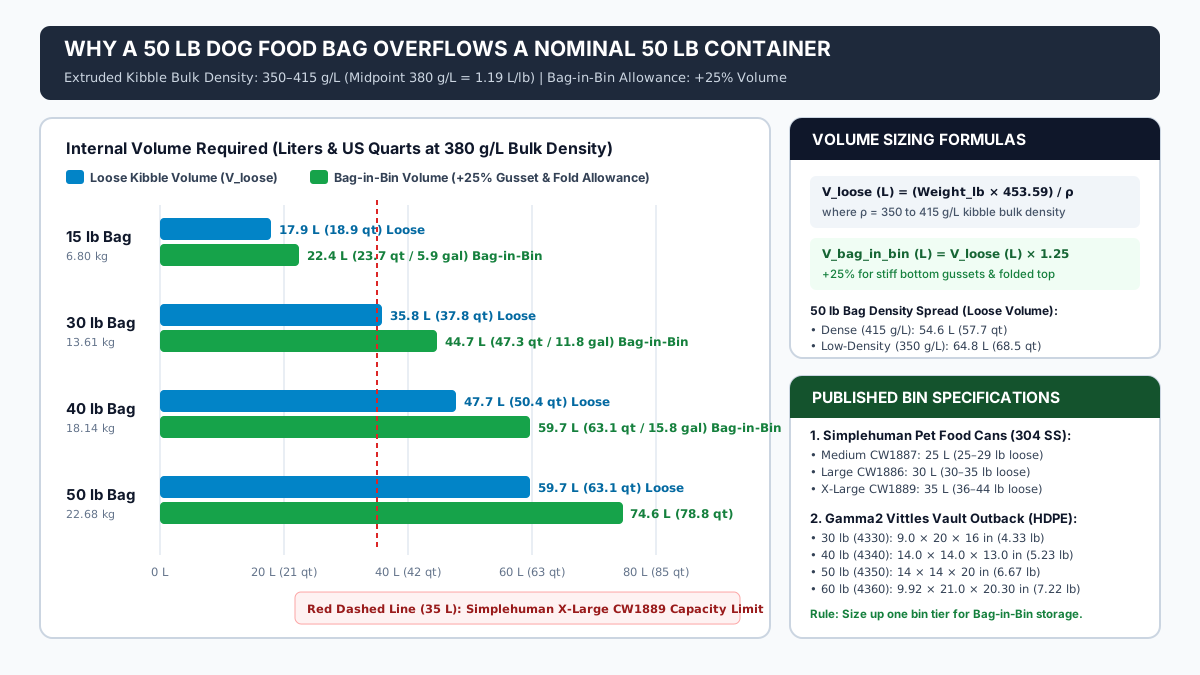
The most common sizing failure when buying a dog food container 50 lbs model is discovering that an intact 50 lb (22.68 kg) retail bag will not fit inside a bin advertised with a “50 lb capacity.” Container manufacturers rate weight capacity by pouring high-density kibble loose to the very brim of the neck ring.
In commercial extrusion studies from the University of Illinois (PMC8835640) and Kansas State University (PMC6735727), standard dry dog kibble is extruded to a bulk density (ρ expressed in g/L) between 350 g/L and 415 g/L (21.8 to 25.9 lb/ft³), depending on die expansion, kibble geometry, and carbohydrate source (ancient grains versus pulse/potato grain-free formulas). At 415 g/L, 1 lb (453.59 g) of loose kibble occupies 1.09 L (1.15 US qt); at 350 g/L, 1 lb occupies 1.30 L (1.37 US qt).
When you follow the FDA Center for Veterinary Medicine (FDA CVM) recommendation and place the entire bag inside the container, stiff bottom gussets, cylindrical-to-rectangular corner voids, and the folded top collar require a +25% internal volume allowance (1.25 multiplier) over the loose kibble volume.
Use these two sizing formulas to calculate the required internal container volume in liters (L) and US dry/liquid quarts (qt):
V_loose (L) = (Bag_Weight_lb * 453.59) / Bulk_Density_g_per_L
V_bag_in_bin (L) = V_loose (L) * 1.25
Worked example (50 lb bag at the 380 g/L commercial midpoint):
- Loose kibble volume:
V_loose = (50 * 453.59) / 380 = 59.7 L(63.1 US qtor15.8 US gal). - Bag-in-bin required volume:
V_bag_in_bin = 59.7 L * 1.25 = 74.6 L(78.8 US qtor19.7 US gal).
Engineering threshold rule: If your container’s internal volume in liters is less than 1.50 * Bag_Weight_lb, a standard 380 g/L retail bag will not close inside the bin without crushing the top fold or forcing you to dump the kibble loose. Always size up one nominal container tier (40 lb bin for a 25–30 lb bag; 60 lb to 80 lb bin for a 50 lb bag) when storing kibble in its original liner.
Scroll horizontally to see all columns.
| Retail Bag Weight | Loose Volume (350–415 g/L Spread) |
Loose Volume at 380 g/L Midpoint |
Bag-in-Bin Volume Required (+25% Allowance) |
Published Commercial Container Fit Check |
|---|---|---|---|---|
15 lb (6.80 kg) |
16.4 – 19.4 L (17.3 – 20.5 qt) |
17.9 L (18.9 qt / 4.7 gal) |
22.4 L (23.7 qt / 5.9 gal) |
Fits intact inside a Simplehuman Medium (25 L, SKU CW1887) or Vittles Vault 25–30 lb bin. |
30 lb (13.61 kg) |
32.8 – 38.9 L (34.6 – 41.1 qt) |
35.8 L (37.8 qt / 9.5 gal) |
44.7 L (47.3 qt / 11.8 gal) |
Overflows a 30 L Simplehuman Large (CW1886) with the bag on; fits inside a Vittles Vault 50 lb Outback (14 x 14 x 20 in, SKU 4350). |
40 lb (18.14 kg) |
43.7 – 51.8 L (46.2 – 54.8 qt) |
47.7 L (50.4 qt / 12.6 gal) |
59.7 L (63.1 qt / 15.8 gal) |
Exceeds Simplehuman X-Large (35 L, SKU CW1889, rated 36–44 lb loose); requires a Vittles Vault 60 lb Stackable (9.92 x 21.0 x 20.30 in, SKU 4360). |
50 lb (22.68 kg) |
54.6 – 64.8 L (57.7 – 68.5 qt) |
59.7 L (63.1 qt / 15.8 gal) |
74.6 L (78.8 qt / 19.7 gal) |
Nominal 50 lb bins hold 50 lb only when dense kibble is poured loose; bag-in-bin requires a 75–80 L (80 qt) bin or splitting 15 lb into a secondary sealed jar. |
Before ordering a tall 50 lb or 60 lb bin for a built-in pantry alcove, measure the clear vertical opening needed to hinge the lid open or unscrew a Gamma Seal lid—the same container height plus retrieval clearance check covered in kitchen pantry cabinet depth and shelf spacing.
Evaluating airtight pet food bins: materials and gasket mechanics
When comparing an airtight pet food bin across kitchen and utility formats, inspect both the container wall resin and the lid compression mechanism. General polymer properties and temperature limits across kitchen plastics, glass, and steel are covered in food storage containers: materials, airtight seals, and temperature limits, while the distinction between gasketed atmospheric closures and active air extraction is detailed in airtight vs. vacuum-sealed food storage.
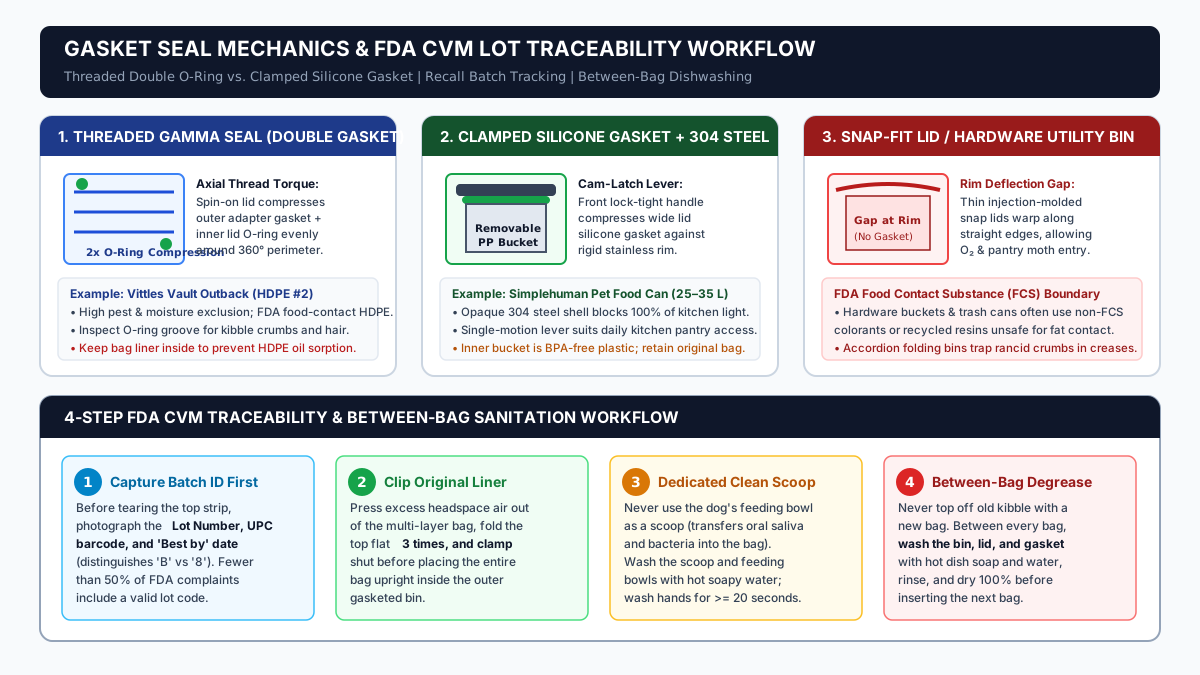
1. Threaded Spin-Off Lids with Double Elastomeric Gaskets (Gamma Seal HDPE)
Heavy-walled blow-molded HDPE containers—exemplified by the Gamma2 Vittles Vault Outback (30 lb SKU 4330 at 4.33 lb tare weight; 50 lb SKU 4350 at 6.67 lb tare weight)—use a threaded adapter ring with a flat perimeter gasket plus a spin-on lid carrying an inner ethylene propylene diene monomer (EPDM) or synthetic rubber O-ring.
- Mechanical strength: Axial thread torque compresses the O-ring evenly around
360°, blocking moisture vapor and preventing raccoons, ants, or dogs from prying the lid open. - Failure mode to prevent: Kibble dust, shed pet hair, or oil residue trapped in the female thread groove prevents full O-ring seating. Wipe the thread track and inspect the O-ring for flattening between every bag.
2. Clamped Silicone Gasket Cans with 304 Stainless Steel Shells
Countertop and pull-out pantry models—such as the Simplehuman Pet Food Can line (25 L Medium CW1887, 30 L Large CW1886, and 35 L X-Large CW1889 at 16.77 lb tare weight)—pair a brushed 304 stainless steel outer body with a front cam-latch handle that compresses a wide, lid-mounted silicone gasket.
- Mechanical strength: Single-handed cam latching makes daily access faster than spinning a threaded lid, and the opaque stainless steel shell blocks
100%of light. - Material nuance: Many stainless steel pet food cans use a removable BPA-free polypropylene inner bucket for lift-out cleaning. Because that inner liner is still a polyolefin plastic, pouring kibble loose into the bucket exposes the walls to the exact same triglyceride sorption as an all-plastic bin. Keep the original pet food bag inside the removable bucket, or choose a seamless, unlined 304 stainless steel canister if kibble will touch the wall.
3. Hardware Utility Buckets, Trash Cans, and Accordion Folding Bins
Avoid storing unwrapped pet food in non-food hardware buckets, outdoor trash cans, or thin collapsible TPE/silicone accordion bins:
- FDA Food Contact Substance (FCS) compliance: Under FDA’s Food Contact Substance regulatory framework, resins, slip agents, plasticizers, and color pigments intended to hold food must not migrate hazardous constituents into fatty matrices. Utility trash cans and hardware buckets frequently contain recycled post-consumer resins or industrial colorants that are not evaluated for direct contact with fat-enrobed food.
- Accordion crease traps: Collapsible pet food bins use thin thermoplastic elastomer (
TPE) folds that flex hundreds of times. Kibble crumbs and liquid surface fats collect inside the interior accordion creases where dishcloths cannot reach, creating permanent pockets of oxidized fat and mold if humidity rises.
FDA lot-number traceability and between-bag sanitation protocol
Beyond preventing lipid rancidity, the U.S. Food and Drug Administration’s Center for Veterinary Medicine (FDA CVM) emphasizes that original packaging is your primary safety record during a contamination event or recall. FDA veterinarian Lauren Carey, DVM notes that fewer than half (<50%) of all pet food complaints submitted to the FDA Safety Reporting Portal include the lot number. Because large pet food brands manufacture the same formula across multiple U.S. plants, the lot code, UPC barcode, and 'Best by' date identify the exact production batch, plant, and date.
Follow this four-step storage and sanitation workflow for every bag of dry dog food:
- Photograph the lot number, UPC, and ‘Best by’ date before opening: On dry pet food bags, the lot code is printed near the
'Best by'date on the side gusset, bottom panel, or along the top seal strip that is often torn off when opening the bag (FDA CVM). Take a clear smartphone photo of the lot number, UPC barcode, and'Best by'date before cutting the top seal so characters such as'B'versus'8'or'V'versus'U'cannot be misread or discarded. Keep visible stock labels organized using the same principles in our pantry organization guide. - Store the clipped bag inside the bin in a cool, dry interior room below
80°F(26.7°C): FDA instructs pet owners to store dry pet food and unopened canned food in a cool, dry location below80°F(26.7°C), because excess heat and moisture accelerate nutrient breakdown and lipid oxidation. Do not store pet food bins in unconditioned garages, sunrooms, or outdoor sheds where summer temperatures exceed80°Fand diurnal humidity swings condense moisture inside the bin. - Use a dedicated clean scoop—never the dog’s feeding bowl: Scooping kibble directly with the pet’s food bowl transfers oral bacteria, saliva, and moisture into the storage bag (
FDA CVM). Dedicate a stainless steel or food-grade plastic measuring scoop to the bin, wash the pet’s bowls and scooping utensils with hot soapy water after use, and wash your hands with soap and water for at least20 secondsbefore and after handling pet food or treats to reduce Salmonella and Listeria cross-contamination risk. - Wash and completely dry the bin and gasket between every bag: Even when using the bag-in-bin method, fine kibble dust and aromatic lipids escape during scooping. Between finishing one bag and inserting the next, wash the storage container, lid, removable silicone or EPDM gasket, and scoop with hot water and grease-cutting dish soap, rinse thoroughly, and allow every surface to air-dry
100%before placing the new bag inside. Trapping residual wash moisture underneath a fresh paper- or film-laminated bag promotes mold growth at the base of the bin.
Storage containers and airtight gaskets preserve aroma, fat quality, and vitamin stability during normal household use, but they never extend safety past the manufacturer’s printed 'Best by' date or make recalled or moldy pet food safe to feed. Check more household container and shelf guides in our food storage hub.
Frequently asked questions
Should I keep dog food in its original bag inside the storage container?
Yes. The FDA Center for Veterinary Medicine explicitly advises placing the entire original bag inside your storage container rather than pouring kibble directly against the bin walls. The multi-layer retail bag is engineered with an internal grease barrier and low oxygen permeability that keeps surface fats from absorbing into bare plastic, while preserving the printed lot number, UPC barcode, and Best-by date in case of a recall.
Why does a 50 lb bag of dog food not fit in a 50 lb storage container?
Container manufacturers calculate pound ratings using dense kibble poured loose to the top rim. Commercial dry dog kibble varies in bulk density from 350 to 415 g/L, so 50 lb of average 380 g/L kibble occupies 59.7 L (63.1 qt) loose, and keeping the stiff gusseted bag intact adds roughly 25% in corner voids and top-fold bulk for a total requirement of 74.6 L (78.8 qt or 19.7 gal). To fit an intact 50 lb bag, choose a container rated for 60 to 80 lb (75–80 L internal volume).
Is stainless steel or plastic better for dog food storage containers?
Both materials work well when you keep the kibble inside its original clipped bag, because the bag liner prevents direct fat contact with the container wall. If you ever pour kibble loose or store smaller portions without a bag, seamless food-grade 304 stainless steel or glass is superior to HDPE (#2) or polypropylene (#5) plastic because metal and glass are non-porous and cannot absorb triglycerides into microscopic scoop scratches. Note that many stainless steel pet food cans use a removable polypropylene inner bucket, which still requires keeping the original bag liner inside.
How often should you wash a dog food storage bin and scoop?
Wash and completely dry the storage container, lid gasket, and dedicated scoop with hot soapy water every time you finish a bag of kibble before inserting a new bag. Never pour a new bag of dog food on top of leftover kibble from an older bag, because oxidized fats and crumbs at the bottom seed free-radical rancidity into the fresh food and obscure which lot code is being fed.
Can I store dog food in an airtight container in the garage?
Only if the garage stays dry and remains below 80°F (26.7°C) year-round. The FDA warns that storing dry pet food above 80°F or in humid environments accelerates lipid oxidation, degrades heat-sensitive vitamins, and encourages mold or mite growth if warm daytime air condenses inside the container overnight. An interior kitchen pantry or climate-controlled utility closet is much safer than an uninsulated garage.
Explore more in Food Storage & Freezer Guides.
Official guidance and sources
Sources last checked October 25, 2026.
- Proper Storage of Pet Food & Treats , U.S. Food and Drug Administration (FDA), Center for Veterinary Medicine (accessed October 25, 2026) Guidance on keeping dry pet food in its original bag inside an outer container, storing below 80°F, retaining lot codes, and washing bins and scoops between bags.
- Save Your Pet Food Lot Number! , U.S. Food and Drug Administration (FDA), Center for Veterinary Medicine (accessed October 25, 2026) Explains where lot codes appear on dry pet food bags and why photographing the lot number and 'Best by' date prevents lost batch traceability.
- Tips for Safe Handling of Pet Food and Treats , U.S. Food and Drug Administration (FDA), Center for Veterinary Medicine (accessed October 25, 2026) Package inspection before purchase, 20-second handwashing, and daily bowl and scoop sanitation.
- Packaging & Food Contact Substances (FCS) , U.S. Food and Drug Administration (FDA) (accessed October 25, 2026) Regulatory definition of Food Contact Substances distinguishing compliant food-storage resins from non-food utility plastics.
- Changes in the Fatty Acid Composition and Antioxidant Properties in Mono-Protein Commercial Dry Dog Foods During Storage , Molecules (MDPI / PubMed Central PMC12430719), West Pomeranian University of Technology (accessed October 25, 2026) Documents statistically significant crude fat loss (18.37 to 16.87 g/100 g DM) and antioxidant depletion over 6 months of ambient storage after opening.
- The Impact of Rendered Protein Meal Oxidation Level on Shelf-Life, Sensory Characteristics, and Acceptability in Extruded Pet Food , Animals (MDPI / PubMed Central PMC4997269), Kansas State University (accessed October 25, 2026) Tracks Peroxide Value (PV), TBARS, volatile aldehydes, and rancid aroma scores across ambient storage of extruded pet foods.
- Volatile Compounds in Dry Dog Foods and Their Influence on Sensory Aromatic Profile , Molecules (MDPI / PubMed Central PMC6270422), Sensory Analysis Center, Kansas State University (accessed October 25, 2026) Identifies 54 volatile compounds in dry dog foods via headspace SPME-GC/MS, including hexanal (1.26 to 10.79 ng/g) as a primary omega-6 linoleic acid oxidation marker.
- Nutritional and physico-chemical implications of avocado meal as a novel dietary fiber source in an extruded canine diet , Journal of Animal Science (Oxford University Press / PubMed Central PMC8835640), University of Illinois at Urbana-Champaign (accessed October 25, 2026) Establishes 350 to 370 g/L bulk density targets and post-extrusion fat and palatant enrobing in commercial adult canine kibble.
- Effect of ancient grains and grain-free carbohydrate sources on extrusion parameters and nutrient utilization by dogs , Translational Animal Science (Oxford University Press / PubMed Central PMC6735727), Kansas State University (accessed October 25, 2026) Documents extrusion bulk density targets around 415 g/L and formula-dependent expansion differences across carbohydrate sources.
- Binding of volatile aroma compounds to can linings with different polymeric characteristics , Food Science & Nutrition (Wiley / PubMed Central PMC5778199) (accessed October 25, 2026) Explains hydrophobic partitioning and sorption of non-polar lipophilic molecules into polyethylene (PE) and polypropylene (PP) matrices.
- Barrier Film Laminations Explained: How to Choose Packaging for Food, Pharma, Cosmetics, and Pets , Glenroy, Inc. (accessed October 25, 2026) Details multi-layer pet food film structures designed for simultaneous low OTR, low MVTR, light blocking, and internal grease barrier performance.
- Vittles Vault Outback Food Storage Container (30 lb & 50 lb) and Outback Stackable (40 lb & 60 lb) , Petmate / Gamma2 Vittles Vault (accessed October 25, 2026) Manufacturer dimensions, FDA food-contact HDPE resin specifications, Gamma Seal double-gasket design, and care instructions regarding oil absorption into plastic.
- Simplehuman Pet Food Can Specifications (X-Large CW1889, Large CW1886, Medium CW1887) , simplehuman (accessed October 25, 2026) Manufacturer liter and pound capacities, stainless steel outer shell, removable BPA-free inner bucket, and lid-mounted silicone compression gasket specifications.