
How to Freeze Cooked Meals: Choose Portions, Cool Promptly and Reheat Safely
Refrigerate portions you will eat within 3 to 4 days and freeze the rest. Cool the batch in shallow containers before the two-hour limit, then thaw and reheat to 165°F.
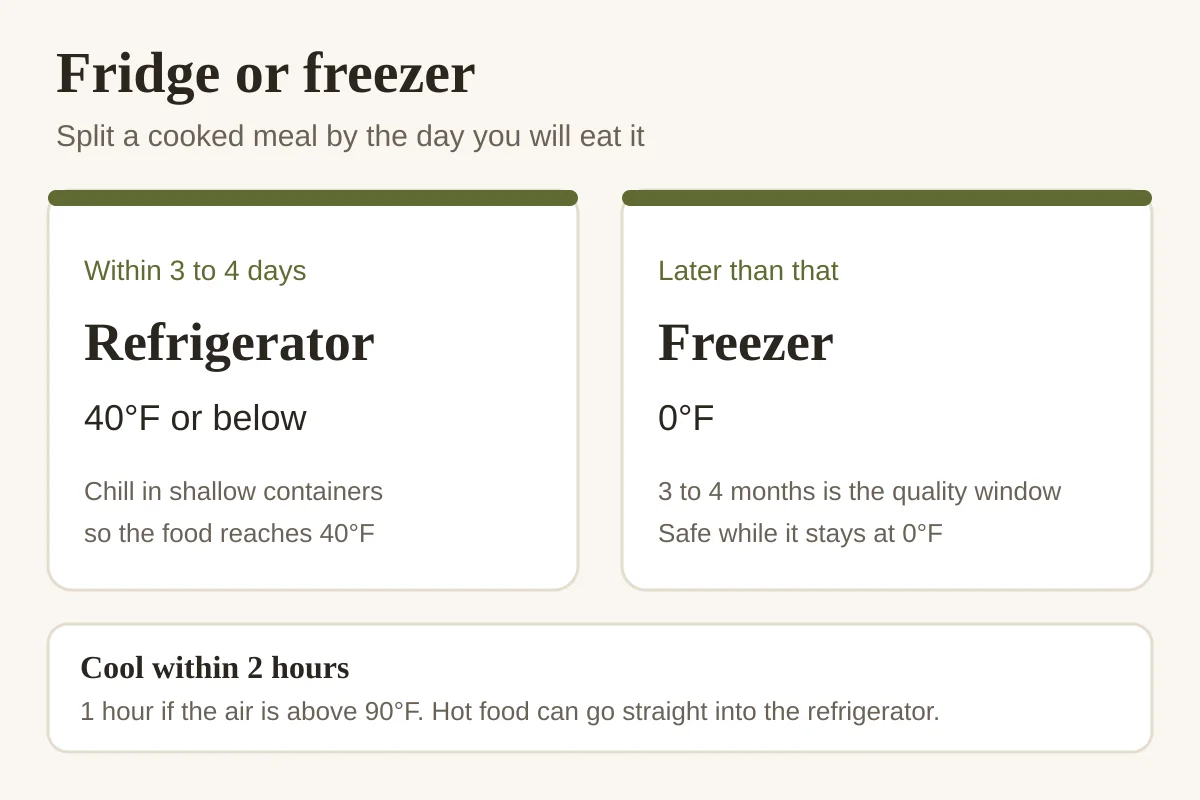
Keep portions you will eat within 3 to 4 days in the refrigerator at 40°F or below, and freeze later portions at 0°F. Leaving the pot on the counter until it feels cool wastes the two-hour limit.
This is for a home cook in the United States who makes one batch for several meals. The figures below come from USDA Food Safety and Inspection Service pages read on October 11, 2026. The guide does not assign a texture result or a freezer life to every recipe, and this site has not cooked a test batch.
Split the batch by when you will eat it
Takeaway: Portions for the next 3 to 4 days go in the refrigerator at 40°F or below. Later portions go in a 0°F freezer. USDA lists 3 to 4 months as the leftovers quality window, and food held constantly at 0°F stays safe.
The food storage guide separates pantry, refrigerator and freezer jobs. For a cooked meal, choose the place from the day you plan to eat that portion.
Scroll horizontally to see all columns.
| When you will eat it | Where it goes | USDA condition |
|---|---|---|
| Within 3 to 4 days | Refrigerator at 40°F or below | Refrigerate within 2 hours of cooking, or within 1 hour if the air is above 90°F. Cool the food so it reaches 40°F quickly. |
| Later than that | Freezer at 0°F | The leftovers page lists 3 to 4 months in the freezer. Food stored constantly at 0°F stays safe, and flavor and moisture decline with time. |
| Already past the time on the counter | Discard | Throw away perishable food left at room temperature more than 2 hours, or 1 hour when the air is above 90°F. |
Check the appliance with a thermometer. USDA’s freezing page says to keep one in the freezer. If a refrigerator’s freezer compartment cannot hold 0°F, or you open the door often, use it for short storage and eat that food soon. Hold the later portions in a freezer set at 0°F or below.
Use the same split when the meal is mostly liquid. The soup portion guide covers headspace for a liquid pack. Keep bread out of the sauce and follow the homemade bread guide for a loaf you will not finish. If dessert is cake, freeze it with the chocolate cake guide instead of in the stew container. A soup that uses bread, such as tomato bread soup, is easier to portion if the bread stays separate from the frozen stew.
Scroll horizontally to see all columns.
| Step | What to check |
|---|---|
| Cool | Shallow containers, into the refrigerator within 2 hours (1 hour above 90°F). Hot food can go in directly, or through an ice bath first. |
| Pack | Cover, airtight wrap, or a sealed container. Write the food and the date. Freeze in a single layer until solid. |
| Thaw | Refrigerator, cold water, or microwave. Not the counter. |
| Reheat | 165°F on a food thermometer. A rolling boil for sauces, soups and gravies. |
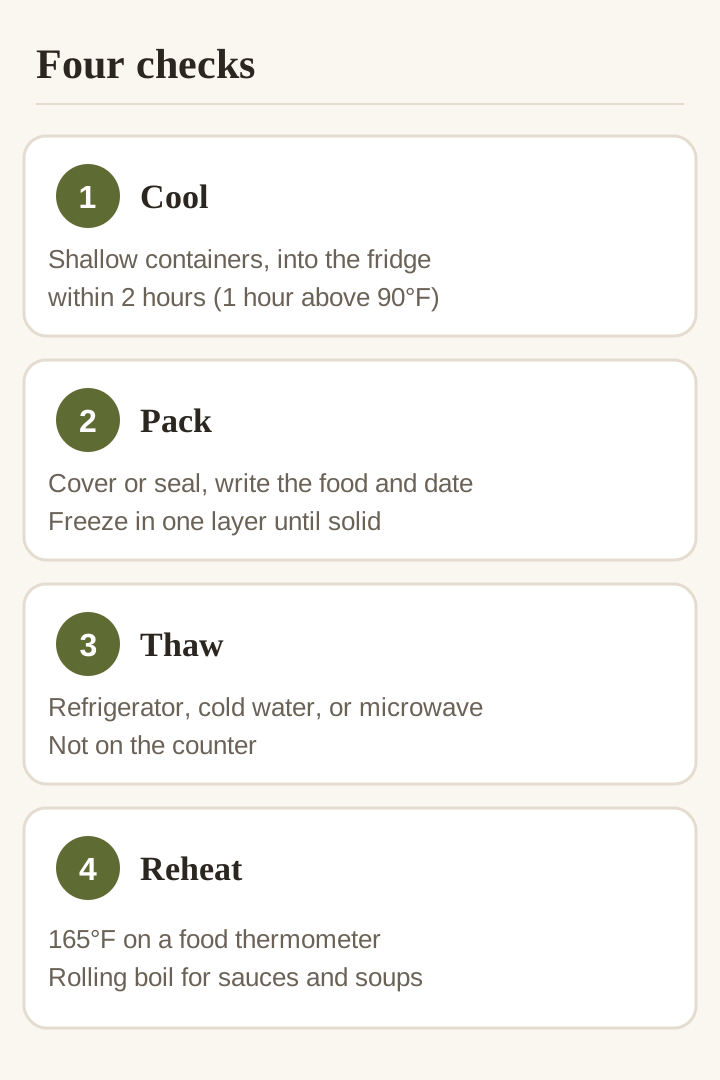
Cool the food inside the two-hour limit
Takeaway: Split the batch into shallow containers and refrigerate it within 2 hours, or within 1 hour if the air is above 90°F. Hot food can go straight into the refrigerator, or into an ice bath first.
Bacteria grow rapidly between 40°F and 140°F. USDA’s leftovers page says leftovers must be refrigerated within 2 hours of cooking, or after the food leaves an appliance that was keeping it hot. The limit shortens to 1 hour when the air is above 90°F. Perishable food left out longer should be thrown away.
A full pot cools slowly, which gives bacteria time to multiply. Divide it into smaller, shallow containers so it reaches 40°F or below quickly. Cut large pieces, such as a roast, into smaller parts. Hot food can go directly into the refrigerator. You can also chill the containers in an ice or cold water bath, then refrigerate them.
- Start the clock when cooking stops, or when the food comes off a warming appliance.
- Move the food into shallow containers before it goes into the cold.
- Put those containers in the refrigerator, or into an ice bath and then the refrigerator.
- Discard the food if it has already spent more than 2 hours at room temperature, or 1 hour above 90°F.
Pack portions so air stays off the surface
Takeaway: Cover the food, wrap it in airtight packaging, or seal it in a container, then refrigerate or freeze it at once. Freezer burn dries the surface where air touches it, and it does not make the food unsafe.
USDA says to cover leftovers, wrap them in airtight packaging, or seal them in storage containers. That helps keep bacteria out, holds moisture, and limits odors from other food in the refrigerator. Refrigerate or freeze the wrapped food immediately so cooling continues.
In the freezer, packaging is also a quality step. USDA says proper packaging helps prevent freezer burn. Freezer burn shows up as grayish-brown leathery spots caused by air on the surface. Cut those spots away before or after cooking. Discard the package for quality when the dry areas ruin the meal. The burn itself does not make the food unsafe.
Freeze the new packages quickly. USDA says a food 2 inches thick should freeze completely in about 2 hours. Spread the packages in one layer until they are frozen solid, and stack them only after that. Slow freezing builds large ice crystals. On thawing, those crystals damage cells, so meat loses juice, and emulsions such as cream separate and look curdled.
Match the container to the maker’s freezer and microwave marks. The food storage containers guide is the place to compare glass, plastic and steel on those limits. A tighter seal still does not extend the safety window. The airtight and vacuum-sealed guide explains what each closure does.
Write the food and the date on the package before it goes in. This page stops there. It does not set label fields or a freezer inventory.
Cream sauce freezes poorly. USDA names mayonnaise, cream sauce and lettuce as examples of foods that do not freeze well, and says cream emulsions separate and look curdled. A cream soup such as cream of spinach soup is in that group, and the emulsion can separate and look curdled.
Thaw in the refrigerator, cold water, or a microwave
Takeaway: Thaw in the refrigerator, in cold water, or in the microwave. Food thawed in the refrigerator can go back in the freezer. Cold-water and microwave thaws need to be cooked to 165°F before you freeze them again.
USDA lists those three methods for leftovers. Thawing on the counter, outdoors, or in a garage leaves the food unsafe.
Refrigerator thawing takes the longest, and the leftovers stay safe the whole time. After thawing, use the food within 3 to 4 days or refreeze it. If a large container holds more than you need, thaw it in the refrigerator, remove the portion, and refreeze the rest without reheating it. USDA notes a loss of quality from the moisture lost in thawing. USDA also says to freeze leftovers within 3 to 4 days, and not to refreeze food left outside the refrigerator longer than 2 hours, or 1 hour above 90°F.
Cold water is faster and needs watching. Keep the food in a leak-proof bag. If the bag leaks, water and bacteria from the surroundings can enter the food. Change the water every 30 minutes so it stays cold. Cook the food before you refreeze it. USDA’s freezing page says to cook immediately after a cold-water thaw.
Microwave thawing is the fastest. Continue heating until a food thermometer reads 165°F. After the food reaches that temperature, you can refreeze it. USDA’s freezing page says some areas become warm and begin to cook during microwave defrost, so finish cooking once you start.
Reheat to 165°F
Takeaway: Reheat leftovers to 165°F on a food thermometer. Bring sauces, soups and gravies to a rolling boil. A frozen portion can go into the pan or microwave without thawing, and it will take longer.
Cover the food so moisture stays in and the heat reaches the center. In a microwave, cover and rotate the food in a microwave-safe dish, and vent the lid so steam escapes. Check the temperature in several places. Let the food rest, then check again, because a microwave leaves cold spots. USDA notes that dense foods keep cooking longer during that rest than thin foods do.
Reheating from frozen is safe. USDA says to use a saucepan or microwave for soup or stew, and an oven or microwave for a casserole or combination meal.
After you reheat a previously frozen leftover to 165°F, any portion you do not eat can go back in the freezer. A meal you bought frozen is a separate case: follow the package directions for thawing, reheating and storing.
Common questions
Do I cool a cooked meal to room temperature before refrigerating it?
No. USDA says hot food can go directly into the refrigerator, or into an ice or cold water bath first, once you have divided it into shallow containers. A long rest on the counter uses up the 2-hour limit, or the 1-hour limit when the air is above 90°F.
Can I refreeze a cooked meal after I thaw it?
Yes, on USDA’s conditions. After a refrigerator thaw, you can refreeze the food or eat it within 3 to 4 days. After a cold-water thaw, cook it before refreezing. After a microwave thaw, heat it to 165°F and then you can refreeze it. Food that sat out past the time limit should be discarded, not frozen again.
How long does a frozen cooked meal stay safe?
USDA says frozen leftovers stay safe indefinitely, and that food stored constantly at 0°F will always be safe. The 3 to 4 month figure is the quality window on the leftovers page. Moisture and flavor decline after that. Only the quality suffers during long freezer storage. A recipe can still taste poor long before safety is the issue, and this page does not promise a result for a specific dish.
Does freezer burn make the meal unsafe?
No. USDA says freezer burn does not make food unsafe. It dries the spots where air reached the surface. Cut the dry parts away, or discard the package when those spots ruin the meal.
Do this week’s portions belong in the fridge or the freezer?
Portions you will eat within 3 to 4 days belong in the refrigerator at 40°F or below. Portions for a later day belong in the freezer at 0°F. Cool both groups the same way before they go in.
Can I reheat a frozen meal without thawing it first?
Yes. USDA says reheating frozen leftovers without thawing is safe, in a saucepan or microwave for soup or stew, or in an oven or microwave for a casserole. Plan on a longer time, and still heat the meal to 165°F.
Sources and review date
Reviewed October 11, 2026 for the United States. Cooling, storage time, thawing, reheating and refreezing rules come from USDA FSIS on Leftovers and Food Safety, last updated July 31, 2020, and from Freezing and Food Safety. Both pages were read on October 11, 2026. Labels on packaged foods take priority over this guide.
Explore more in Food Storage & Freezer Guides.
Official guidance and sources
Sources last checked October 11, 2026.
- Leftovers and Food Safety , USDA Food Safety and Inspection Service (accessed October 11, 2026) Two-hour rule, shallow-container cooling, 3 to 4 days in the refrigerator, 3 to 4 months as a freezer quality window, thawing, reheating to 165°F, and when refreezing is allowed. Page last updated July 31, 2020.
- Freezing and Food Safety , USDA Food Safety and Inspection Service (accessed October 11, 2026) Constant 0°F storage stays safe while quality declines, freezer burn, fast freezing, cold-water thawing, and foods such as cream sauce that freeze poorly.