
How to Label Leftovers: Keep Cooking, Freezing and Thawing Dates Clear
Copy a household leftover label with the dish, made date, frozen date, thawed date, portions, and the USDA leftovers page. Keep the same record when the container moves to the freezer.
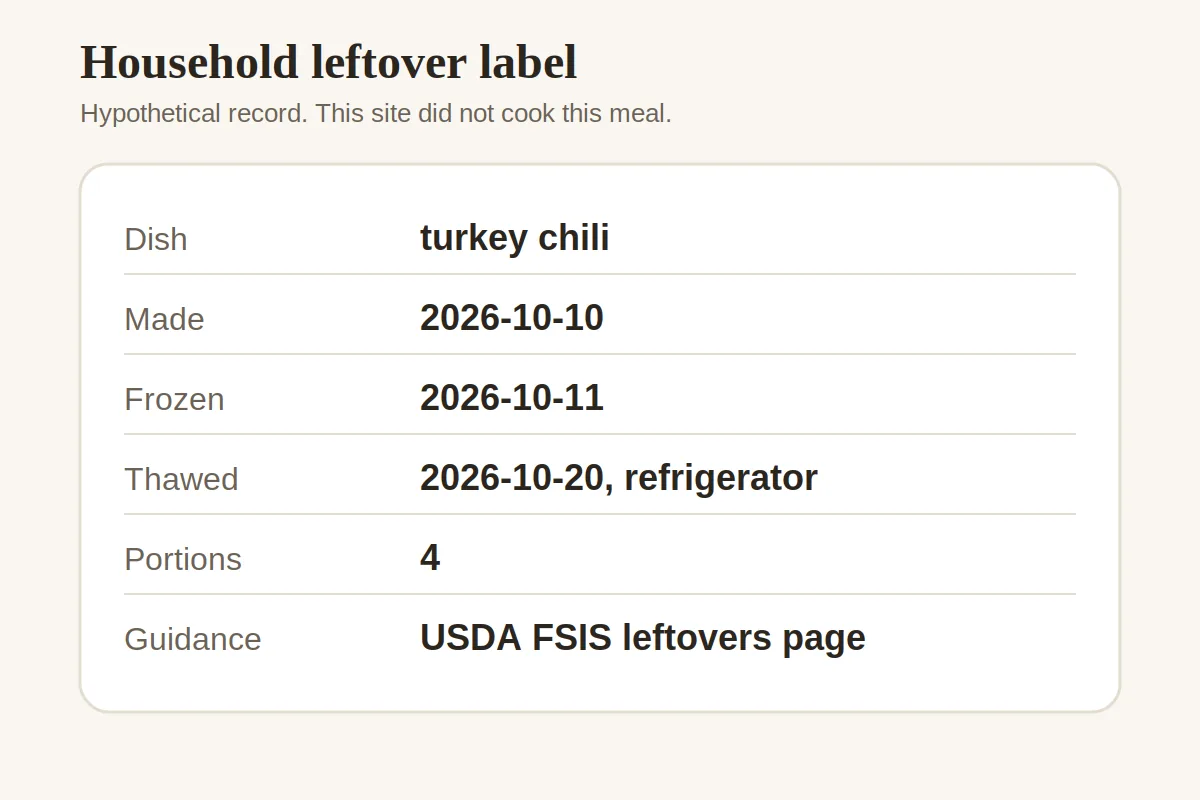
To label leftovers, put six lines on one container: the dish, the made date, the frozen date, the thawed date, the portions, and a link to the USDA leftovers page. Leave a date blank until that step happens. A family can then tell one batch from another without guessing whether a single scribbled day means cooking, freezing, or thawing.
This is a home-kitchen record for readers in the United States. It was reviewed on October 12, 2026. Storage times and temperatures below come from the USDA Food Safety and Inspection Service leftovers page, last updated July 31, 2020, and from the National Center for Home Food Preservation packaging page, read again from saved copies on October 12, 2026. The filled chili label further down is a hypothetical record. This site did not cook, freeze, or thaw that food.
How to label leftovers in the fridge
Write the label when you portion the food, before the container goes into the refrigerator. Use year-month-day, as in 2026-10-10, so month and day cannot swap places when someone else reads the tape. USDA and the extension page do not require that order. It is a household choice so two people do not read the same numbers differently.
Copy the blank label, or print this page and copy the lines onto freezer tape:
Dish:
Made:
Frozen:
Thawed:
Portions:
Guidance: https://www.fsis.usda.gov/food-safety/safe-food-handling-and-preparation/food-safety-basics/leftovers-and-food-safety
Here is the same label filled in as a hypothetical turkey chili record. The frozen and thawed lines were not known on cooking day. They were added on the days those steps happened:
Dish: turkey chili
Made: 2026-10-10
Frozen: 2026-10-11
Thawed: 2026-10-20, refrigerator
Portions: 4
Guidance: https://www.fsis.usda.gov/food-safety/safe-food-handling-and-preparation/food-safety-basics/leftovers-and-food-safety
In that story, the chili was cooked and refrigerated on October 10, packed for the freezer on October 11, and thawed in the refrigerator on October 20. Four portions were in the container. The guidance line points at Leftovers and Food Safety. Nothing on the label is a lab result or a meal prepared for this page.
The extension page also asks for any added ingredients and the form of the food, such as whole or sliced. Add a short note when it changes how you will use the batch, for example “no pasta” or “sliced.” The six lines above are the record that keeps the dates apart.
What each date field means
The made date is the day the food was cooked and put into the refrigerator. USDA says leftovers can be kept in the refrigerator for 3 to 4 days. That window applies when the food was handled as the leftovers page describes: refrigerate it within 2 hours of cooking, or within 1 hour if the air is above 90°F, and cool it so it reaches 40°F or below quickly. Bacteria grow rapidly between 40°F and 140°F. Hot food can go straight into the refrigerator, or into an ice or cold water bath first, after you divide it into shallow containers.
The frozen date is the day you pack that same food for the freezer. The extension page calls this the packaging date, and it says to cool food before packaging. On this label the frozen date sits under the made date. You add it on packing day, and the cooking day stays where it is. USDA says leftovers can be frozen for 3 to 4 months. It also says frozen leftovers are safe indefinitely, and that they can lose moisture and flavor when stored longer. The frozen date lets you see which package went in first.
The thawed date is the day thawing finished, plus the method, because the next step depends on it. USDA lists three safe thawing methods: the refrigerator, cold water, and the microwave. After a refrigerator thaw, use the food within 3 to 4 days or refreeze it. Cold-water thawing needs a leak-proof package, and food thawed that way should be cooked before you refreeze it. Microwave thawing should continue until the food reaches 165°F on a food thermometer, and food thawed that way can be refrozen after it reaches that temperature. Write “refrigerator,” “cold water,” or “microwave” on the thawed line so the next person follows the matching step.
Portions are how many servings are in this container. The extension page says to pack food in quantities that will be used for a single meal, and to label the number of servings or the amount.
The guidance line is the official page, not a private eat-by date. Handwriting does not replace that page.
Scroll horizontally to see all columns.
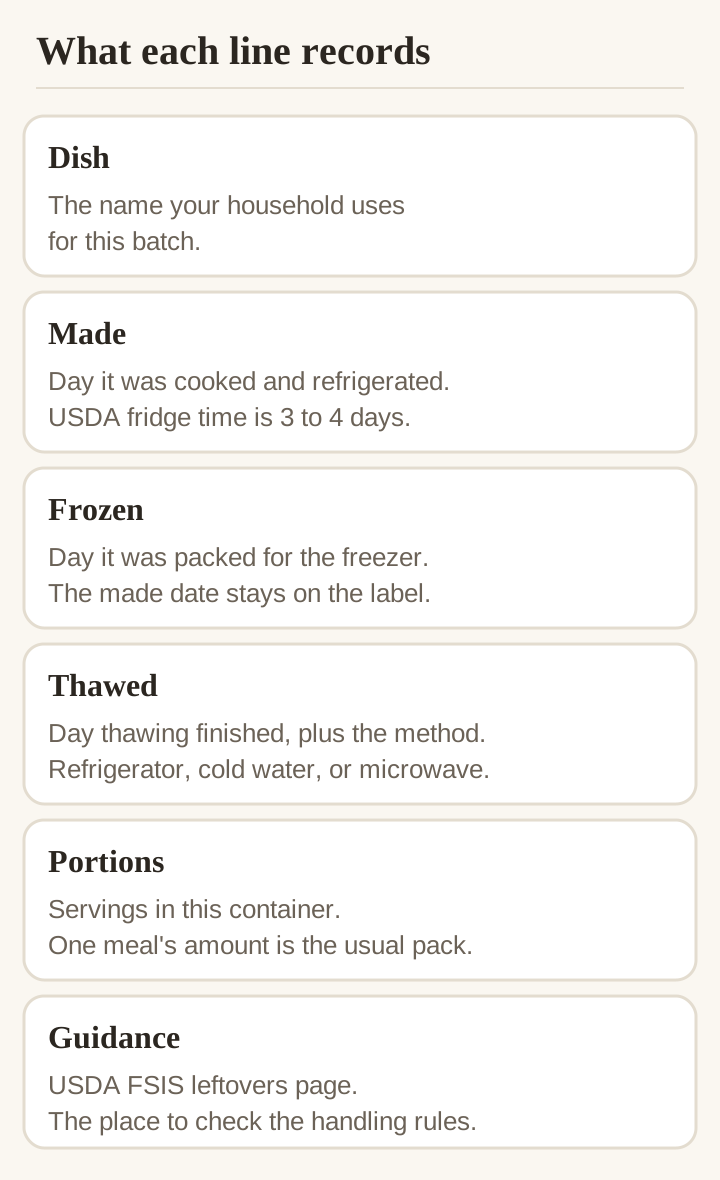
| Line | Write this | What it records |
|---|---|---|
| Dish | The name your household uses | Which food is in the container |
| Made | Year-month-day it was cooked and refrigerated | The start of the 3 to 4 day refrigerator period, when cooling followed the USDA leftovers page |
| Frozen | Year-month-day it was packed for the freezer | The extension page’s packaging date, kept separate from the cooking day |
| Thawed | Year-month-day thawing finished, and the method | The start of USDA’s after-thaw instruction for that method |
| Portions | Servings in this container | How much is in the batch |
| Guidance | USDA leftovers page | Where the household checks the handling rules |
Keep the batch record when the container moves
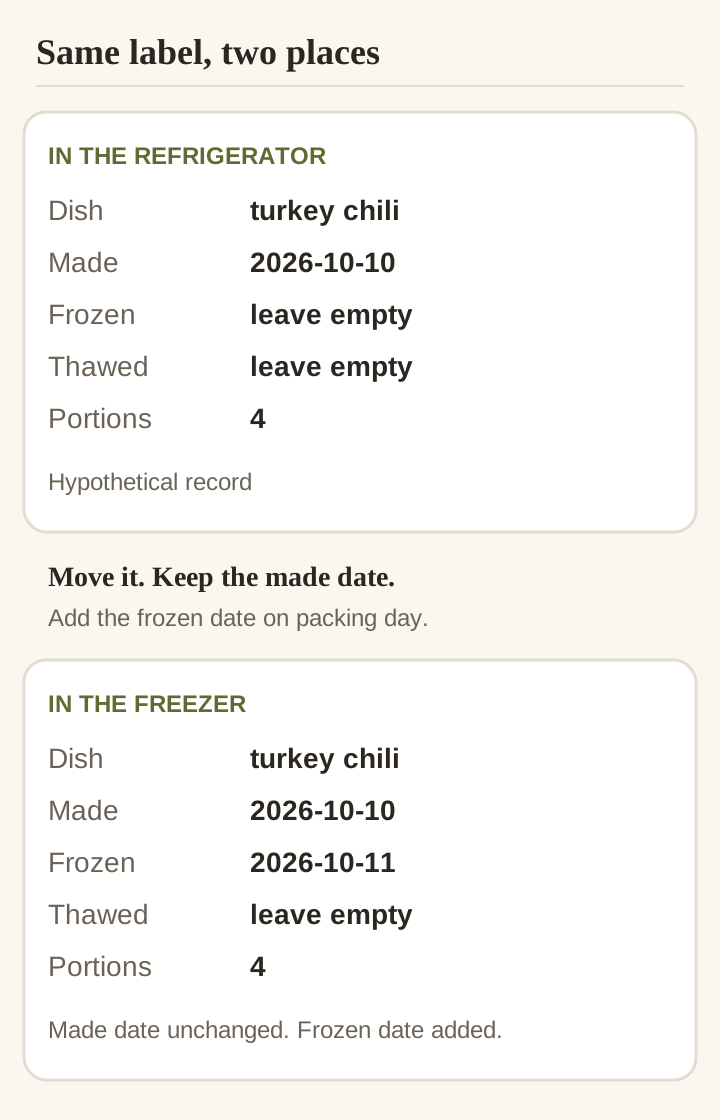
When the container leaves the refrigerator for the freezer, the label goes with it. Keep every date already written. Add the frozen date on the day you pack it. In the hypothetical chili record, October 10 stays on the made line and October 11 is added on the frozen line. Someone opening the freezer can see both events.
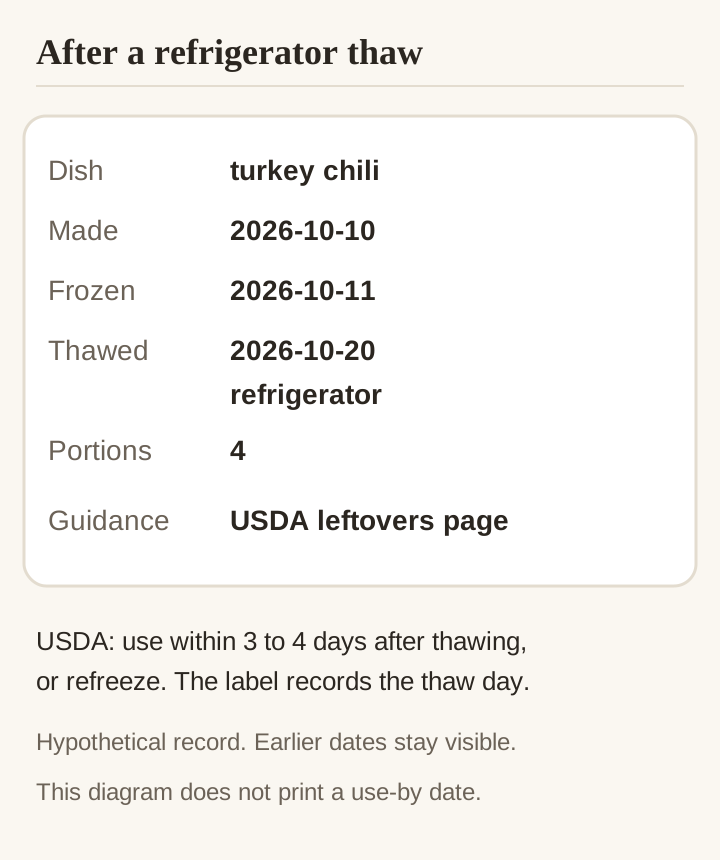
Leave the thawed line blank while the food is frozen. Fill it on the day thawing finishes. In the example, a refrigerator thaw on October 20 does not replace October 10 or October 11. USDA says that after thawing, the food should be used within 3 to 4 days or can be refrozen. Compare that instruction with the thawed date. The label does not calculate a use-by day for you, and this page does not turn October 20 into a guaranteed last day.
If a large container was frozen and you need only part of it, USDA says to thaw it in the refrigerator, remove the portion you need, and refreeze the rest without reheating it. The portion you keep out gets its own label: copy the dish, the made date, and the frozen date, then write the thawed date and the smaller portion count. On the container that goes back to the freezer, keep the made date and the original frozen date, and add a note with the day it was thawed and refrozen. That thaw still happened, so the record should say so.
Cold-water and microwave thaws are different records. A thawed line that says “cold water” means the food should be cooked before it is frozen again. A thawed line that says “microwave” means it was brought to 165°F, which is also the temperature USDA gives for reheating leftovers. Sauces, soups, and gravies should be brought to a rolling boil. The cooked meals guide carries the cooling, thawing, and reheating steps. This page only keeps those events readable on the container.
Mark the container so the writing survives
For a package that will be frozen, the National Center for Home Food Preservation says to use freezer tape, marking pens or crayons, or gummed labels made for freezer use. Put that mark on while the container is still in the kitchen. If you wait until the package is frosted, you may have to guess the made date from memory.
A container that will stay in the refrigerator can use the same six lines. If you might freeze it later, use a freezer mark from the start so the made date is still there on moving day.
The extension page says to seal rigid containers with a tight lid and to keep the sealing edge free of moisture or food. Write on the tape or the label, and keep food off the rim so the lid still closes. Container materials and the maker’s freezer and microwave marks are covered in the food storage containers guide.
A date records history you already know
Food with an unknown cooling or temperature history stays unsafe if you add a date later. USDA says to throw away perishable food left at room temperature more than 2 hours, or 1 hour when the air is above 90°F. Finding that container and writing today’s date does not supply the missing hours or the missing temperature.
Write a made date only when you know the food was cooked and refrigerated inside that limit and cooled so it reached 40°F or below. Write a frozen date only when you know the food was cooled before it was packed. Write a thawed date only when you know which thawing method was used. If you cannot say those things, the label has nothing true to record.
The date helps the household tell batches apart. Handling still follows the USDA leftovers page.
Keep household labels separate from restaurant rules
This label is for food a household cooked and stored at home. Restaurant and retail date-marking rules are a different system, with their own foods, times, and records. Do not copy a commercial date-marking rule onto this home label. Packaged food you bought still follows the package directions, which take priority over this guide.
Common questions
What do I write when I label leftovers in the fridge?
Write the dish, the made date, and the portions, and leave frozen and thawed blank until those days happen. Add the USDA leftovers link on the same label. Use year-month-day.
How do I keep the dates straight after freezing?
Keep the made date. Add the frozen date on the day you pack the cooled food. Add the thawed date, with the method, on the day thawing finishes. Each line names one event.
Can I label food after I forget how it was cooled?
Only if you still know the cooling and temperature history. If you do not know that the food was refrigerated within 2 hours, or within 1 hour above 90°F, USDA’s instruction is to throw perishable food away. A new date does not rebuild that history.
How long do the dates say the food will last?
They point at USDA’s windows. They do not replace them. Refrigerated leftovers: 3 to 4 days. After a refrigerator thaw: use within 3 to 4 days or refreeze. Freezer: the leftovers page lists 3 to 4 months, and frozen leftovers kept frozen stay safe indefinitely while moisture and flavor can decline. Check the guidance line on the label before you eat.
Portion the food, then fill the label
Cool and portion a cooked batch with the cooked meals guide, then fill this label for each container. For soup, use the soup portion guide for headspace, and put the same six lines on that container. Print or copy the blank label above, write the dates you actually know, and leave the rest blank until the day they happen.
Sources and review date
Reviewed October 12, 2026, for home kitchens in the United States. Refrigerator time, the two-hour rule, freezer quality, thawing, and reheating come from USDA FSIS, Leftovers and Food Safety, last updated July 31, 2020. Package wording and freezer marking materials come from the National Center for Home Food Preservation, Packaging and Labeling Foods, extracted from So Easy to Preserve, 6th edition, 2014. Both pages were read again from saved copies on October 12, 2026.
Explore more in Food Storage & Freezer Guides.
Official guidance and sources
Sources last checked October 12, 2026.
- Leftovers and Food Safety , USDA Food Safety and Inspection Service (accessed October 12, 2026) Two-hour rule, 40°F cooling, 3 to 4 days in the refrigerator, 3 to 4 months as a freezer quality window, thawing, and reheating. Page last updated July 31, 2020. Read again from the saved copy on October 12, 2026.
- Packaging and Labeling Foods , National Center for Home Food Preservation, University of Georgia (accessed October 12, 2026) Cool food before packaging. Label the product name, added ingredients, packaging date, number of servings or amount, and form. Use freezer tape, marking pens or crayons, or gummed freezer labels. Extracted from So Easy to Preserve, 6th edition, 2014.