
Food Storage Containers: Materials, Airtight Seals, and Temperature Limits
How to choose food storage containers by material (glass, Tritan, stainless steel, silicone), lid and seal type, and the maker's freezer, microwave and oven limits.
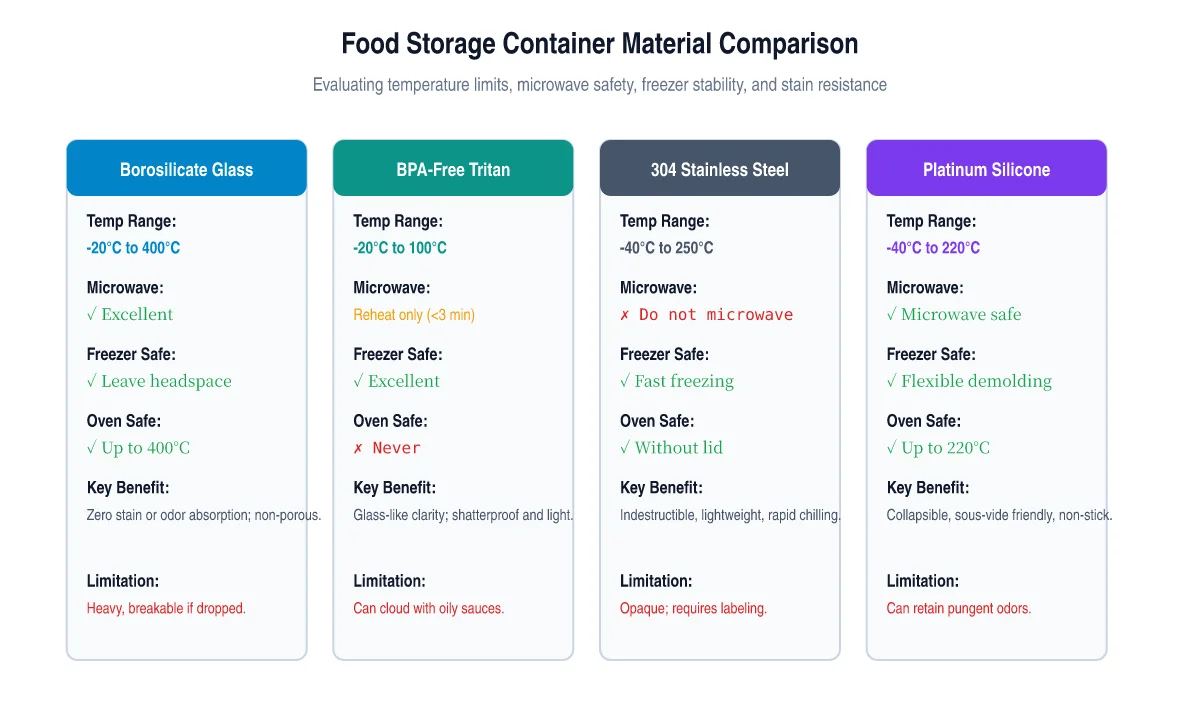
Selecting the right food storage containers is essential for minimizing food waste, preserving ingredient flavors, and preventing chemical migration. Yet kitchen cabinets are frequently filled with mismatched containers, warped lids, and discolored plastic bowls that leak in transit.
Choosing containers comes down to matching the food-grade material and sealing mechanism to your actual cooking and storage habits, then following the temperature limits the maker prints for that product. The container and its lid usually have different limits.
Every “yes” below applies only to a product whose maker labels it for that use; check the base and the lid separately.
Scroll horizontally to see all columns.
| Use | Glass storage dish | Plastic or gasketed lid | Tritan | Stainless steel | Silicone |
|---|---|---|---|---|---|
| Meal prep and fridge | Usually yes | Usually yes | Usually yes | Usually yes | Usually yes |
| Freezer | If labeled; leave headspace | If labeled | If labeled | If labeled (some steel canisters are not) | If labeled |
| Microwave | If labeled | If labeled; often reheating only, vented | If labeled | No | If labeled |
| Oven | Only dishes rated for it: preheated oven, within the maker’s limit, food thawed first | Only if the lid itself is rated | No | Only if the base is rated; check the lid separately | Only if rated |
1. Material Evaluation: Glass vs. Plastic vs. Steel vs. Silicone
Every container material presents distinct culinary and thermal trade-offs:
A. Glass (Borosilicate or Tempered Soda-Lime)
- Temperature limits: Set by the maker, and many glass storage dishes sold in the US are tempered soda-lime rather than borosilicate. Anchor Hocking, for example, rates its glass bakeware and food storage dishes for preheated ovens up to 425°F, and its plastic covers are not for oven use.
- Culinary Advantage: Glass is non-porous, so it does not take up tomato sauce stains, garlic odors, or acidic dressings the way some plastics do.
- Freezer to oven: Only glass dishes the maker rates for both freezer and oven can make that trip, and only after the food has thawed. Anchor Hocking’s instructions for its glass bakeware and food storage dishes say not to take a dish directly from the freezer to a preheated oven or microwave, to avoid sudden or severe temperature changes, and to use only preheated ovens up to 425°F. Glass pantry jars and other storage glass may not be rated for the freezer or oven at all.
- Practical Check: Inspect container rims for chips. For freezer storage, leave headspace for expansion according to the container’s size and opening; our freezing soup in portions guide explains how.
B. BPA-Free Tritan Copolyester
- Temperature limits: Check the container maker’s microwave and dishwasher guidance; Tritan containers are not for the oven.
- Culinary Advantage: Tritan offers glass-like clarity and resists breaking when dropped. It is lightweight, making it ideal for packed work lunches and mobile meal prep.
- Limitation: Very oily foods can get hot enough in the microwave to mark plastic. Follow the maker’s reheating instructions, and transfer oily dishes to glass or a microwave-safe plate if the label is unclear.
C. Food-Grade 304 (18/8) Stainless Steel
- Temperature limits: Freezer and oven use depend on the product; check the base and the lid separately, because a rating for the base does not cover the lid.
- Culinary Advantage: Durable and light. Useful for raw meat storage and dry snack transport. For fat-coated dry goods such as pet kibble—where bare polyethylene or polypropylene walls absorb surface oils over time—keeping the original barrier bag inside a gasketed bin or seamless steel canister prevents rancid buildup; see dog food storage containers, lipid oxidation, and bag liners.
- Limitation: Opaque construction requires writing contents and dates on the lid. Cannot be placed inside a standard microwave oven.
D. Platinum Cured Silicone
- Temperature limits: Use the maximum the maker prints for that product; ratings differ between brands.
- Culinary Advantage: Flexible, and some designs collapse for compact pantry storage. Useful for portioning and freezing stocks, soups, and purees where the product is labeled for the freezer.
- Limitation: Can absorb strong odors (such as onions). If washing does not remove them, follow the maker’s cleaning instructions rather than a general oven-baking rule.
2. Sealing Mechanisms: What Truly Keeps Food Fresh?
Food spoilage and freezer burn are driven by moisture migration and oxygen exposure:
- Four-Latch Silicone Gaskets: Hinged locking flaps on all four sides compress a food-grade silicone ring against the container lip. How well a particular container holds liquid on its side depends on the model, so check the maker’s leak-proof claim; a quick test with water will show an obvious leak but does not prove the lid is airtight. For proper sanitation, remove the removable gasket periodically to wash and dry the groove.
- Vacuum-Sealed Valves: Hand-pump or motorized vacuum valves remove air from the container. How much that extends freshness depends on the food and the product. Contrast this with pantry storage in our airtight vs vacuum-sealed storage comparison.
- Friction-Fit Press Lids: Lids that push into place without mechanical latches suit dry flour, oats, and cereal in pantries. Check how well a given lid holds before carrying it in a bag.
3. Maintenance and Odor Elimination
To extend the lifespan of your storage collection:
- Avoid Thermal Shock: Do not move glass straight from the freezer into a preheated oven or microwave. Thaw the food first, put the dish in an oven that is already at temperature and within the maker’s limit, and set a hot dish on a dry cloth or rack, never on a wet or cold surface.
- Stain Prevention: Store strongly colored foods such as tomato sauce or turmeric dishes in glass if staining bothers you.
- Dishwasher: Follow the lid’s care label. Anchor Hocking, for example, rates its plastic covers for the top rack only.
Explore more in Food Storage & Freezer Guides.
Official guidance and sources
Sources last checked October 6, 2026.
- Packaging & Food Contact Substances (FCS) , U.S. Food and Drug Administration (accessed October 6, 2026) Safety requirements for materials intended to contact food.
- Refrigeration and Food Safety , USDA Food Safety and Inspection Service (accessed October 6, 2026) Guidelines on airtight containers to prevent bacterial cross-contamination in refrigerators.
- Care & Use , Anchor Hocking (accessed October 7, 2026) Manufacturer instructions for glass bakeware and food storage: oven limit, thawing before cooking, and plastic cover limits.