
Are Dented Cans Safe? Seam Defects and Sharp Crease Checks
Small, smooth dents on the flat body of a can away from seams are generally safe, while dents over side or end seams, sharp creases, finger-deep dents, heavy rust, and bulging lids must be discarded.
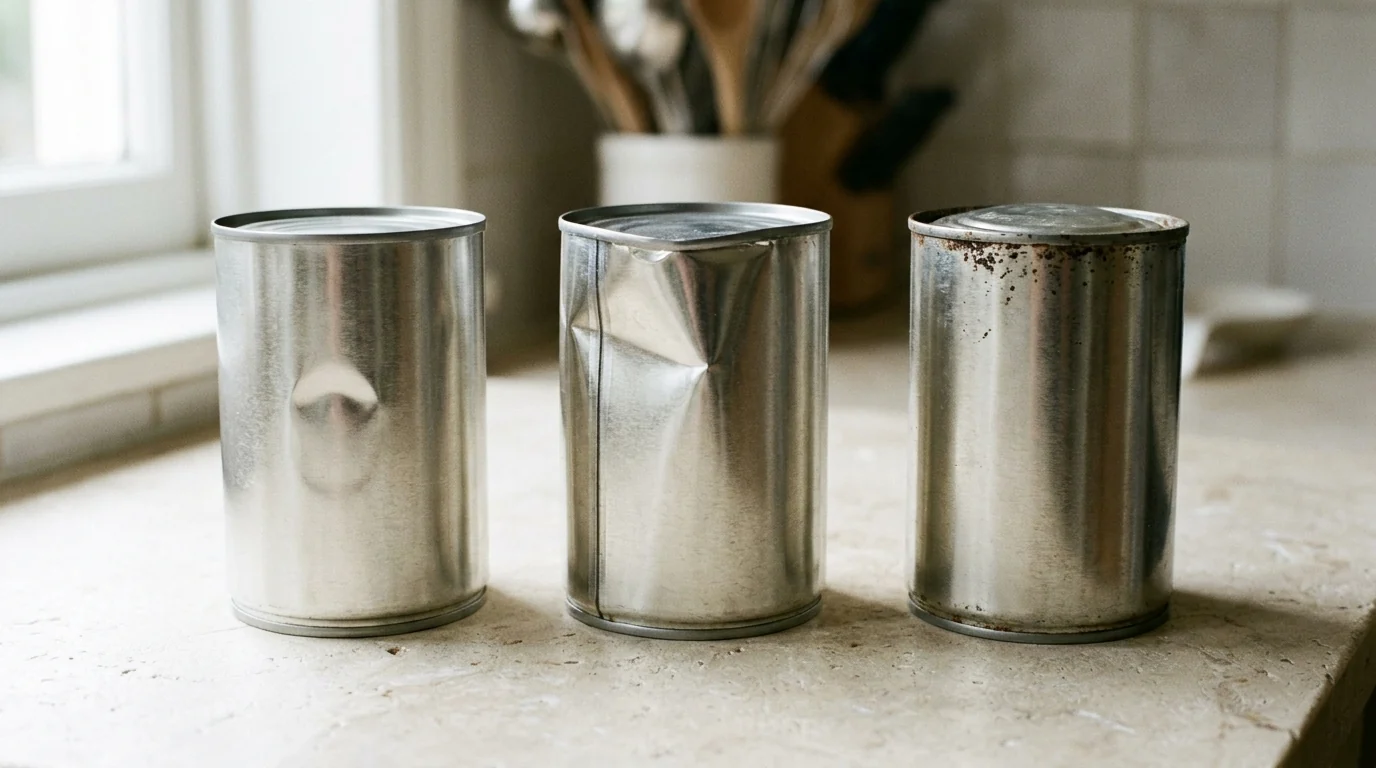
A dented food can is generally safe to eat only when the dent is small, smooth, shallow, and completely clear of the top, bottom, and side seams. Discard any can with a dent touching a seam, a sharp point or crease, a dent deep enough to lay your finger into, heavy rust, leaking liquid, or a bulging lid.
The size of a dent matters far less than where it lands and whether it folds the metal sharply. Understanding how seams and internal liners protect canned food is a core part of food packaging safety, because physical seal damage overrides every date stamp printed on the label, as explained in our Sell By vs Use By guide.
How Do You Tell Safe vs. Unsafe Dented Cans Apart?
Public-health inspection separates damaged cans into three tiers: Minor (Class III) defects are safe smooth dents clear of all seams, Major (Class II) defects are unsafe dents over seams, sharp creases, crushed walls, or finger-deep impacts, and Critical (Class I) defects are bulging, leaking, or punctured cans that should be discarded immediately.
Under the visual defect classification published by the Larimer County Department of Health and Environment, along with guidance from University of Nebraska-Lincoln Extension and Ohio State University Extension, inspect every damaged can against the criteria below before opening:
Scroll horizontally to see all columns.
| Defect Tier | Physical Inspection Cues | Seal & Safety Risk | Household Action |
|---|---|---|---|
| Minor (Class III) | Small, smooth, shallow dent on the flat side wall away from top, bottom, and side seams; smooth dent on a seamless two-piece bottom; tiny outer rim notch that does not deform the end seam | Hermetic seam stays intact and metal is not sharply creased | Generally safe to eat if the rest of the can is in good shape |
| Major (Class II) | Any dent crossing a side seam or top or bottom end seam; any side dent near the top affecting the end seam; sharp or pointed edges; two dents meeting at a point to form a crease; crushed can; deep dent you can lay your finger into | Compromised seam integrity or sharp metal crease allows air and bacteria to enter | Discard the can unopened; do not taste the contents |
| Critical (Class I) | Bulging or swollen can whose lid gives under pressure; leaking liquid; visible holes; heavily rusted metal that may harbor tiny pinholes | Active gas pressure from spoilage microbes, broken seal, or perforation | Discard immediately unopened in sealed trash bags; never open or taste |
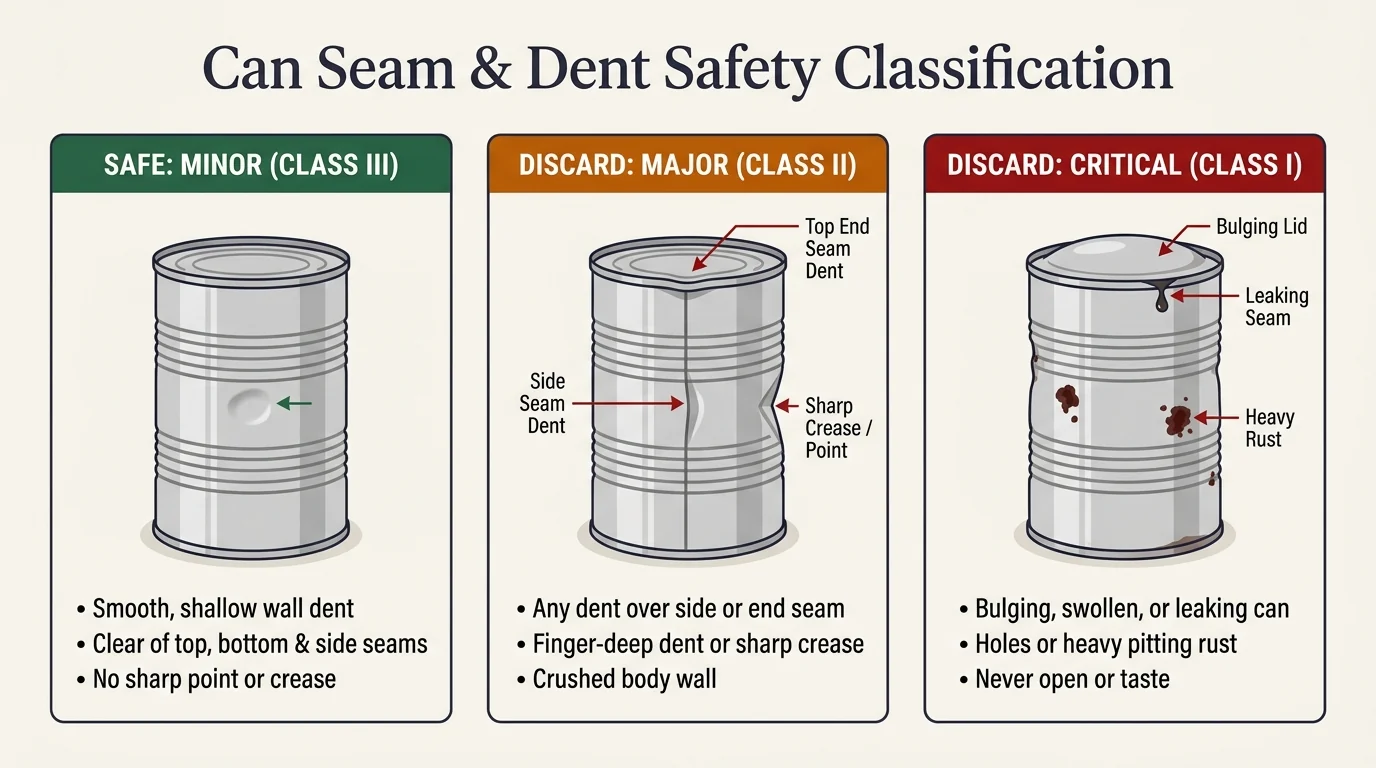
When you cannot tell whether a dent touches a seam or creases the metal wall, follow the Larimer County Department of Health and Environment rule: when in doubt, throw it out. Utah State University Extension also advises skipping rusted, dented, scratched, or bulging cans at the store and avoiding scratch-and-dent budget resellers when stocking food storage.
Two-Piece vs. Three-Piece Cans and Hidden Side Seams
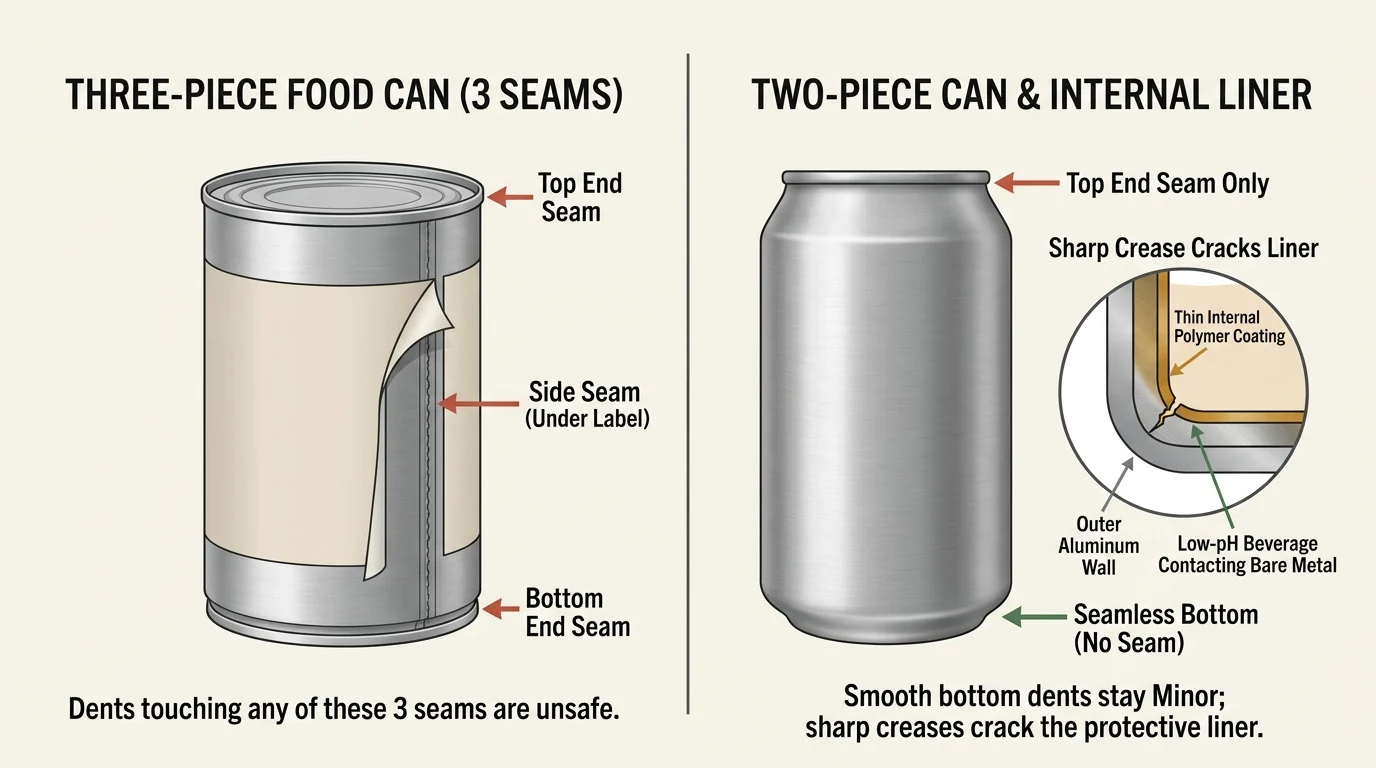
Commercial metal cans come in two main structural designs: three-piece cans with seams at both the top and bottom plus a vertical side seam, and two-piece cans with a seam only on the top and a seamless bottom. On three-piece food cans, the vertical side seam is usually hidden beneath the paper label, so peel back the label before judging a side dent.
Because a seamless two-piece bottom has no end seam to pry open, the Larimer County Department of Health and Environment notes that smooth bottom dents without sharp points or edges remain Minor defects on seamless-bottom cans. On a three-piece can with a bottom end seam, the exact same dent over the bottom seam becomes an unsafe Major defect.
Are Dented Cans Safe to Eat If Only the Side Is Dented?
A side-dented can is safe to eat only when the dent is smooth, shallow, and completely clear of the vertical side seam and both end seams. Even a dent confined to the side wall becomes unsafe if it is deep enough to lay your finger into, forms a sharp point or crease, or sits near the top rim.
Run a quick step-by-step check on any side-dented pantry can before you reach for the can opener:
- Locate the hidden side seam. Peel back the paper label to expose the vertical seam; according to Ohio State University Extension, a dent on the side seam or rim seams means the food was exposed to air, creating an environment for harmful bacteria to grow.
- Test the depth with a finger. University of Nebraska-Lincoln Extension defines a deep dent as one you can lay your finger into; deep dents often create sharp points that damage seams, so discard deeply dented cans.
- Feel for sharp points or intersecting creases. Under Larimer County Department of Health and Environment defect criteria, a smooth large body dent away from seams is still a Minor defect, whereas a dent with pointed edges or two dents meeting at a point forms a sharp crease that makes the can an unsafe Major defect.
- Check proximity to the top and bottom rims. A side dent positioned close to the top of the can can deform and weaken the top end seam even without directly sitting on the lid rim, turning an otherwise smooth impact into an unsafe Major defect.
Why Can Dented Cans Carry a Botulism Risk?
Dented cans carry a botulism risk because commercial canning forces air out of the container to create an anaerobic environment where Clostridium botulinum grows best. When a seam dent or sharp crease breaches the seal, bacteria can enter, and Clostridium botulinum spores in low-acid foods can germinate and produce a deadly toxin that cannot be seen, smelled, or tasted.
As Utah State University Extension explains, botulism is a rare but serious foodborne illness caused by a toxin produced by Clostridium botulinum. The bacterium forms heat-resistant spores—survival units that resist treatments such as boiling water—which is why low-acid foods require proper commercial retorting or pressure processing as outlined in our water bath vs pressure canning guide.
University of Wyoming Extension highlights that low-acid vegetables such as green beans, corn, beets, and peas—which can pick up Clostridium botulinum spores from soil—along with canned meats face heightened risk whenever a container seal fails or processing is compromised. Because you cannot see, smell, or taste botulinum toxin, never take a test bite from a suspect can.
What Warning Signs Point to Botulism or Spoilage?
Warning signs of botulism or spoilage include bulging or swollen lids that give under finger pressure, leaking seams, spurting liquid when opened, foul or unnatural odors, milky liquid surrounding vegetables that should sit in clear liquid, white, blue, black, or green cotton-like mold, and heavy rust or interior rust.
Growth of spoilage bacteria and yeast generates gas that pressurizes the food, swells lids, and breaks seals, as documented by the National Center for Home Food Preservation. Ohio State University Extension states flatly that bulging cans contain spoiled food and must be thrown away, and University of Wyoming Extension warns never to use food from leaking, bulging, or badly dented cans or any container with foul odor, milky vegetable brine, or spurting liquid.
Surface Rust vs. Heavy Rust and Interior Corrosion
Not every speck of rust on a pantry can carries the same risk, so University of Nebraska-Lincoln Extension separates external rust into three distinct checks:
- Light surface rust: Surface rust that rubs off easily with your finger or a paper towel is not serious, and you can keep the canned food if the seams and body are intact.
- Heavy exterior rust: Heavily rusted cans must be discarded because deep corrosion can form tiny pinholes through the metal wall that allow bacteria to enter.
- Rust inside an opened can: If you open a can and see any rust inside, do not eat the food, because rust (oxidized iron) is unsafe to consume.
How to Discard or Detoxify Suspect Cans Safely
Never open a sealed bulging, leaking, or badly dented can to empty it down the sink, because botulinum toxin can be fatal whether swallowed or absorbed through openings in the skin. Follow the disposal and detoxification steps from the National Center for Home Food Preservation and University of Wyoming Extension based on whether the container is still sealed:
- Sealed swollen or suspect metal cans: Leave the can unopened, double-bag it tightly inside heavy plastic garbage bags so people or animals rummaging in trash cannot be exposed, and place it in regular outdoor non-recyclable trash or landfill disposal.
- Unsealed, open, or leaking low-acid suspect cans: Put on disposable rubber or heavy plastic gloves, lay the suspect can and lid on their sides in an 8-quart or larger stock pot, cover with at least 1 inch of water above the container without splashing, place a lid on the pot, and boil for 30 minutes to detoxify the food and container before cooling and trashing.
- Spill and tool decontamination: Wearing rubber or heavy plastic gloves, wet contaminated counters, can openers, equipment, or clothing with a fresh solution of 1 part unscented liquid household chlorine bleach (5 to 6% sodium hypochlorite) to 5 parts clean water, let stand 30 minutes, wipe spills into a plastic bag with paper towels, apply the bleach solution for a second 30-minute stand time, then rinse and wash thoroughly before discarding gloves.
Can You Drink From a Dented Beverage Can?
You can generally drink from an aluminum beverage can with a minor, smooth cosmetic dent on the side wall if the can stays pressurized, unpunctured, and clear of the top lid seam. Discard beverage cans with top-seam dents, leaks, or sharp creases, because sharp bends can crack the thin internal polymer liner and expose bare aluminum to low-pH drinks.
Global manufacturers produce more than 250 billion metal cans annually, and aluminum beverage cans rely on an invisible barrier to keep acidic drinks from attacking the metal wall. According to electrochemical corrosion research published in Materials and archived on NIH PubMed Central, drinks with a low pH can dissolve the natural aluminum oxide passivation layer on bare aluminum, so cans are lined inside with a thin polymer coating such as vinylic or phenolic lacquers or epoxy resins.
In laboratory electrochemical measurements comparing factory-coated beverage can walls against uncoated bare aluminum in commercial soft drink electrolytes, intact internal polymer coatings reduced corrosion rates by 80 to 99% and raised polarization resistance by 31 to 1349 fold:
Scroll horizontally to see all columns.
| Beverage Can Test Sample | Internal Polymer Liner Status | Corrosion Current Density (microamps per sq cm) | Measured Corrosion Rate (mpy) | Protection Impact |
|---|---|---|---|---|
| Green Cola main solution | Intact organic coating | 6.0 | 2.6 | Coating sharply curbs metal dissolution compared with bare alloy |
| Green Cola main solution | Uncoated bare aluminum | 41.3 | 17.7 | Nearly sevenfold jump in corrosion rate when liner is absent |
| Red Bull main solution | Intact organic coating | 0.9 | 0.4 | Coating maintains very low corrosion current in acidic energy drink |
| Red Bull main solution | Uncoated bare aluminum | 10.0 | 4.3 | More than tenfold rise in corrosion rate without internal barrier |
Because metal corrosion speeds up with low pH, oxygen entry, dissolved salts or ions, and warmer storage temperatures, a sharp crease or top-seam impact on an aluminum soda or energy-drink can poses both a seal-leak risk and an internal coating-damage risk. Skip sharply creased or top-rim-dented drink cans, and drink smooth cosmetically dented beverage cans promptly rather than storing them long term.
How Long Do Unopened Canned Goods Keep?
Commercially canned foods retain their best quality for 2 to 5 years from manufacture—with high-acid foods keeping shorter than low-acid foods—though Ohio State University Extension recommends rotating everyday pantry cans within one year and canned fruit juices within nine months at 70 degrees F. In emergency storage, intact commercial metal cans remain safe as long as the seal stays unbroken.
Temperature, moisture, and rotation control whether stored cans develop rust or broken seals long before their printed code dates arrive. Keep metal cans off bare concrete floors so moisture cannot wick upward and trigger rust, avoid storing cans where temperatures climb above 70 degrees F (and never above 95 degrees F, such as in a garage or shed), and prevent freezing, which can burst seams, break seals, and encourage rust according to Utah State University Extension. Use sturdy, properly rated shelving from our pantry shelf weight capacity and can organizers guide and label purchase dates for first-in, first-out rotation with our pantry organization guide.
Scroll horizontally to see all columns.
| Container or Food Category | Recommended Storage Window | Key Temperature & Handling Rules |
|---|---|---|
| Commercial canned goods (general quality) | 2 to 5 years from manufacture (high-acid items shorter); 12 months everyday pantry rotation | Store cool and dry at or below 70 degrees F, never above 95 degrees F; keep off bare concrete floors |
| Commercial canned fruit juices | 9 months at 70 degrees F | Keep cool and rotate first-in, first-out; discard if bulging, leaking, or heavily rusted |
| Home-canned foods (unopened) | One year for best quality; use before two years | Store in a cool, dark, dry space protected from freezing and wide temperature swings |
| Retort metal-Mylar pouches (unopened) | 8 to 10 years maximum tested | Do not store longer than 10 years; inspect pouch seals before use |
| Opened canned fish, seafood, meat, or poultry | 2 days refrigerated | Transfer to glass or plastic containers tightly covered to avoid metallic taste |
| Opened canned vegetables | 3 days refrigerated | Refrigerate promptly in non-metal covered containers |
| Opened canned tomato sauce | 5 days refrigerated | High-acid foods leach metallic flavors in open cans; transfer immediately |
| Opened canned fruit | 1 week refrigerated | Store covered in glass or plastic containers; discard if mold or off odor appears |
| Opened canned pickles or olives | 1 to 2 months refrigerated | Keep tightly covered in the refrigerator |
Even on intact, older cans stored safely, vitamin A and C levels decline at 5 to 20% per year while mineral content holds steady. Utah State University Extension recommends heating low-acid canned foods to 165 degrees F or boiling them for 5 to 10 minutes before eating, and transferring all opened leftovers out of the metal can into covered glass or plastic containers in the refrigerator.
Frequently Asked Questions
Is a small dent on the side of a can safe?
Yes, if the dent is small, smooth, and shallow, has no sharp point or crease, and stays clear of the top end seam, bottom end seam, and label-covered vertical side seam. If you can lay your finger into the dent or see a sharp fold, discard the can.
Can you get botulism from a dented can that looks normal inside?
Yes. Clostridium botulinum toxin cannot be seen, smelled, or tasted, so a compromised low-acid can may look and smell normal while still containing deadly toxin. Never taste food from a seam-dented, sharply creased, leaking, or bulging can to check whether it is safe.
Are dented cans on clearance or at scratch-and-dent stores safe to buy?
Utah State University Extension advises avoiding scratch-and-dent resellers and skipping rusted, dented, scratched, or bulging cans when buying food for storage. Because you do not know how hard a clearance can was dropped or how long a micro-leak has sat at warm room temperature, intact cans are the safer choice.
What if a can was frozen and thawed in a cold pantry or garage?
Ohio State University Extension notes that intact canned goods frozen and thawed once may suffer a slight breakdown in texture, whereas Utah State University Extension warns that freezing can burst cans, break seals, and trigger rust. Inspect any previously frozen can carefully for swollen lids, seam distortion, or leaks, and discard it immediately if the seal is compromised.
Can you eat food from a slightly rusty can?
If light surface rust rubs off easily with your finger or a paper towel and the seams are undamaged, University of Nebraska-Lincoln Extension considers the can safe to keep. Discard any heavily rusted can that could harbor tiny pinholes, and never eat food if you spot rust (oxidized iron) inside the can after opening.
Explore more in Food Packaging Explained.
Sources
Sources last checked November 25, 2026.
- Pantry Food Storage (HYG-5401) , Ohio State University Extension (accessed November 25, 2026)
- Is This Food Still Safe to Eat? Frequently Asked Questions , University of Nebraska-Lincoln Extension (accessed November 25, 2026)
- Storing Canned Goods , Utah State University Extension (accessed November 25, 2026)
- What Is Botulism? , Utah State University Extension (accessed November 25, 2026)
- Identifying and Handling Spoiled Canned Food , National Center for Home Food Preservation (University of Georgia) (accessed November 25, 2026)
- Corrosion Behavior of Aluminium-Coated Cans , Materials (NIH PubMed Central) (accessed November 25, 2026)