
Amcor and Choví's Polypropylene Flip-Top Closure: What Was Announced and What Isn't Confirmed
Amcor announced a custom flip-top cap for Spanish sauce brand Choví, described as made entirely from polypropylene with a silicon valve. Here is what the release says, where the mono-PP label came from, and what is still unconfirmed.
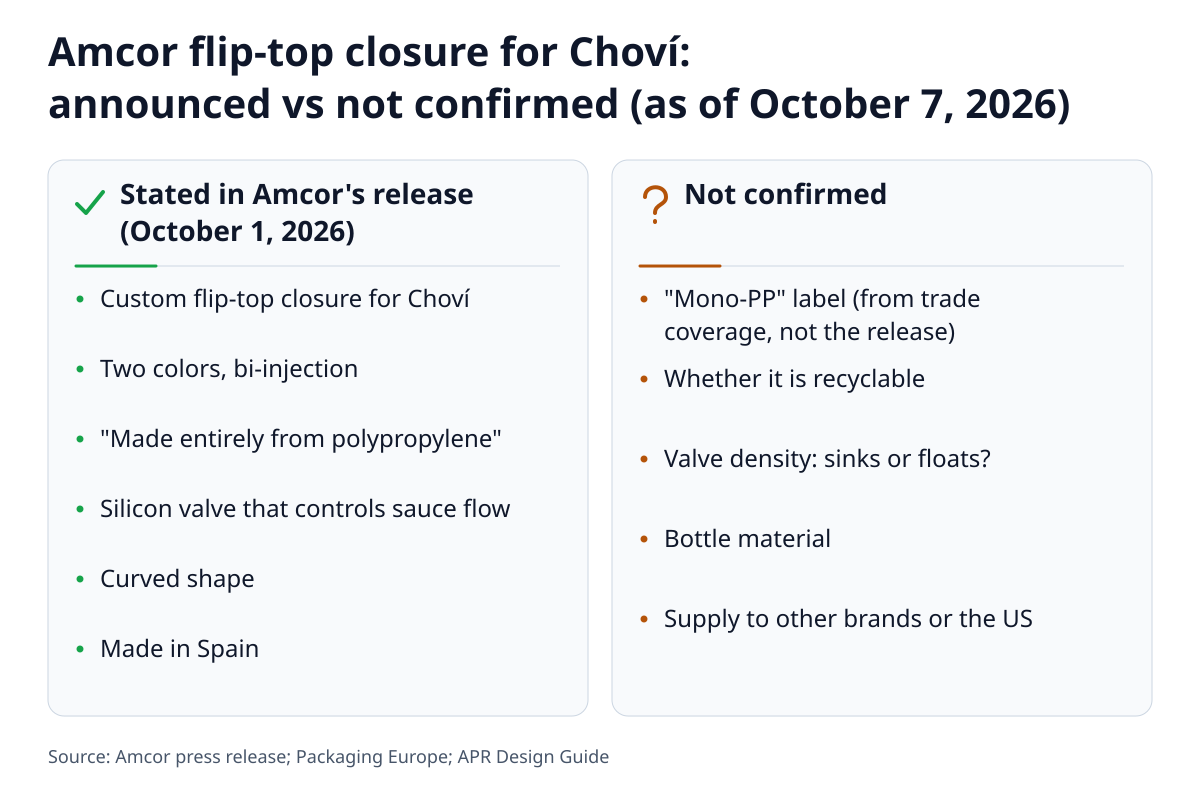
On October 1, 2026, Amcor announced a custom flip-top closure for Choví, a Spanish sauce brand: a two-color cap that Amcor describes as made entirely from polypropylene, with a silicon valve that controls how the sauce comes out. The press release does not call the cap mono-material or recyclable; the mono-PP label came from trade-press coverage. This page separates what Amcor said from what was added later, and lists what nobody has confirmed yet.
If you saw headlines about a “mono-PP” flip-top cap from Amcor for Choví sauces, the confirmed part is narrower than the headline. Amcor’s October 1, 2026 release says the bi-injection closure “has been made entirely from polypropylene” and “incorporates a silicon valve” to control flow. It makes no recycling claim. Whether a polypropylene cap with a silicone valve counts as single-material, and whether it can be recycled with its bottle, depends on details that have not been published, such as how dense the valve material is and what the bottle is made of. For US shoppers nothing changes. For small sauce makers, the gaps make a useful list of questions for a cap supplier.
Key points:
- The event rests on one source: Amcor’s press release of October 1, 2026. The other coverage we found rewrites or reposts it.
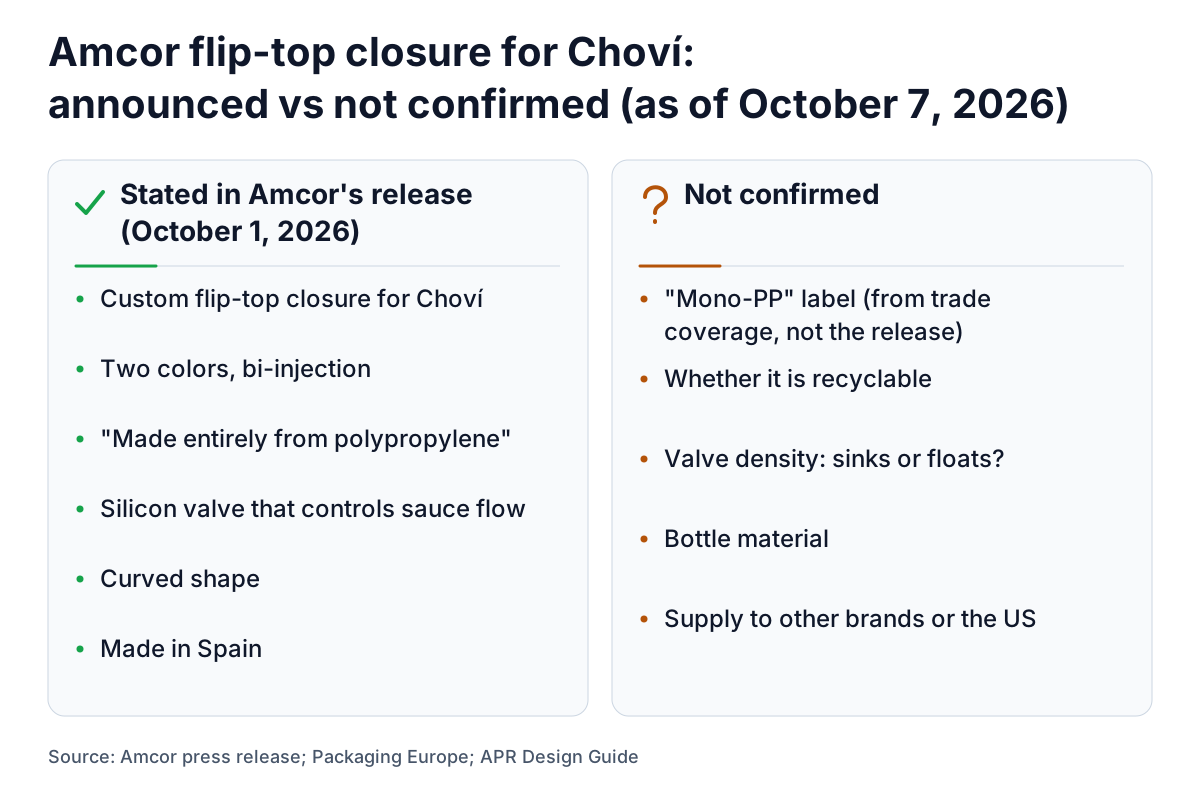
- The release states: a custom flip-top for Choví, two colors, bi-injection, “made entirely from polypropylene”, a valve that controls flow, a curved shape, and manufacturing in Spain.
- The release does not contain the words mono-material, mono-PP or recyclable, and it says nothing about the bottle material, the valve’s density or supply to other brands.
- US recycler design guidance (from the Association of Plastic Recyclers, APR) judges silicone parts in polypropylene packages by whether they sink or float in water, so the recycling question for this cap is open.
What did Amcor announce?
Amcor, a global packaging company, announced on October 1, 2026 that it had developed a customized flip-top closure for Choví, which it describes as one of the most popular sauce brands in Spain. The release is the only primary source. Everything else in the timeline below repeats it or comments on it.
Scroll horizontally to see all columns.
| Date | What appeared | Source | Type of source |
|---|---|---|---|
| October 1, 2026 | Press release: bespoke flip-top closure for Choví | Amcor newsroom | Company statement (primary) |
| October 2, 2026 | Rewrite headlined “mono-PP flip-top closure” | Packaging Europe | Trade media, based on the release |
| October 5, 2026 | Article that repeats the release and adds analysis of capping and dispensing | IN Food | Trade media, release facts plus its own analysis |
| Early October 2026 | Further articles, reposts and social posts (Packaging Gateway, reposted on Yahoo Finance, a release aggregator, LinkedIn) | Various | Treated as copies or rewrites of the release, not independent sources |
What the release itself says:
- The closure is bespoke, made for Choví, a long-standing Amcor customer that chose Amcor for its reputation in closures and its Spanish manufacturing facility.
- It is a bicolor, bi-injection closure. Bi-injection (also called two-shot molding) means two shots of plastic are molded into one part; here, according to the release and IN Food, that is how the cap gets its two colors.
- “The bi-injection closure has been made entirely from polypropylene.”
- It “incorporates a silicon valve designed to control the flow of the sauce as it is dispensed from the bottle.”
- Its curved shape helps the packs stand out on the shelf “while also boosting functionality”, in Amcor’s words. The release also mentions the closure’s robustness.
- It is being used on Choví’s sauces for salads, barbecues and snacks: La Brava, Allioli, Cheddar, Kebab White, Ajonesa, Barbacoa, Ketchup, César, Yogur and Miel y Mostaza.
- Choví’s logistics and purchasing manager is quoted saying the innovation is “made in Spain for a Spanish brand.”
This valve has a different job from the one-way valve on a coffee bag, which lets gas out of a sealed bag (see why coffee bags have valves). IN Food describes the sauce valve as regulating how sauce leaves the bottle, rather than letting it pour out unrestricted when the bottle is turned over or squeezed.
Is it “mono-PP”, and is it recyclable?
Neither is confirmed. Amcor’s release says the closure is “made entirely from polypropylene” and, in the same paragraph, that it incorporates a silicon valve. The word “mono-polypropylene” appears in Packaging Europe’s article, not in the release, and none of the sources we read makes a recycling claim for this closure.
Scroll horizontally to see all columns.
| Source | What it says about materials | What it says about recycling |
|---|---|---|
| Amcor release, October 1 | “made entirely from polypropylene”; “incorporates a silicon valve” | Nothing |
| Packaging Europe, October 2 | “mono-polypropylene flip-top closure”; “features a silicone valve” | Nothing for this closure. It mentions an earlier Amcor cap, the Flava Flip Top Closure 38/400, which it says is considered “recyclable-ready” with PET, HDPE and PP bottles |
| IN Food, October 5 | “The main closure is made from polypropylene”; an “integrated flow-control valve” (material not named) | Nothing |
Silicone is a different material from polypropylene, so a cap that contains a silicone valve is, strictly, made of more than one material. Amcor spells it “silicon valve”; Packaging Europe calls it a silicone valve, and we read it the same way. Neither source gives the valve’s grade or density.
How do recyclers judge a cap like this? In the US, the Association of Plastic Recyclers publishes a design guide. Its pages for rigid polypropylene (PP) packages, last updated May 15, 2026, say:
- Closures, closure liners and safety seals should be made from materials that do not harm the quality of the recycled plastic. They can either be compatible with the package’s main resin or separate from it in the sink/float step, where plastics are sorted in water by whether they sink or float.
- A PP closure on a PP package is the same polymer, so it is captured and processed with the PP.
- Silicone that sinks in water can be separated out in the sink/float step and does not affect the recycled PP. Silicone that floats goes through with the PP, is difficult to remove by other methods, and can cause contamination if it is not compatible with PP. APR’s test protocol PP-CG-01 can determine the impact. APR lists this under dispensers and pumps; it has no separate entry for flip-top valves.
- Plastics denser than 1.0 g/cm³ are expected to sink and separate from PP.
- APR recommends that caps and closures stay attached to the package when it goes into the recycling stream.
The limit is important. This is design guidance for polypropylene packages in US recycling. The release does not say what Choví’s bottles are made of, how dense the valve material is, or whether any recyclability test was run. The cap is made in Spain for a Spanish brand, where recycling is assessed under European rules and programs that this page did not review. So the guidance tells you which questions decide the answer, not the answer itself.
Who does this affect, and how?
For most US readers, nothing changes directly. The release describes a cap for one Spanish brand’s sauces and mentions no other market. The story is more useful as an example of how a recycling-sounding label can grow between a press release and a headline, and as a set of checks for small sauce makers. Other pack features and labels, from coffee-bag valves to chip-bag seals, are explained in Food Packaging Explained.
Scroll horizontally to see all columns.
| Reader | What changes | Basis |
|---|---|---|
| Home cooks in the US buying squeeze-bottle sauces | Nothing to do. The release does not mention US sales. For any cap, follow your local recycling program’s instructions. APR’s design guidance recommends that caps stay attached to the package. | Amcor release; APR design guide |
| Shoppers who buy Choví sauces | Amcor says the listed flavors use the new cap, with a valve meant to control flow as you pour. No recycling instructions were announced. | Amcor release |
| Small sauce makers choosing a bottle and cap | A reference point, not a product you can order. The release calls the cap bespoke for Choví and does not say it is available to other brands. Use the supplier questions below. | Amcor release |
| Anyone filling and capping bottles, such as a co-packer | IN Food notes that a cap has to feed into capping equipment, be applied at controlled torque and keep its seal through transport and repeated use, and that one valve used across sauces of different thickness adds a variable to test. | IN Food analysis |
When would you need to act?
No date requires anyone to act. The only firm date is the announcement on October 1, 2026. Amcor says the closure is already in use on Choví’s range. No dates were given for other brands, other markets, recycling tests or sampling, and we have not inferred any; those items are listed under the next section.
Scroll horizontally to see all columns.
| Date | Item | Status |
|---|---|---|
| October 1, 2026 | Amcor announces the closure and says it is being used on Choví’s sauce range | Company statement |
| October 2 to 5, 2026 | Trade coverage (Packaging Europe, IN Food) and reposts | Based on the release |
If you only buy sauces, there is nothing to do. If you make sauce and are already planning a bottle or cap change, add the questions below to your supplier brief now rather than waiting for news about this particular cap.
What is still unconfirmed?
Eight points are open. Each one names who could settle it and what document would do so. Until then, treat “mono-PP” and any recycling claim for this closure as unverified.
- Whether “entirely from polypropylene” covers the valve. Who can confirm: Amcor. What to look for: a materials list for each part of the closure.
- The valve’s material grade, and whether it sinks or floats in water. Who: Amcor. What: a density figure or a sink/float result.
- What Choví’s bottles are made of. Who: Choví. What: the bottle specification.
- Whether the closure and bottle together can be recycled in a given system. Who: Amcor or Choví. What: recyclability test results, stating the system they apply to. In the US, PP-CG-01 is APR’s protocol for PP rigid containers; European assessments were not reviewed here.
- Whether other brands, including US brands, can get this cap or a similar one. Who: Amcor. What: a product or sales statement.
- How this cap relates to Amcor’s Flava 38/400 closure, which Packaging Europe describes as recyclable-ready. Who: Amcor. What: product documentation for each cap.
- How the cap performs on the capping line and when dispensing each of Choví’s sauces. Who: Amcor and Choví. What: line-trial and dispensing results, which neither company has released.
- Timing for anyone else: when, or whether, other brands could evaluate, sample or trial a similar custom cap. No dates have been announced. Who: Amcor, or any cap supplier you approach. What: a quoted timeline for samples and line trials.
If you make sauce, what should you ask a cap supplier?
If a supplier offers you an “all-PP” or “mono-material” valve cap, ask for documents that back each part of the claim, then test the cap with your own sauce and bottle. These questions come from the open points above and from the production issues IN Food raises.
- Materials, part by part: body, lid, hinge, valve and any liner or seal. Which parts are polypropylene, and which are not?
- For any part that is not polypropylene: its density, or whether it sinks or floats in water.
- Recycling evidence for your cap on your bottle, not for the cap alone, and which recycling system it was tested for.
- Fit: does the cap match your bottle’s neck?
- Capping: does it feed through your capper, or apply cleanly by hand, at a torque you can repeat, and does it stay sealed after shipping?
- Dispensing with each recipe: IN Food lists sauce thickness, how the bottle squeezes, fill temperature, headspace and storage conditions as things that change how a valve dispenses. Test thin and thick sauces, at the temperature you fill and again after storage.
- Samples: fill and pour finished samples with your own sauce before ordering in volume.
Write these into the protection and notes sections of a food packaging brief for small brands so that every supplier answers the same questions. The checklist helps you compare caps you are offered. It does not tell you whether a valve cap suits your sauce; only filling and pouring your own recipe can show that.
Our reading
This is our judgment, not a statement from either company. The announcement is about a cap that pours in a controlled way and stands out on the shelf; recycling is not part of what Amcor claimed. “Mono-PP” may be a fair shorthand for the molded cap body, the part made in two colored shots, but it is not a verified description of the whole closure, because the same release says the closure contains a silicon valve. We would treat any recycling claim for this closure as unconfirmed until Amcor or Choví publish part-by-part materials and test results.
Common questions
Is a flip-top cap with a silicone valve recyclable? It depends on the valve material’s density, the bottle’s material and the recycling system. For polypropylene packages, APR’s design guide says silicone that sinks can be separated, while silicone that floats needs testing. Your local program decides what goes in your bin.
Is Amcor’s Choví closure mono-material? Amcor says it is “made entirely from polypropylene” and that it incorporates a silicon valve. The mono-polypropylene label came from trade coverage. Amcor has not published a part-by-part materials list.
Can I get this cap for my own sauce brand? The release describes a bespoke closure developed for Choví and does not mention supply to other brands or to the US. If you want something similar, ask suppliers for the documents in the checklist above.
How we checked this
On October 7, 2026 we reviewed Amcor’s newsroom release, the Packaging Europe and IN Food articles, and APR’s design guide pages for rigid polypropylene packages. Because the trade articles summarize the same announcement, the specifications above rest on Amcor’s primary release. This page will be updated if either company publishes component material breakdowns, test data, or broader supply terms.
Last updated October 7, 2026.
Explore more in Food Packaging Explained.
Sources
Sources last checked October 7, 2026.
- Amcor delivers bespoke flip top closure for Spanish sauce brand Choví , Amcor (company press release, October 1, 2026) (accessed October 7, 2026) Primary source for the announcement, the materials wording, the valve, the sauce range and Spanish manufacturing.
- Amcor and Choví debut mono-PP flip-top closure for smooth sauce dispensing , Packaging Europe (October 2, 2026) (accessed October 7, 2026) Trade-press rewrite of the release; source of the mono-polypropylene wording and the mention of the Flava 38/400 closure.
- Amcor develops polypropylene closure for Choví sauces , IN Food (October 5, 2026) (accessed October 7, 2026) Repeats the release and adds the publication's own analysis of capping, sealing and dispensing across sauces of different thickness.
- APR Design Guide, PP Rigid (Natural) , Association of Plastic Recyclers (last updated May 15, 2026) (accessed October 7, 2026) US recycler design guidance on closures and silicone parts in polypropylene packages.
- APR Design Guide, PP Rigid (Colored) , Association of Plastic Recyclers (last updated May 15, 2026) (accessed October 7, 2026) Same closure and silicone guidance for colored polypropylene packages.