
Pantry Shelf Weight Capacity and Can Organizers
A pantry shelf fails when its load number comes from a different mount. Match the printed row, then multiply by length.
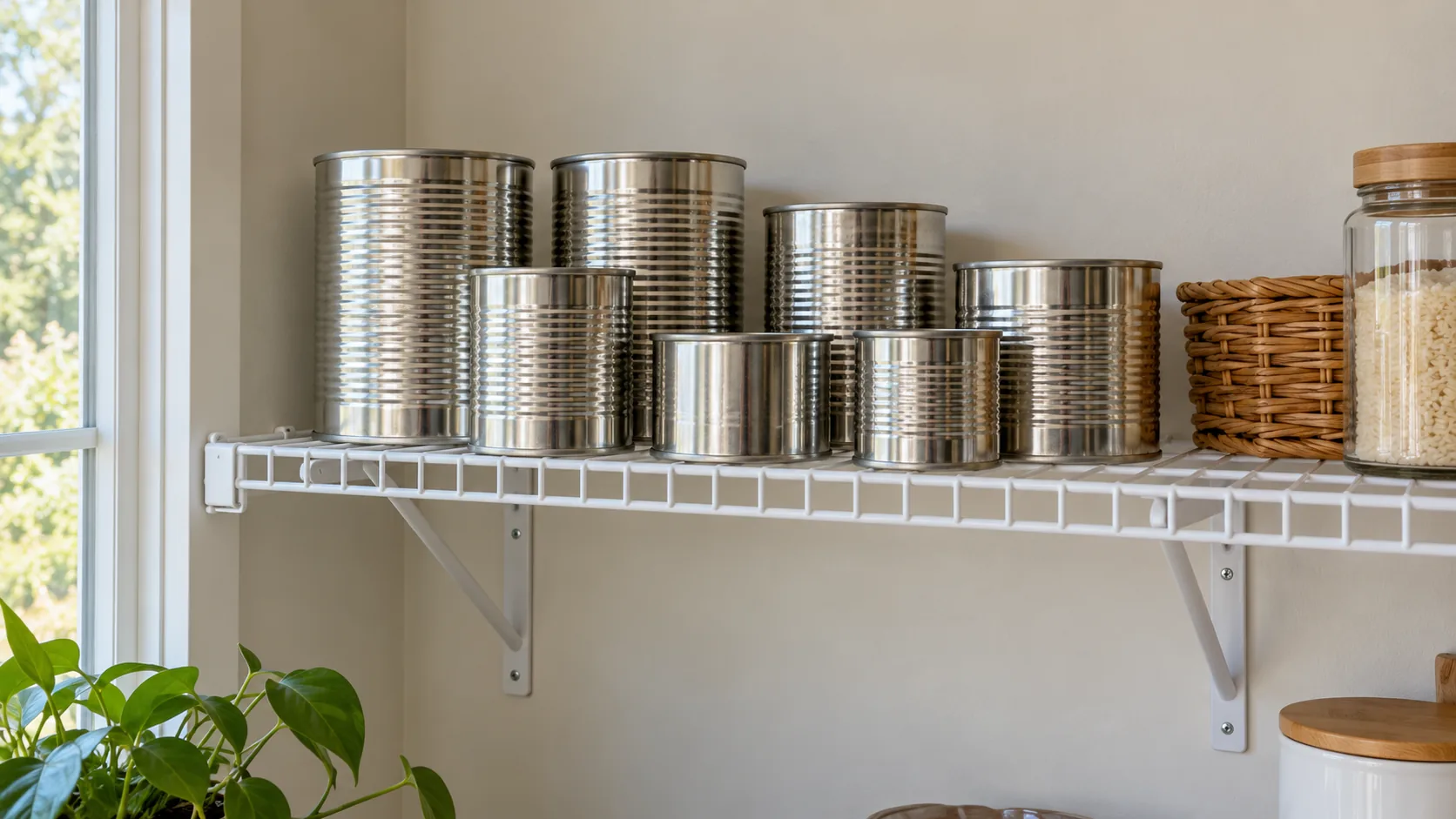
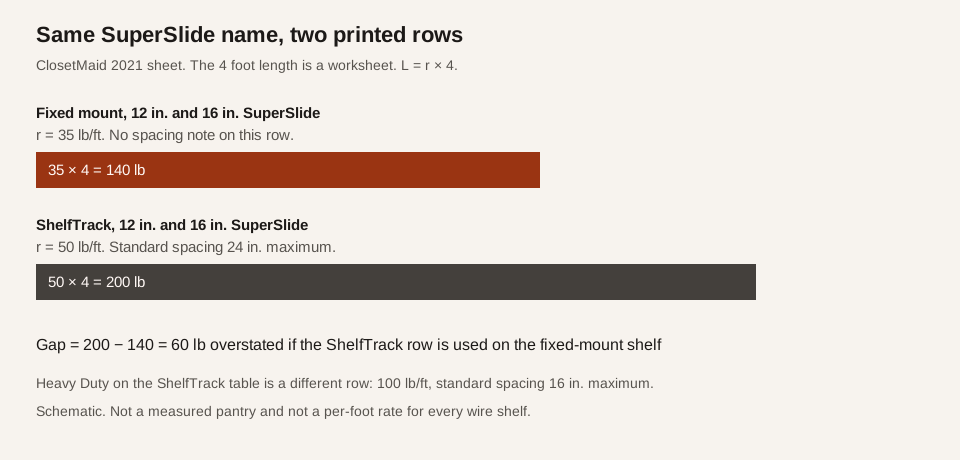
A pantry shelf fails when the load number comes from a different mount than the one on the wall. ClosetMaid’s 2021 sheet prints 35 lb per foot for fixed-mount SuperSlide and 50 lb per foot for ShelfTrack SuperSlide, so one borrowed number overstates the other.
Use the row that names the mount, the shelf, and any spacing the sheet prints. Multiply that per-foot rating by the shelf length. A can rack spends the rating of the foot it covers. A freestanding Metro shelf is rated per shelf, inside a length band, and the unit has a separate cap.
Shelf depth and the gap above a jar are a different measurement, on the pantry cabinet page. This page is only the load.
Which printed row matches the shelf?
The sheets below were retrieved on 20 October 2026. A row applies to the product and the installation it names.
Scroll horizontally to see all columns.
| What is on the wall | Printed load, retrieved 20 October 2026 | Dominant failure mode and prevention |
|---|---|---|
| ClosetMaid fixed mount, 12 in. and 16 in. Shelf and Rod, or the same sizes in SuperSlide, or 16 in. Close Mesh and Linen | 35 lb/ft. The sheet calls these safe weight loads when ClosetMaid hardware is installed in 1/2 in. or 5/8 in. drywall. | Reading the ShelfTrack 50 onto this table. The fixed-mount SuperSlide row is 35, and this table prints no spacing note. |
| ClosetMaid fixed mount, 20 in. Close Mesh and Linen | 25 lb/ft, on the same fixed-mount conditions. | Treating a wider shelf as a higher per-foot rating. On this table the 20 in. row is lower than the 16 in. close-mesh row. |
| ClosetMaid ShelfTrack, 12 in. and 16 in. SuperSlide | 50 lb/ft, standard spacing 24 in. maximum. | Using 50 where the supports are farther apart than 24 in., or where the mount is the fixed-mount bracket instead of ShelfTrack. |
| ClosetMaid ShelfTrack, Heavy Duty Shelving | 100 lb/ft, standard spacing 16 in. maximum. | Putting 100 on the SuperSlide row. Heavy Duty is a separate line, and its spacing note is tighter. |
| Organized Living Shelftech | Maximum loading 45 lb per linear foot of shelf, in the Shelftech specification’s performance criteria. | Substituting the Lifetime page’s 75. The product page states 75 lb per linear foot for Lifetime, which is a different system. |
| Metro Super Erecta Pro | Evenly distributed: 800 lb per shelf for lengths 24 in. to 48 in.; 600 lb per shelf for 54 in. or longer; 2,000 lb maximum per unit. Copyright 2020 sheet. | Dividing 800 by the shelf length and calling the result a pantry per-foot rating. The sheet states a per-shelf figure for a length band. |
ClosetMaid’s fixed-mount paragraph ties the safe-load wording to ClosetMaid hardware and to 1/2 in. or 5/8 in. drywall. The ShelfTrack section lists hang-track fastening for drywall, studs, and concrete. Those are installation conditions on that sheet, not a rating for a wood cabinet shelf or for another brand’s brackets.
How much does the length add?
For a sheet that prints pounds per foot:
L = r × S
L is the load in pounds, r is the per-foot rating from the matching row, and S is the shelf length in feet.
Worksheet length: S = 4. That length is assumed so the arithmetic can be checked. It is not a shelf length ClosetMaid prints.
ShelfTrack, 12 in. and 16 in. SuperSlide, with the sheet’s standard spacing of 24 in. maximum:
L = 50 × 4 = 200 lb
The fixed-mount row for 12 in. and 16 in. SuperSlide, on a shelf of that same worksheet length:
L = 35 × 4 = 140 lb
Using the ShelfTrack 50 on the fixed-mount shelf overstates the printed load by
200 − 140 = 60 lb
The Heavy Duty row is not a substitute. It prints 100 lb/ft and standard spacing of 16 in. maximum. If the supports are 24 in. apart, that is the SuperSlide spacing note, not the Heavy Duty note.
What a can organizer spends
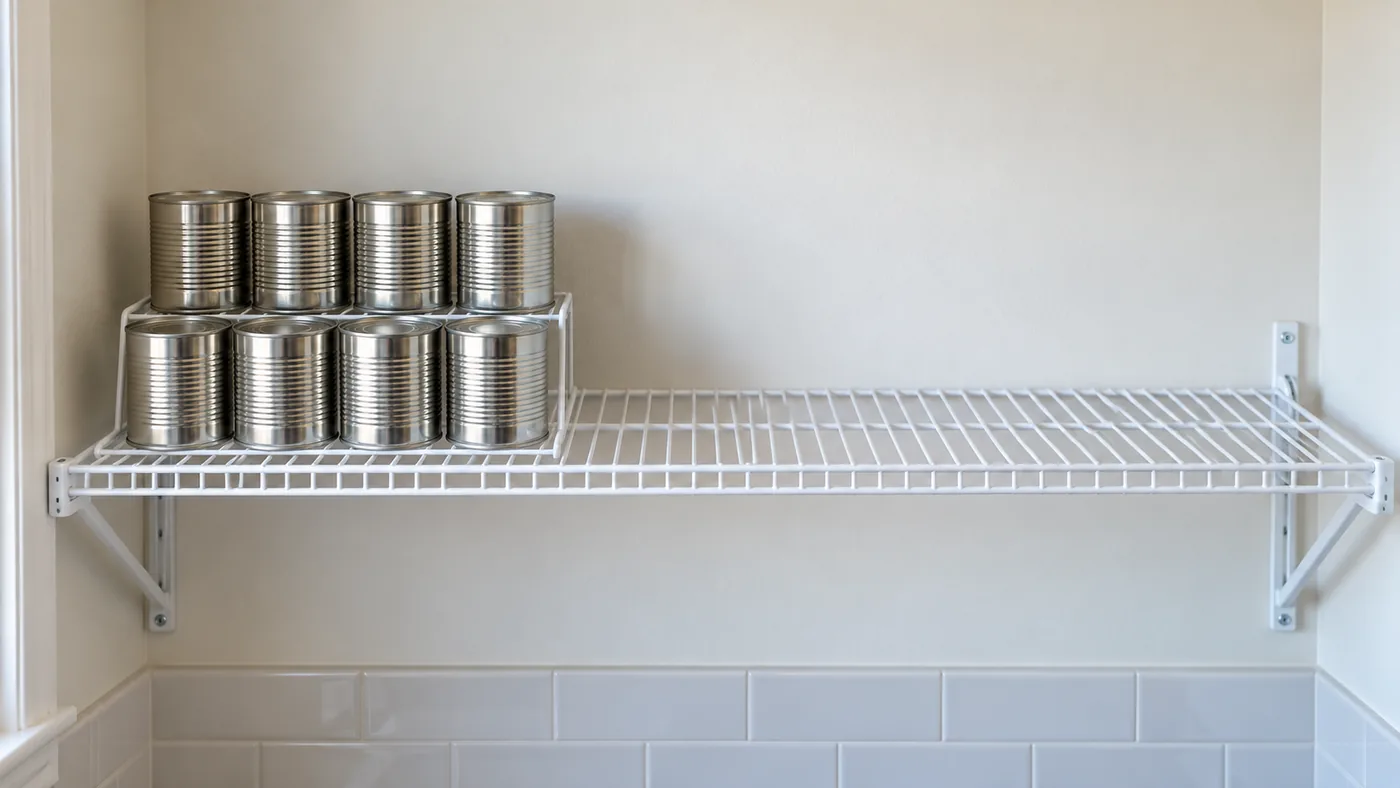
A rack that occupies one foot of the shelf spends that foot. It does not get to use the empty length beside it. On the ShelfTrack SuperSlide row above, one foot at the stated spacing is 50 lb, not the 200 lb of the whole 4 foot worksheet shelf.
The ounces on a food label are the contents. They leave out the can.
Contents in pounds = net ounces / 16
A label that reads 15 oz is 15 / 16 = 0.9375 lb of contents. The can is still sitting on the wire. Weigh one full can and call that scale reading w pounds.
Cans on that foot = r / w, dropping any remainder.
Worksheet scale reading: w = 1.25 lb. That reading is assumed. It is not a can specification. For the ShelfTrack SuperSlide foot, r = 50:
50 / 1.25 = 40 cans, and 40 × 1.25 = 50 lb.
Those 40 cans meet one foot. They do not authorize another 40 on the next foot unless that foot is the same rated shelf and the cans are actually there. Stacking the same cans higher on a shorter rack still has to fit inside the one-foot figure.
Why a freestanding unit does not convert to per foot
The Metro Super Erecta Pro sheet states evenly distributed loads: 800 lb per shelf for lengths of 24 in. to 48 in., 600 lb per shelf for 54 in. or longer, and 2,000 lb maximum per unit.
A shelf of 36 in. sits inside the 24 in. to 48 in. band, so the printed shelf figure is 800 lb. Dividing 800 by 4 feet and multiplying by 3 feet produces 600. That rate is not on the sheet.
The unit cap is separate. Three shelves each taken to the 800 lb figure would be
3 × 800 = 2,400 lb
which is 2,400 − 2,000 = 400 lb over the printed unit maximum. Two shelves at 800 lb are 1,600 lb, still under 2,000. The per-shelf number does not stack without the unit number.
Organized Living’s Lifetime page states 75 lb per linear foot for that fixed wire system. Its Shelftech specification states a maximum of 45 lb per linear foot of shelf. Neither figure replaces a ClosetMaid row, and the pages retrieved on 20 October 2026 do not print the support spacing ClosetMaid prints beside 50 and 100.
Rules of thumb
If the bracket is ClosetMaid fixed-mount SuperSlide in the 12 in. or 16 in. row, the 2021 sheet prints 35 lb/ft. The 50 belongs to ShelfTrack. If the supports are farther apart than the spacing printed on the row, that row does not apply: 24 in. maximum on ShelfTrack SuperSlide, 16 in. maximum on ShelfTrack Heavy Duty. If the cans sit in a rack about one foot wide, start from one foot of r and a full can on a scale. If the sheet says per shelf and names a length band, keep the band. Do not divide it into a per-foot rate. If more than one shelf could each reach its own number, add them and compare the total with the unit cap before treating every shelf as fully available.
A load rating says nothing about how long the food keeps. Storage time stays on the package and on the food-storage hub. Where the cans sit so the labels stay readable is the pantry organization guide.
Common questions
Does every pantry shelf hold 30 to 50 pounds per foot?
No. On the ClosetMaid 2021 sheet the fixed-mount rows are 25 or 35 lb/ft, and the ShelfTrack rows are 50 or 100 lb/ft with different spacing notes. Organized Living prints 45 for Shelftech and states 75 for Lifetime. Metro prints per-shelf figures, not a per-foot pantry number.
Can the net ounces on a can be used as its shelf weight?
No. Net ounces convert to contents: divide by 16. A 15 oz label is 0.9375 lb of contents and does not include the can. The shelf feels the full can, which is a scale reading.
Does a higher number from another brand raise this shelf’s rating?
No. The higher number belongs to the product in that sentence. ShelfTrack Heavy Duty at 100 lb/ft does not raise fixed-mount SuperSlide, and an 800 lb Metro shelf does not raise a wall-mounted wire shelf.
Methods and sources
The ClosetMaid figures are the 2021 Ventilated Wire Shelving weight-capacity sheet. The Metro figures are the Super Erecta Pro specification sheet, copyright 2020, including the evenly distributed wording and the 2,000 lb unit maximum. Shelftech’s 45 lb per linear foot is the maximum loading in that specification’s performance criteria. Lifetime’s 75 lb per linear foot is the ventilated-wire product page. All four were retrieved on 20 October 2026. The 4 foot shelf, the 36 inch Metro example’s place inside the printed band, the 15 oz label, and the 1.25 lb scale reading are worksheet arithmetic. The 36 inch length is inside the band the sheet already rates; it is not an extra Metro capacity.
- ClosetMaid ventilated wire shelving weight-capacity sheet (PDF)
- Metro Super Erecta Pro specification sheet (PDF)
- Organized Living Shelftech specification (PDF)
- Organized Living ventilated wire systems
Explore more in Food Storage & Freezer Guides.
Official guidance and sources
Sources last checked October 20, 2026.
- Ventilated Wire Shelving — Weight Capacity Specification Information , ClosetMaid Professional Services, The Ames Companies (accessed October 20, 2026) 2021 sheet. Fixed-mount and ShelfTrack tables are different rows.
- Super Erecta Pro Starter and Add-on Units specification sheet , InterMetro Industries Corporation (accessed October 20, 2026) Copyright 2020. Per-shelf figures for evenly distributed loads, plus a unit maximum.
- Shelftech 3-part specification, section 105700 , Organized Living (accessed October 20, 2026) Performance criteria state maximum loading of 45 lb per linear foot of shelf.
- Ventilated wire shelving systems , Organized Living (accessed October 20, 2026) Product page states 75 lb per linear foot for the Lifetime fixed wire system.