
Oxygen Absorbers Capacity Calculation: Headspace Air Volume, Void Fraction & CC Rating Matching
Calculate oxygen absorbers capacity from headspace and void space, compare manufacturer sizing charts, and check handling and oxygen indicator rules.
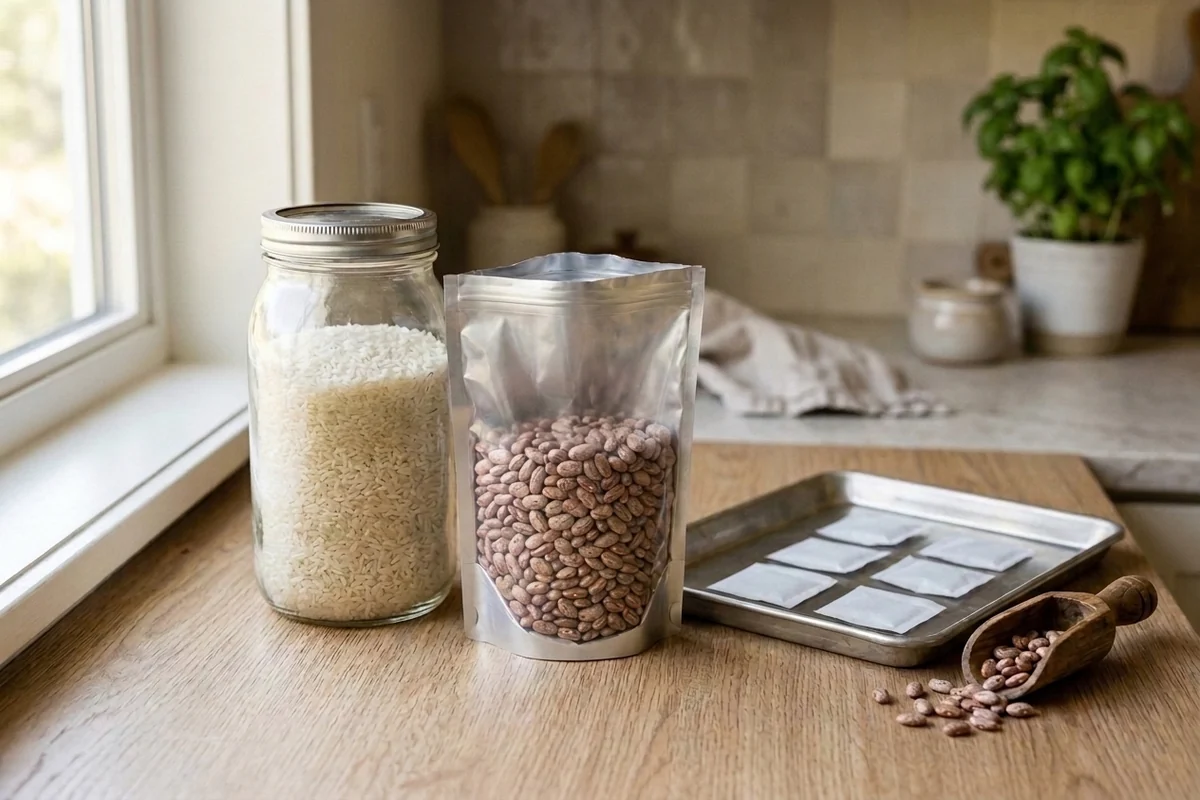
Oxygen absorber nominal capacity ratings (such as 300 cc) specify the cubic centimeters of oxygen they absorb, not the total container volume; one milliliter (ml) equals one cubic centimeter (cc). Atmospheric air consists of approximately 78% nitrogen, 21% oxygen, and 1% other gases; after an oxygen absorber removes the oxygen inside a sealed container, the remaining gas is 99% pure nitrogen in a partial vacuum.
Normal air is approximately 21 percent oxygen (O2); oxygen absorbers can reduce oxygen levels inside high-barrier packaging (such as metal cans or Mylar-style metal foil-plastic bags) to less than 0.01 percent, and maintaining oxygen below 1 percent eliminates weevils, moths, and flour beetles.
Use the sections below to calculate residual air volume, compare published manufacturer and extension sizing charts, and check packet handling and indicator rules. For more kitchen preservation guides, visit our food storage hub or compare active gas flushing in nitrogen flushing in coffee packaging.
How to calculate residual air volume and required absorber capacity
Total residual air volume inside a filled container equals the sum of top headspace volume plus interstitial voidspace volume between food particles: (x) cc Headspace + (x) cc Voidspace = Residual Air Volume. IMPAK reference empty container volumes are 3,980 cc for a #10 can, 18,942 cc for a 5-gallon plastic pail, and 22,730.4 cc for a 6-gallon plastic pail.
AGM Container Controls’ standard volume conversions for O-Buster sizing are: 1 oz. = 30 cc, 1 liter = 1000 cc, 1 pt. = 473 cc, 1 qt. = 946 cc, 1 gallon = 3785 cc, 1 cu. in. = 16.4 cc, and 1 cu. ft. = 28,300 cc. IMPAK’s unit conversion factors for oxygen absorber calculations are: inches to centimeters multiply by 2.54; square inches to square centimeters multiply by 6.54; cubic inches to cubic centimeters multiply by 16.387; fluid ounces to milliliters multiply by 29.57; and weight ounces to grams multiply by 28.35.
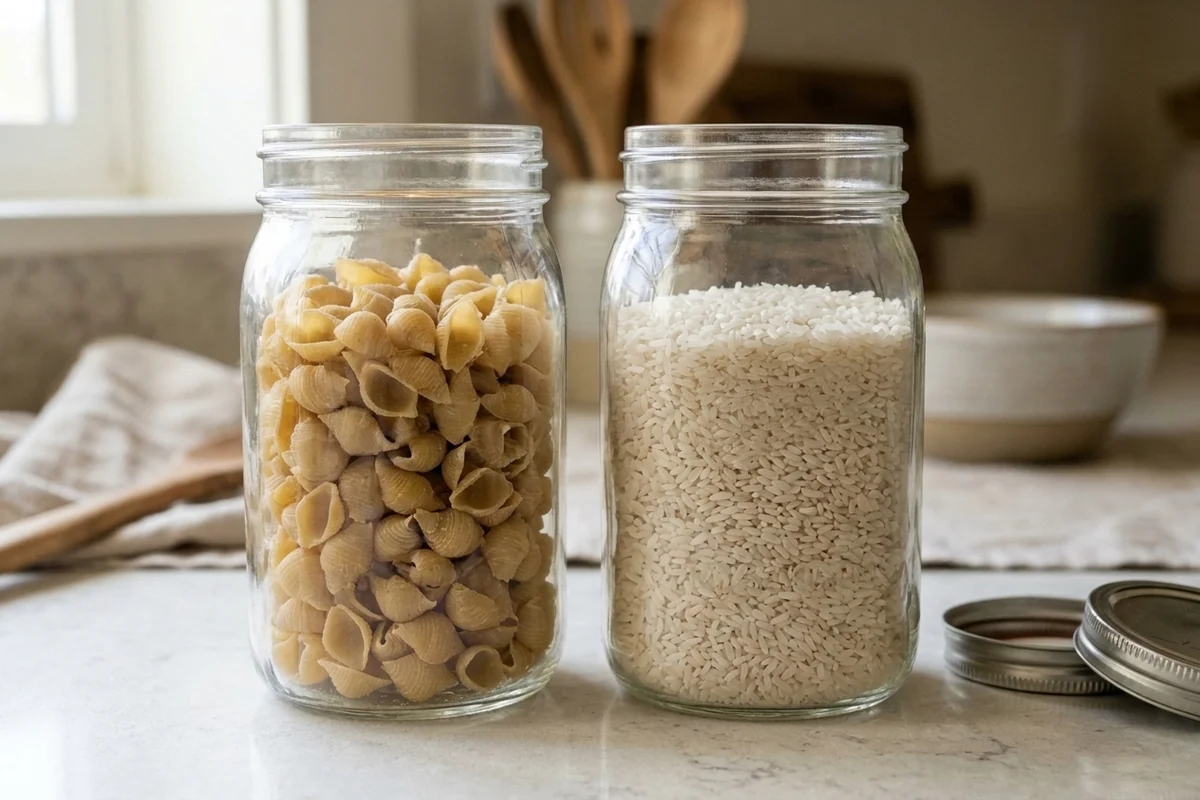
Headspace and void-fraction worked examples
In a #10 can (3,980 cc total volume) filled to 90% of its volume, the remaining 398 cubic centimeters of headspace contains 81.6 cubic centimeters of oxygen (0.21 x 398 = 81.6) because air is 21.0% oxygen. In a five-gallon pail (18,942 cc) filled with spherical marbles where void spaces and headspace represent 38% of the container volume, the residual air volume is 7,197.96 cc (0.38 x 18,942 cc), of which 21.0% is oxygen.
Rigid-container weight-subtraction method
Under IMPAK’s weight-subtraction method, residual air volume in cc is found by subtracting the net gram weight of the food from the container volume in cc, and multiplying by .21 yields the cc volume of oxygen. In IMPAK’s worked 5-gallon rice example, a 5-gallon plastic bucket (18,942 cc) holding 35 pounds (15,876 grams) of rice leaves 3,066 cc of residual air volume (18,942 - 15,876) and 628.53 cc of oxygen volume (3,066 x .21), for which a 750 cc oxygen absorber is sufficient.
Irregular flexible Mylar bags: water-displacement check
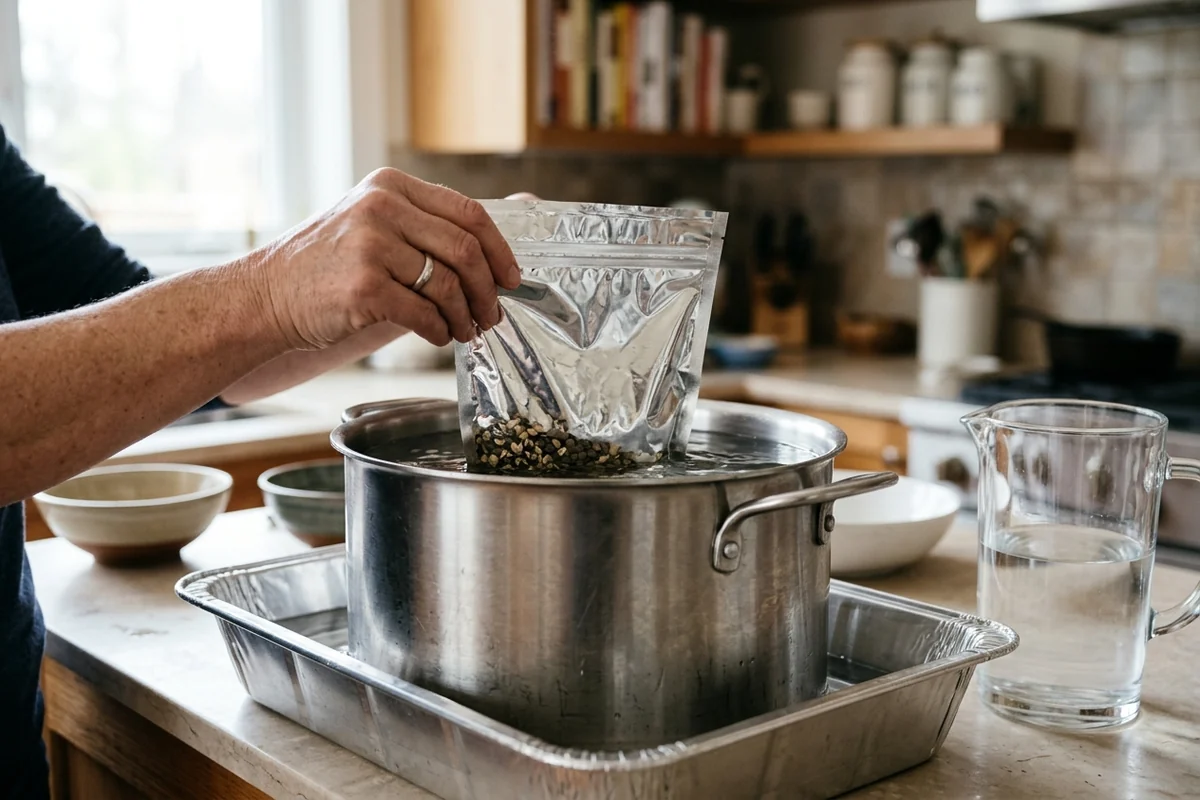
For irregular flexible Mylar bags, IMPAK specifies assuming a product specific gravity of 1, submerging the filled sealed container in a water-filled vessel to let water overflow, measuring the milliliters (ml) of water required to refill the vessel (where 29.57 ml = 1 fl oz and 1 ml = 1 cc), and comparing against the product weight in grams (28.35 g = 1 oz).
Manufacturer and extension oxygen absorber size charts
Compare the published sizing charts below by container volume, void-space fraction, and bag dimensions. For pouch film construction and heat-sealing checks, see our Mylar bags guide.
| Published source or sizing chart | Published sizing and capacity details |
|---|---|
| AGM Container Controls void-fraction chart | AGM Container Controls' O-Buster sizing chart differentiates absorber capacity by container void fraction (under 10% void space vs 25% or more void space): Pint = 20 cc (FT-20) vs 50 cc (FT-50); Quart/Liter = 50 cc (FT-50) vs 100 cc (FT-100); 1 Gallon = 100 cc (FT-100) vs 300 cc (FT-300); 5-6 Gallons = 500 cc (FT-500) vs 750 cc (FT-750). |
| Utah State University Extension container guide | Utah State University Extension states that oxygen absorber packets usually come in 100 cc, 300 cc, or 500 cc sizes: typically one 100 cc packet is used for pint or quart jars and small foil bags of the same size; one-gallon foil-lined bags or No. 10 cans may need the 300 cc size; and five-gallon buckets use 500 cc (either one 500 cc pack or five 100 cc packs). |
| Church home-storage guide | The Church of Jesus Christ of Latter-day Saints home storage guide specifies one 300 cc oxygen absorber packet for properly packaged dry food in containers up to 1-gallon capacity (4 liters), where a 1-gallon foil pouch holds 7 pounds (3.2 kilograms) of wheat, 6.8 pounds (3.1 kilograms) of white rice, or 5 pounds (2.3 kilograms) of dry milk. |
IMPAK StayFresh Mylar bag sizing chart
- IMPAK’s StayFresh Mylar bag sizing chart lists higher recommended oxygen absorber cc ratings for less dense foods (pasta, popcorn, etc.) than for fine grains (sugar, flour, etc.) across small to mid-size bags: 6” x 6” uses 20cc vs 50cc; 8” x 8” uses 50cc vs 100cc; 10” x 14” uses 100cc vs 200cc; and 10” x 16” uses 150cc vs 300cc.
- For large Mylar bags, IMPAK’s StayFresh sizing chart specifies 500cc (fine grains) vs 1000cc (less dense foods) for 16” x 18” bags, 750cc vs 1500cc for 18” x 28” and 20” x 24” bags, and 1000cc vs 2000cc for 20” x 30” bags.
Utah State University Extension specifies that a No. 10 can holds about 5.7 lbs (2.6 kgs) of polished or brown rice and recommends food-safe oxygen absorbers in No. 10 cans, Mylar-type bags, glass jars, or food-safe PETE containers to preserve rice quality and protect from insect infestation. In insect control using oxygen absorbers, Utah State University Extension states that the internal oxygen concentration must be lowered to below 1 percent and held there for at least 12 days to kill insects in all life stages (using 100 cc packets for pints/quarts, 300 cc for 1-gallon containers, and 500 cc for 5-gallon containers).
Container barrier limits, long-term permeation, and food safety rules
Oxygen permeability, heat seals, and plastic bucket limits
To maintain an oxygen-free container over a target storage period, Mitsubishi Gas Chemical specifies selecting an oxygen absorber size corresponding to the total of the initial amount of oxygen enclosed in the packaging container plus the amount of oxygen permeating the packaging container within the storage period. Mitsubishi Gas Chemical recommends packaging films and containers with an oxygen permeability of 20 ml/m2 atm/24 hours or less and a heat-seal width of 10 mm or more, warning that HDPE or PP containers may not provide a sufficient oxygen barrier.
Daniel and Lambert (Getty Conservation Institute / WAAC) define the oxygen absorption rate parameter (‘absorbance’ C) as the Ageless capacity in liters divided by the enclosure volume in liters, and model equilibrium oxygen concentration in a leaking enclosure as [O2] = L / 12.7 C, where L is the leak rate in ppm per day. Penn State Extension states that Mylar bags (multilayer, metalized, sealable bags) block out air and light during freeze-dried food storage, but must be used with a properly sized single-use oxygen absorber and heat-sealed with an impulse sealer, whereas vacuum packaging in plastic bags is limited to midterm storage (about two to three years) because water and oxygen pass through plastic.
Utah State University Extension notes that plastic buckets will permit oxygen to penetrate over time, so oxygen absorbers will kill insects but over time will not prevent food oxidation. The Church of Jesus Christ of Latter-day Saints storage guide notes that oxygen absorbers are effective for insect control in metal cans and foil pouches, whereas oxygen absorbers have not been found effective for insect treatment in food-grade plastic buckets.
Compare gasketed closures with active air extraction in our airtight vs vacuum-sealed storage guide.
Moisture threshold, botulism prevention, and hand-warmer exclusions
Foods packaged with oxygen absorbers must be dry (about 10 percent or less moisture content) and low in oil; using oxygen absorbers with moist products above 10 percent moisture may result in botulism poisoning. Utah State University Extension warns that vacuum sealing high-moisture foods and subsequent storage at room temperature can lead to deadly foodborne illnesses like botulism, so emergency vacuum packaging should be confined to dried foods with less than 10 percent residual moisture.
Mitsubishi Gas Chemical’s Precautions for Use warns that while AGELESS oxygen absorbers are effective in inhibiting aerobic microorganisms such as molds, they are not effective in inhibiting the growth of biased anaerobic bacteria, microaerophilic bacteria, or yeasts. Utah State University Extension warns against using chemical hand warmers as DIY substitutes for food-grade oxygen absorbers because hand warmers are not manufactured or rated for food-package oxygen scavenging.
Reaction kinetics, open-air exposure windows, and storing leftover packets
Iron oxidation chemistry and relative humidity effects
Standard iron-based oxygen absorbers use a mixture of iron powder, sodium (which acts as a catalyst so the iron powder can rust even below the normal 65% relative humidity threshold), and activated carbon (which adsorbs gases and odors), reducing internal oxygen to approximately 0.01%. Daniel and Lambert (Getty Conservation Institute / WAAC) report that Mitsubishi recommends a minimum relative humidity of 55% RH for Ageless-Z, and that at 33% RH the oxygen reaction rate remained constant for four months before dropping to one-seventh of that rate by one year; laying packets flat on a floor rather than elevating them on a wire support exposed on both sides reduced reaction rate by 20%.
Open-air exposure clock and leftover packet storage
Before opening a factory master bag of AGELESS oxygen absorbers, Mitsubishi Gas Chemical specifies hanging the vacuum-packaged outer bag from one end to confirm that the packets do not drop to the bottom (which indicates a pinhole and loss of vacuum). Daniel and Lambert (Getty Conservation Institute / WAAC) report that exposing Ageless-Z packets to room air for more than ten minutes triggers exothermic warming and causes a loss of 0.02% of the oxygen-absorbing capacity per minute.
Iron-based oxygen absorber packets contain iron powder or filings (plus activated charcoal and salt); Utah State University Extension notes that once opened, the packets begin absorbing oxygen in 20 minutes, may be spent in approximately 5 hours, and cannot be reused. Mitsubishi Gas Chemical warns that AGELESS generates heat during oxygen absorption, so packets must not be stacked on top of each other while exposed to air after opening the outer bag (which traps heat and raises temperature) and must never be microwaved.
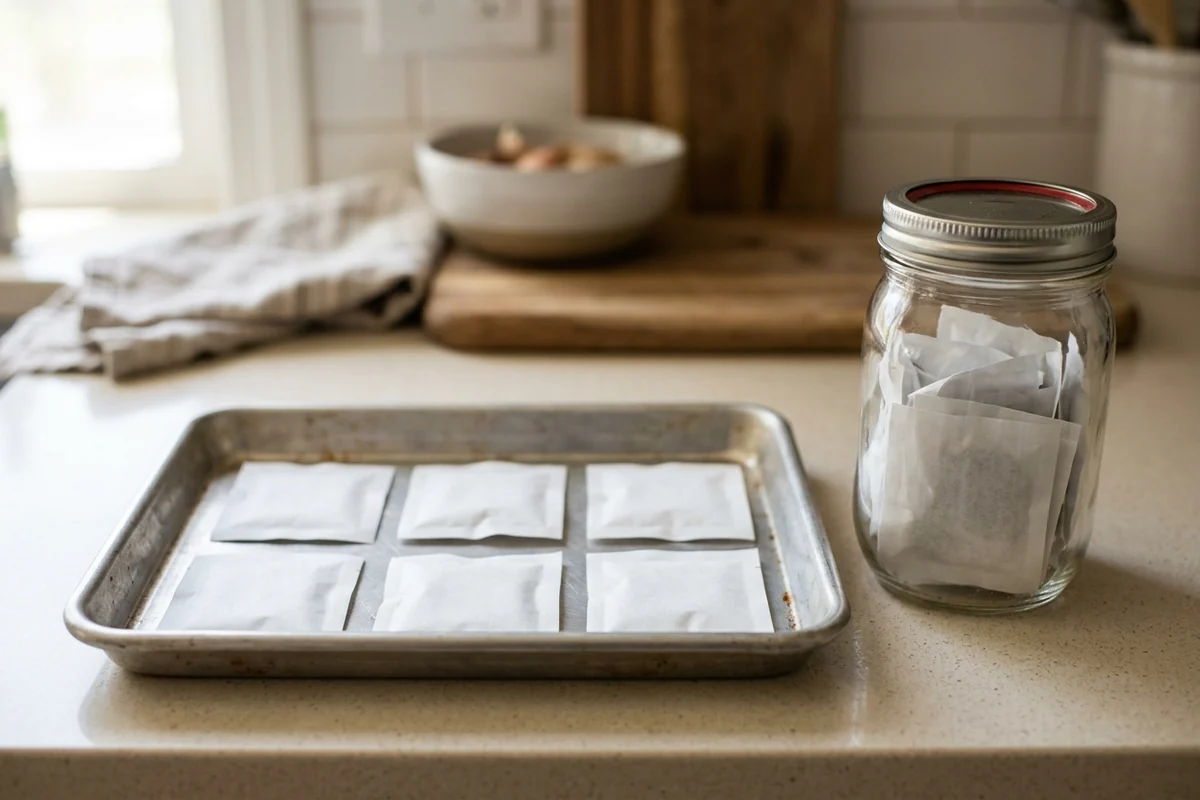
IMPAK’s handling protocol instructs users to prepare a clean, small sealable jar for unused absorbers before opening the master bag, place unused absorbers into the jar and tighten the lid immediately, and seal the prepared food containers within 30 minutes. The Church of Jesus Christ of Latter-day Saints storage guide advises removing only the number of absorber packets needed for the next 20 to 30 minutes of packing, spreading them out on a tray, and never storing absorbers in ziplock bags. A 1-pint (500 milliliters) glass canning jar with a gasketed metal lid holds 25 oxygen absorber packets for resealing between uses.
Oxygen indicator color thresholds and response times
Review the published oxygen indicator specifications below for color thresholds, transition speeds, and storage conditions:
| Published indicator specification | Thresholds, response times, and handling rules |
|---|---|
| Mitsubishi Gas Chemical AGELESS EYE color thresholds | Mitsubishi Gas Chemical's AGELESS EYE oxygen indicator visually confirms an oxygen-free state by turning pink at an oxygen concentration of 0.1% or less and turning blue at 0.5% or more. |
| Mitsubishi Gas Chemical AGELESS EYE reaction and storage rules | At 25±2 degrees C, Mitsubishi Gas Chemical's AGELESS EYE-LS indicator transitions from blue to pink within 24 hours (and EYE-LM transitions within 30 hours), requires application within 12 hours under 500 lux or below light, and must be stored in a dark refrigerator below 15°C (6 months guarantee period). |
| Dry Pak Industries reversible indicator thresholds | Dry Pak Industries' reversible oxygen indicators indicate the lack of oxygen (less than 0.01%) by turning pink, and turn purple at an oxygen level of 0.5% or greater. |
| Dry Pak Industries reversible indicator reaction times | Dry Pak Industries specifies that the presence of oxygen is indicated in five minutes or less (pink to purple), whereas the change from purple back to pink may take three hours or more. |
Mitsubishi Gas Chemical states that AGELESS-EYE indicators cannot be reused because their discoloration performance gradually decreases, and requires confirming that AGELESS EYE shows pink against a white background before the outer bag is opened.
Frequently asked questions
What does the nominal rating on an oxygen absorber packet measure?
Oxygen absorber nominal capacity ratings (such as 300 cc) specify the cubic centimeters of oxygen they absorb, not the total container volume; one milliliter (ml) equals one cubic centimeter (cc).
Why must foods packaged with oxygen absorbers be dry and low in oil?
Foods packaged with oxygen absorbers must be dry (about 10 percent or less moisture content) and low in oil; using oxygen absorbers with moist products above 10 percent moisture may result in botulism poisoning.
How should leftover oxygen absorber packets be stored after opening the master bag?
A 1-pint (500 milliliters) glass canning jar with a gasketed metal lid holds 25 oxygen absorber packets for resealing between uses.
Continue with our food packaging guides or return to the food storage guide.
Explore more in Food Storage & Freezer Guides.
Official guidance and sources
Sources last checked October 30, 2026.
- IMPAK / Sorbent Systems — Oxygen Absorbers: Measuring Volume of Oxygen
- Utah State University Extension — How Can I Get the Most Out of My Food Storage
- Utah State University Extension — A Guide to Food Storage for Emergencies (Oxygen Removal)
- AGM Container Controls — O-Buster Oxygen Absorbers
- The Church of Jesus Christ of Latter-day Saints — Long-Term Food and Water Storage
- IMPAK / Sorbent Systems — StayFresh Oxygen Absorbers Overview & Bag Sizing Chart
- Utah State University Extension — Packaging Foods
- Utah State University Extension — A Guide to Food Storage for Emergencies (Insect Treatments)
- Mitsubishi Gas Chemical — Oxygen Absorbers & AGELESS EYE Technical Brochure
- Mitsubishi Gas Chemical — AGELESS and AGELESS EYE Precautions for Use
- WAAC Newsletter (Daniel & Lambert, Getty Conservation Institute) — Ageless Oxygen Scavenger: Practical Applications
- Penn State Extension — Let's Preserve: Freeze-Drying
- IMPAK Corporation — All About Oxygen Absorbers
- IMPAK / Sorbent Systems — How to Use Oxygen Absorbers
- Dry Pak Industries — Oxygen Absorbers & Oxygen Indicators