
Dehydrating Food Guide: Water Activity Reduction, Case Hardening Prevention & Conditioning Checks
Review how dehydrating food lowers water activity to inhibit spoilage, how temperature and airflow prevent case hardening, and how jar conditioning checks residual moisture.
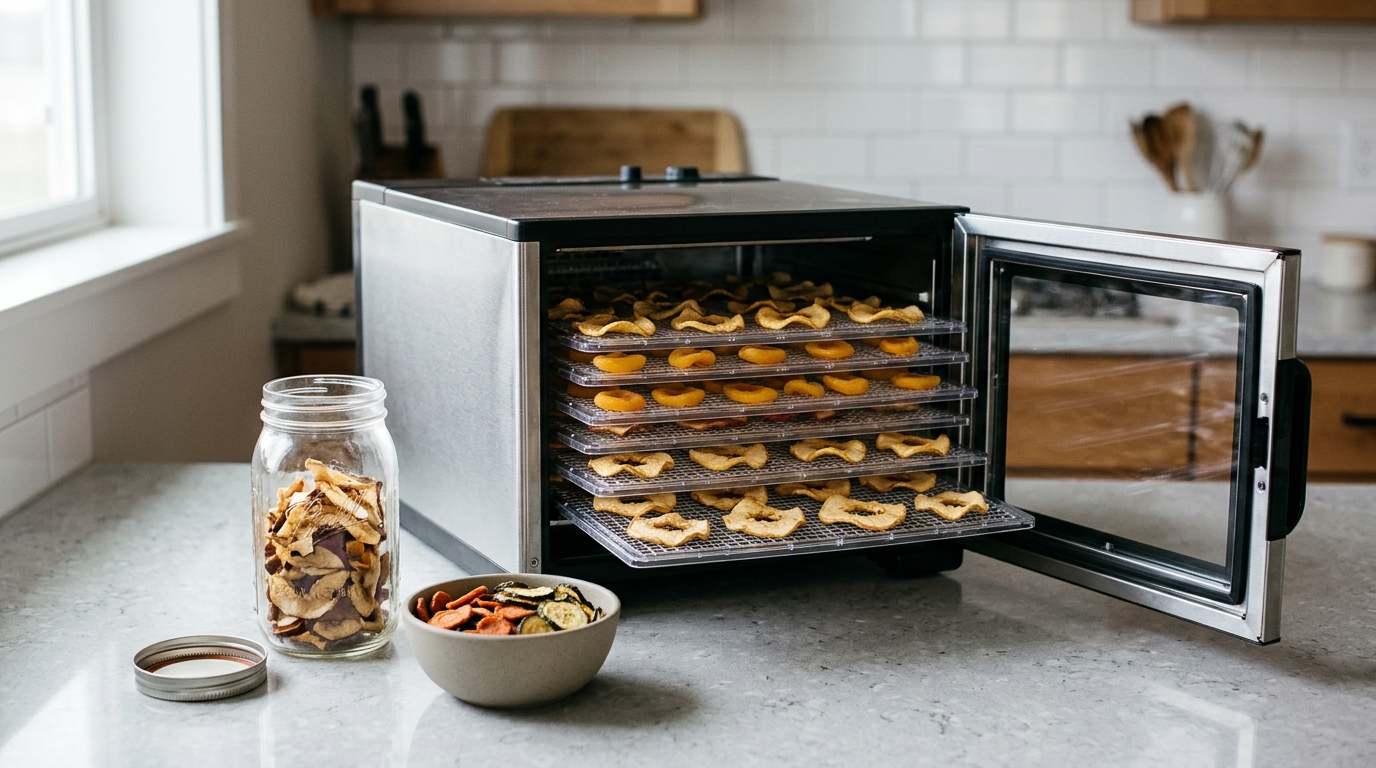
Drying removes moisture from food so that bacteria, yeasts, and molds are less likely to grow, but drying does not effectively destroy disease-causing microorganisms; for surface sanitation, use a disinfecting solution of 1 1/2 teaspoons of chlorine bleach to 1 pint of water and let sit one minute before wiping.
Under 21 CFR § 117.3, water activity (aw) is a measure of the free moisture in a food and is the quotient of the water vapor pressure of the substance divided by the vapor pressure of pure water at the same temperature.
The moisture content of home dried fruit should be about 20 percent, and conditioning is the process used to equalize residual moisture among pieces to reduce the risk of mold growth.
Vegetables should be dried until they are brittle or crisp (some shatter if hit with a hammer); at this stage they should contain about 10 percent moisture and do not need conditioning like fruits.
Use the sections below to compare regulatory water activity definitions, dehydrator airflow and case hardening controls, post-drying jar conditioning steps, and meat jerky heating schedules. For broader pantry organization and container selection, visit our food storage hub or review how dried fruit can pass moisture to crisp oats in storing homemade granola.
How water activity and free moisture govern food dehydration
Statutory definitions and microbial growth boundaries
Under 21 CFR § 117.3, a safe-moisture level is a level of moisture low enough to prevent the growth of undesirable microorganisms in the finished product under the intended conditions of manufacturing, processing, packing, and holding, and is related to its water activity (aw).
The water activity (aw) of a food is the ratio between the vapor pressure of the food itself, when in a completely undisturbed balance with the surrounding air media, and the vapor pressure of distilled water under identical conditions; a water activity of 0.80 means the vapor pressure is 80 percent of that of pure water.
Water activity is equal to equilibrium relative humidity divided by 100 (aw = ERH/100), where ERH is the equilibrium relative humidity (%).
Most foods have a water activity above 0.95, which provides sufficient moisture to support the growth of bacteria, yeasts, and mold; if the water activity of food is controlled to 0.85 or less in the finished product, it is not subject to the regulations of 21 CFR Parts 108, 113, and 114.
Under 21 CFR § 113.3(n), low-acid foods are any foods, other than alcoholic beverages, with a finished equilibrium pH greater than 4.6 and a water activity (aw) greater than 0.85, excluding tomatoes and tomato products having a finished equilibrium pH less than 4.7.
Under 21 CFR 113.3(e)(1)(ii), commercial sterility can be achieved by the control of water activity and the application of heat, with heat generally necessary at aw levels above 0.85 to destroy vegetative cells of microorganisms of public health significance and spoilage microorganisms.
Total moisture content versus water activity and laboratory testing sensitivity
Compare the regulatory water activity benchmarks, laboratory screening conditions, and total-moisture comparisons in the table below.
| Measurement parameter or food benchmark | Published regulatory finding and condition |
|---|---|
| Total moisture versus water activity comparison | Both peanut butter with 15% total moisture and dry milk with 8% total moisture have a water activity (aw) of 0.70. |
| Common food water activity values | Reported water activity (aw) values of common foods are 0.96 for liverwurst, 0.95 for cheese spread, 0.93 for red bean paste, 0.92 for caviar, 0.83 for fudge sauce and soft moist pet food, 0.82 for salami, and 0.80 for soy sauce. |
| Hygrometer salt-slush screening range | For initial water activity screening using the Abbeon aw-Value Analyzer, salt slushes of sodium chloride, potassium nitrate, and potassium sulfate give a range of water activity at 25 C from 0.758 to 0.969. |
| Headspace temperature sensitivity | Stoloff (1978) states that at 25 C, a 0.1 C difference between the solid or liquid sample and the supernatant air will result in an approximate 0.005 difference in water activity measurement. |
| Thermal drift and botulism growth floor | Allowing the temperature between the sample air interface and the supernatant air to vary by 1 C (approximately 1.8 F) could result in a difference in aw reading of 0.05, and the minimum aw for the growth of C. botulinum is approximately 0.93 (and depending on product characteristics can be as high as 0.96). |
Pathogen survival in dried ingredients
Researchers in the ILSI Europe expert group review noted that although low water activity (aw) inhibits microbial growth, bacterial pathogens (including Bacillus cereus, Clostridium perfringens, pathogenic Escherichia coli, and Salmonella enterica) can survive in dried ingredients for extended periods.
In the ILSI Europe microbial risk framework for dried ingredients, post-harvest decontamination treatments are considered controlled if validated to achieve reductions of at least 5 log colony forming units per gram (cfu/g) of the most resistant surrogate.
Preventing case hardening through temperature, airflow, and pretreatment
How excessive initial heat traps internal moisture
If the drying temperature is too high at first, a hard shell may develop on the outside, trapping moisture on the inside—a condition known as case hardening that leads to a moldy food product—whereas temperatures that are too high at the end of the drying period may cause food to scorch.
In commercial dehydration, Raising the Core Temperature warms the product to 10 to 20 degrees Fahrenheit below the process air temperature, Rapid Dehydration maintains process air humidity at 12 to 18% at the hot end, with humidity at the cooler end potentially reaching 35 to 50%, Transition drives off moisture via cellular capillary action where reduced evaporative cooling increases case hardening risk, and Bake Out often constitutes over half of total drying time.
A preheated dehydrator can initially be set at 145°F (62°C) when surface moisture is on the fruit or vegetable, and reduced after one hour to 135°F (57°C) to 140°F (60°C) to finish drying without case hardening.
General drying temperature guidelines by food type are 125 to 135 degrees F for fruits, 115 to 130 degrees F for vegetables, 155 degrees F for meat/jerky, and 95 to 105 degrees F for herbs.
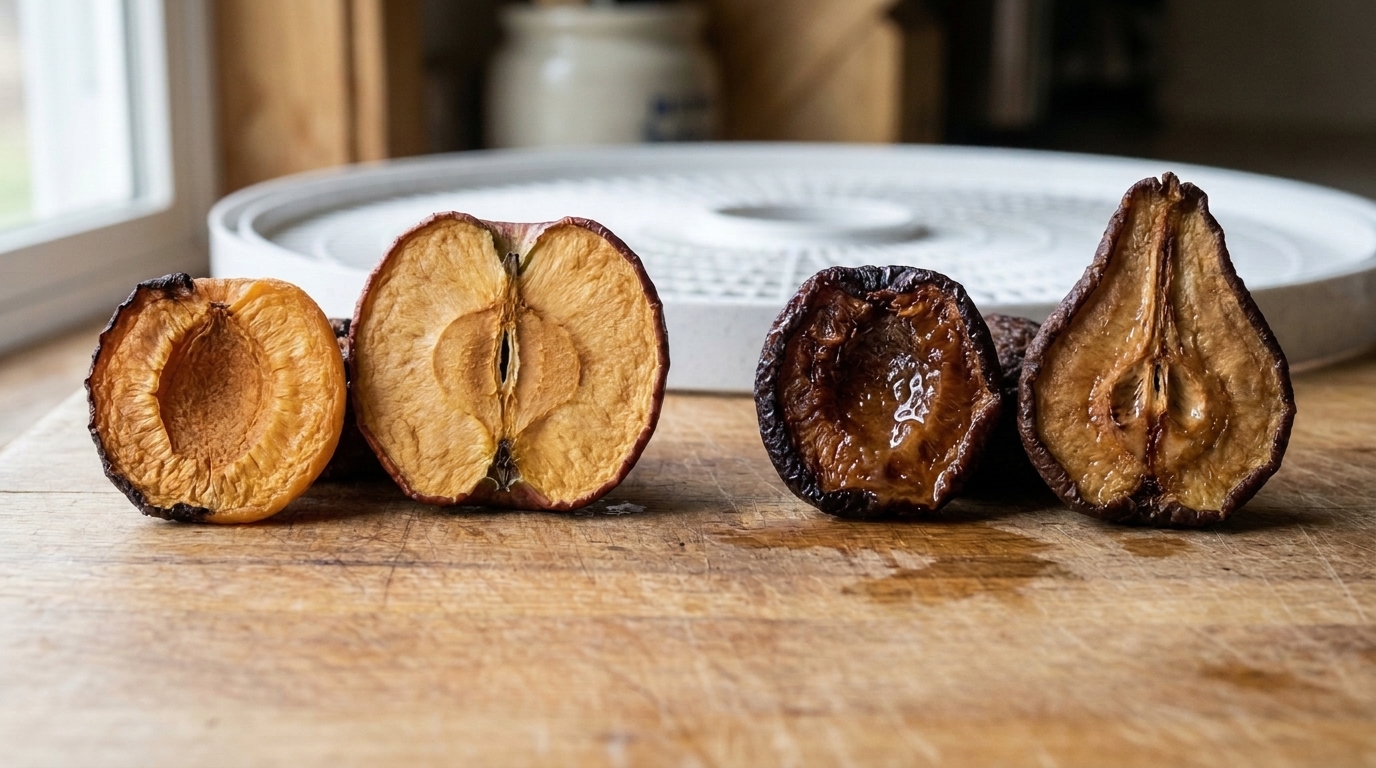
Dehydrator design, airflow orientation, and oven drying clearances
Review the equipment specifications, fan airflow orientations, and oven drying clearances below before loading trays.
| Equipment or drying method | Published design and operating parameters |
|---|---|
| Electric food dehydrator capacity and speed | Electric food dehydrators are efficiently designed to dry foods fast at 140ºF, and twelve square feet of drying space dries about a half-bushel of produce. |
| Recommended household dehydrator construction | Recommended food dehydrator features include double-wall construction of metal or high-grade plastic (wood is not recommended because it is a fire hazard and difficult to clean), an enclosed thermostat from 85ºF to 160ºF, four to 10 open mesh plastic trays, a UL seal of approval, and a one-year guarantee. |
| Horizontal versus vertical airflow geometry | Horizontal air flow dehydrators locate the heating element and fan on the side of the unit (reducing flavor mixing, providing equal heat penetration to all trays, and preventing liquids from dripping into the heating element), whereas vertical air flow dehydrators locate the heating element and fan at the base. |
| Two-speed fan and tray rim height | A dehydrator fan with two speeds is desirable (high speed at the beginning when surface moisture is readily available, and low speed to slowly remove remaining moisture), and tray edges should be a quarter- to a half-inch high. |
| Conventional oven tray spacing and load | An oven takes 2 to 3 times longer to dry food than a dehydrator, holds about 4 to 6 pounds of food, requires trays at least 1 1/2 inches narrower than the inside of the oven with at least 2 1/2 inches between trays and 3 inches of free space at the top, and requires propping the oven door open at least 4 inches while maintaining 140°F (lowering to 120°F toward the end if possible to prevent scorching). |
| Alternative oven door opening range | Oven drying works well if the oven can be set to a temperature of 140°F (60°C) to 150°F (65°C) with the oven door opened 2 inches (5 cm) to 3 inches (7.5 cm) to allow moisture to escape. |
Fruit anti-browning dips, waxy skin crazing, and vegetable blanching
- For pretreating fruit before drying, ascorbic acid is dissolved at 1 tablespoon of powder in 1 quart of cold water, citric acid is dissolved at 1 tablespoon in 1 quart of water, and sodium bisulfate is dissolved at 2 teaspoons of powder in 1 quart of water.
- Cut fruits can be pretreated for 10 minutes in 2 cups of water containing 3 3/4 teaspoons of powdered ascorbic acid or 1/2 teaspoon of powdered citric acid (or equal parts bottled lemon juice and water), while syrup blanching simmers fruit for 10 minutes in 1 cup sugar, 1 cup white corn syrup, and 2 cups water followed by standing for 30 minutes.
- Fruits with a protective wax coating (such as plums, figs, cranberries, blueberries, and grapes) are pretreated by dipping in boiling water for 1 to 2 minutes (‘crazing’), and vegetables (except green peppers, onions, garlic, mushrooms, and okra) must be blanched with hot water or steam before dehydrating.
Post-drying cooling, doneness testing, and jar conditioning checks
Cooling before testing and packaging
Dried foods are susceptible to insect contamination and moisture reabsorption and must first be cooled completely before packaging because warm food causes sweating which could provide enough moisture for mold to grow.
When judging dryness, it is better to overdry than to underdry; when in doubt, continue drying for an additional 15–30 minutes and allow the product to cool before testing.
Sealed-jar conditioning protocols and insect pasteurization
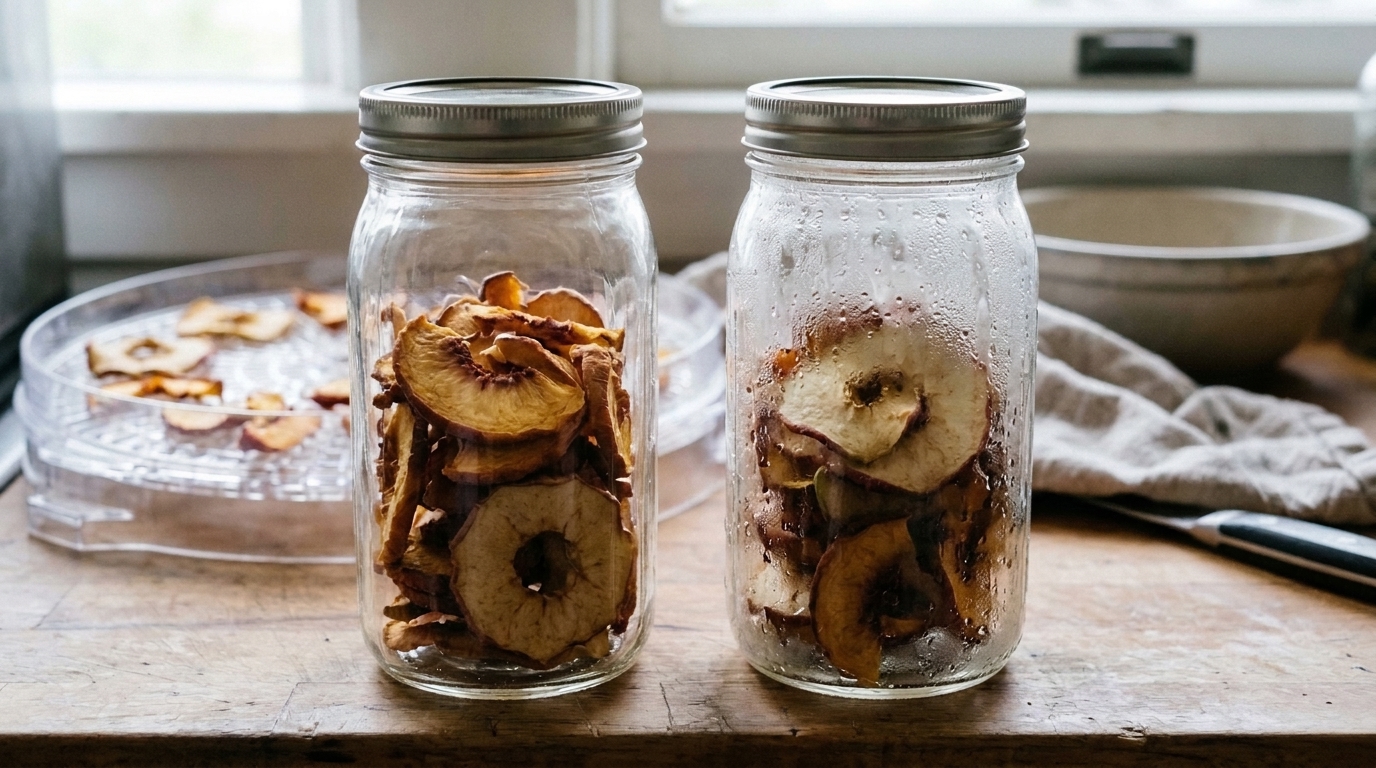
To condition home-dried fruit, pack cooled dried fruit loosely in plastic or glass jars, seal the containers for 7 to 10 days so drier pieces absorb excess moisture, shake the jars daily to separate pieces and check for moisture condensation, and return the fruit to the dehydrator if condensation develops.
To condition dried foods (usually fruits, herbs, and seeds), pour cooled food into a large nonporous food-grade container, cover and shake the container daily or stir contents at least once a day for 10–14 days, and add any freshly dried fruit only within the first five days.
To destroy insect eggs on unpeeled or uncovered dried fruits, heat the dried fruit in an oven at 160°F (71°C) for 30 minutes or chill in a freezer at 0°F or below for 48 hours. For most vegetables before dehydrating, blanching in a solution containing 1/4 teaspoon of citric acid per quart of water is recommended; steam blanching is an option.
For fruit leathers, puree is poured about 1/4 inch (6 mm) thick (2 cups of puree makes one roll for a 13-inch by 15-inch / 33 cm by 38 cm sheet), dried for 6 hours to several days at 140°F (60°C), and kept for up to one month at room temperature or up to one year if frozen.
Meat and poultry jerky heating rules
Follow the published preparation, parasite-freezing, and internal-temperature schedules below when making meat or poultry jerky at home:
- When pork or wild game is used to make jerky, a meat portion 6 inches or less thick should be frozen at 0ºF or below for at least 30 days before slicing and marinating to kill the trichinella parasite, although freezing will not eliminate bacteria from the meat.
- For safe handling of meat and poultry for jerky, wash hands with soap and running water for at least 20 seconds, keep meat and poultry refrigerated at 40ºF or below, and use ground beef and poultry within 2 days or red meats within 3 to 5 days.
- To decrease the risk of foodborne illness (including E. coli O157:H7) from home-dried jerky while preventing case hardening, the internal temperature of the meat must reach 160ºF either by boiling meat strips (sliced no thicker than 1/4 inch) in marinade for 5 minutes before drying at 140ºF, or by heating dried strips (originally cut 1/4 inch thick or less) for 10 minutes in an oven preheated to 275ºF.
- Unheated meat strips dried at 140ºF require 10 to 24 hours until a test piece cracks but does not break when bent (checking samples after 3 hours), and properly dried jerky keeps at room temperature for two weeks in a sealed container.
Comparing food preservation methods, packaging barriers, and storage shelf life
Air drying, sun drying, dehydrofreezing, freeze-drying, and unsafe dry canning
Compare the moisture-removal levels, climate requirements, and safety boundaries across preservation methods in the table below.
| Preservation method or comparison | Published moisture, equipment, and safety details |
|---|---|
| Air drying, dehydrofreezing, and freeze-drying comparison | Fruits dried at home normally have 80 percent of their moisture removed and vegetables 90 percent; dehydrofreezing removes 70 percent of the moisture before freezer storage; and freeze-drying (at -30°F to -50°F, costing $2000 to $10,000 for home machines) removes up to 98 percent of the water with 5% to 15% shrinkage compared to around 80% shrinkage for air drying. |
| Caloric density concentration in dried fruit | Dried foods have more calories on a weight-for-weight basis because of nutrient concentration; 100 grams of fresh apricots has 51 calories, whereas 100 grams of dried apricots has 260 calories. |
| Outdoor sun-drying humidity limit | Foods dried in the sun can take 3–4 days to dry and require constant exposure to direct sunlight during the day and a relative humidity of less than 20%. |
| Outdoor sun-drying temperature and screen materials | Outdoor sun drying of fruits requires a minimum temperature of 85°F and relative humidity below 60 percent, using stainless steel, Teflon-coated fiberglass, or plastic screens while avoiding galvanized hardware cloth (coated with cadmium or zinc), copper screening (which destroys vitamin C and increases oxidation), and aluminum screening. |
| Exclusion of unvalidated dry canning | Canning raw vegetables in canning jars with no added liquid ('dry canning') is a very hazardous practice that carries the risk of fatal botulism (Clostridium botulinum) because bacteria and bacterial spores are more sensitive to wet heat than dry heat and die in hot dry air much more slowly than in hot water. |
Packaging materials, oxygen-absorber moisture boundary, and rehydration
The Church foil-pouch guidance specifies dry foods with about 10 percent moisture or less that are shelf-stable and low in oil. Foods stored in airtight containers with oxygen absorbers must be dry, with about 10 percent moisture content or less, because storing moist products in packaging that reduces oxygen can result in botulism poisoning.
Fruit that has been sulfured should not touch metal and must be placed in a plastic bag before storing in a metal can because sulfur fumes will react with the metal and cause color changes in the fruit.
Recommended storage times for dried foods in cool, dry, dark areas range from 4 months to 1 year; most dried fruits can be stored for 1 year at 60ºF or 6 months at 80ºF, while vegetables have about half the shelf-life of fruits.
Dried foods stored at temperatures under 60°F will keep about one year, whereas at 80–90°F the food begins to deteriorate within several months.
During rehydration of dried foods, do not add salt or sugar during the first 5 minutes because they hinder water absorption; use a general ratio of 2 cups of dried fruit to 1 cup of liquid, and allow 1 to 2 hours up to 8 hours under refrigeration to rehydrate vegetables.
For pouch barrier specifications and absorber packet sizing on brittle dried vegetables, review our Mylar bags guide, check container headspace calculations in oxygen absorbers capacity matching, or explore our food packaging hub.
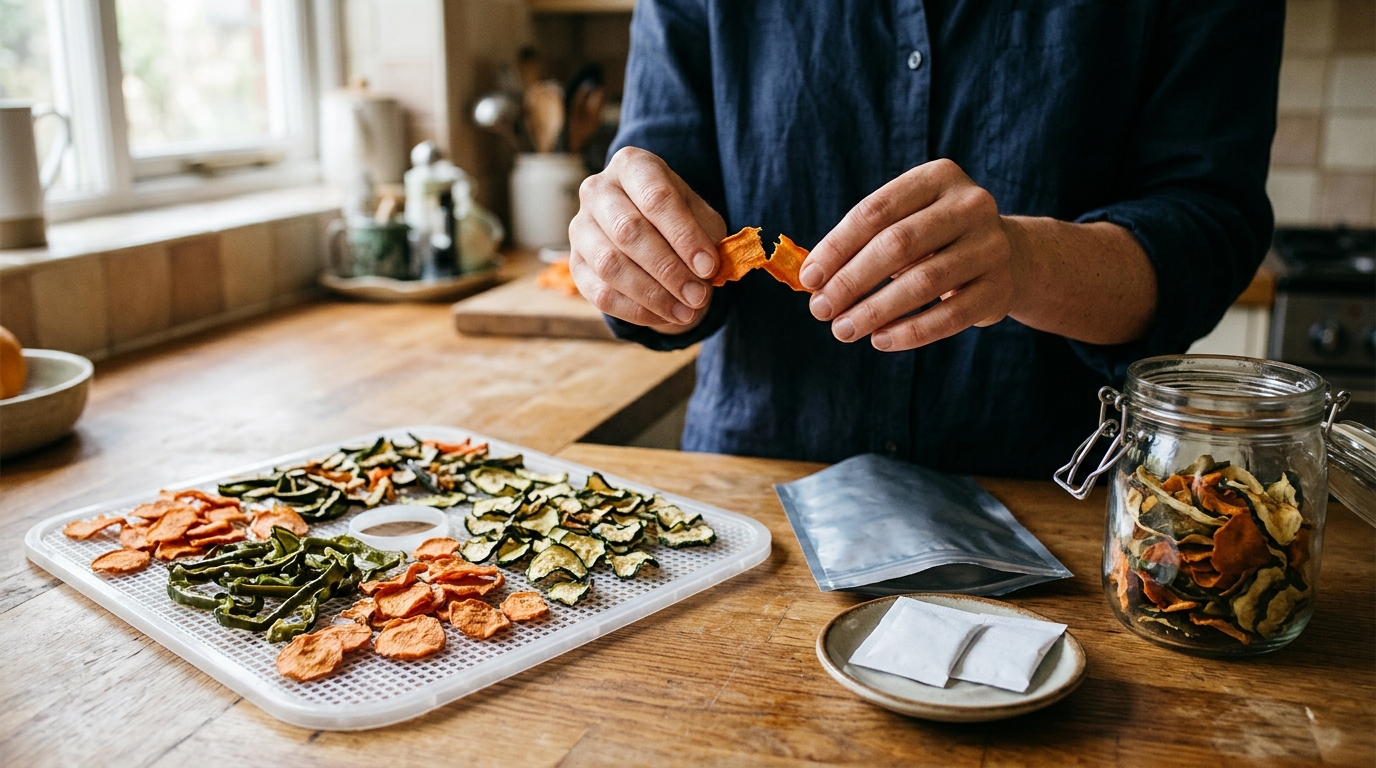
Household dryness check and jar conditioning log
Keep the following step-by-step verification sequence at your dehydrating station before transferring batches into pantry storage:
- When judging dryness, it is better to overdry than to underdry; when in doubt, continue drying for an additional 15–30 minutes and allow the product to cool before testing.
- Dried foods are susceptible to insect contamination and moisture reabsorption and must first be cooled completely before packaging because warm food causes sweating which could provide enough moisture for mold to grow.
- Vegetables should be dried until they are brittle or crisp (some shatter if hit with a hammer); at this stage they should contain about 10 percent moisture and do not need conditioning like fruits.
- To condition home-dried fruit, pack cooled dried fruit loosely in plastic or glass jars, seal the containers for 7 to 10 days so drier pieces absorb excess moisture, shake the jars daily to separate pieces and check for moisture condensation, and return the fruit to the dehydrator if condensation develops.
- The Church foil-pouch guidance specifies dry foods with about 10 percent moisture or less that are shelf-stable and low in oil. Foods stored in airtight containers with oxygen absorbers must be dry, with about 10 percent moisture content or less, because storing moist products in packaging that reduces oxygen can result in botulism poisoning.
Frequently asked questions
Does total moisture percentage equal water activity in dried foods?
Both peanut butter with 15% total moisture and dry milk with 8% total moisture have a water activity (aw) of 0.70.
What causes case hardening when dehydrating food?
If the drying temperature is too high at first, a hard shell may develop on the outside, trapping moisture on the inside—a condition known as case hardening that leads to a moldy food product—whereas temperatures that are too high at the end of the drying period may cause food to scorch.
How do you condition home-dried fruit and check for excess moisture?
To condition home-dried fruit, pack cooled dried fruit loosely in plastic or glass jars, seal the containers for 7 to 10 days so drier pieces absorb excess moisture, shake the jars daily to separate pieces and check for moisture condensation, and return the fruit to the dehydrator if condensation develops.
Can home-dried fruit be sealed with oxygen absorbers?
The Church foil-pouch guidance specifies dry foods with about 10 percent moisture or less that are shelf-stable and low in oil. Foods stored in airtight containers with oxygen absorbers must be dry, with about 10 percent moisture content or less, because storing moist products in packaging that reduces oxygen can result in botulism poisoning.
Sources
- U.S. Food and Drug Administration — Inspection Technical Guide: Water Activity in Foods
- U.S. Food and Drug Administration — Code of Federal Regulations: Preventive Controls Definitions
- U.S. Food and Drug Administration — Code of Federal Regulations: Thermally Processed Low-Acid Foods Definitions
- National Center for Home Food Preservation (University of Georgia) — Packaging and Storing Dried Foods
- National Center for Home Food Preservation (University of Georgia) — Food Dehydrators
- National Center for Home Food Preservation (University of Georgia) — Meat and Poultry Jerky
- National Center for Home Food Preservation (University of Georgia) — Dry Canning Raw Vegetables is an Unsafe Practice
- University of Missouri Extension — Introduction to Food Dehydration
- University of California Agriculture and Natural Resources — Dehydrating Basics
- Penn State Extension — Let’s Preserve: Drying Fruits and Vegetables
- Clemson Cooperative Extension — Home and Garden Information Center: Drying Foods
- Food Safety Magazine — ILSI Europe Framework to Rank Microbial Risks of Dried Ingredients
- Commercial Dehydrator Systems — Dehydration: Case Hardening and Moisture Migration
Continue with our food packaging guides or return to the food storage hub.
Explore more in Food Storage & Freezer Guides.
Official guidance and sources
Sources last checked November 4, 2026.
- U.S. Food and Drug Administration — Inspection Technical Guide: Water Activity in Foods
- U.S. Food and Drug Administration — Code of Federal Regulations: Preventive Controls Definitions
- U.S. Food and Drug Administration — Code of Federal Regulations: Thermally Processed Low-Acid Foods Definitions
- National Center for Home Food Preservation (University of Georgia) — Packaging and Storing Dried Foods
- National Center for Home Food Preservation (University of Georgia) — Food Dehydrators
- National Center for Home Food Preservation (University of Georgia) — Meat and Poultry Jerky
- National Center for Home Food Preservation (University of Georgia) — Dry Canning Raw Vegetables is an Unsafe Practice
- University of Missouri Extension — Introduction to Food Dehydration
- University of California Agriculture and Natural Resources — Dehydrating Basics
- Penn State Extension — Let's Preserve: Drying Fruits and Vegetables
- Clemson Cooperative Extension — Home and Garden Information Center: Drying Foods
- Food Safety Magazine — ILSI Europe Framework to Rank Microbial Risks of Dried Ingredients
- Commercial Dehydrator Systems — Dehydration: Case Hardening and Moisture Migration