
Old Recipe Measurements: Separate Conversions from Amounts You Need to Record
Separate defined old recipe units that have modern NIST equivalents from teacups, lumps of butter, and price-marked cans you must weigh and record on a worksheet.
Guessing at an old recipe measurement wastes ingredients when a modern measuring cup does not match the original cook’s vessel. Separate defined units that have modern NIST equivalents from unverified teacup, butter-lump, and price-marked can amounts, and record what you actually weigh on a kitchen worksheet. This guide provides a seven-column recording worksheet, NIST-published modern US customary and metric equivalents, and a scale-based workflow for logging trial amounts in your own kitchen.
When reading an old US or family recipe, classify every ingredient line before you mix anything. Standard units such as 1 gill (4 US fluid ounces or 118 mL in NIST Metric Household Table 1, updated August 27, 2025) and 1 pound (454 g in NIST Cooking Measurement Equivalencies, updated April 29, 2026) convert to modern measures when the recipe uses the US customary system. Household vessels like a teacup, visual lumps like butter the size of an egg, and store descriptions like a 10-cent can have no historical standard; leave their conversion cells blank and record your weighed trial in grams.
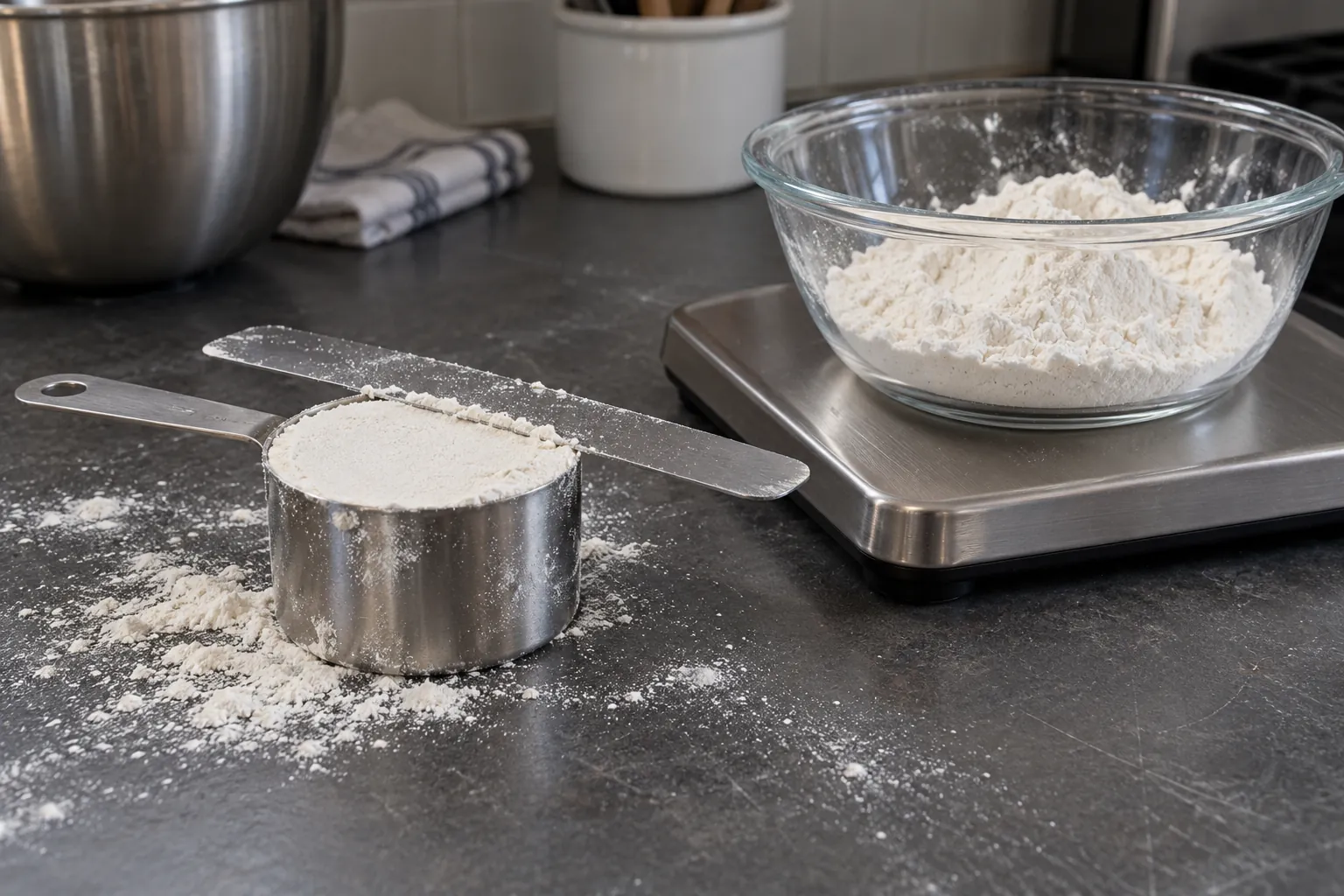
Which old recipe measurements convert and which stay blank?
Sort each line on the recipe card into one of four groups before looking up a number. A single conversion chart fails when a recipe combines defined capacity units with dishes from the writer’s cupboard or grocery prices from an unknown decade.
Scroll horizontally to see all columns.
| Measurement group on the card | Examples in old recipes | Convertible from a standard table? | How to handle it on your worksheet |
|---|---|---|---|
| Standard US capacity or weight unit | 1 gill, 2 fluid drams, 1/4 pound, 1 liquid pint |
Yes, when the recipe is in US customary units | Enter the modern NIST US customary and metric equivalent, then weigh the ingredient in grams |
| Customary unit from another country or system | 1 pint, 1 gallon, 1 cup, 1 tablespoon in a British, Canadian, or metric-cup book |
Only after you identify the country and period | Record the region or book origin first; NIST notes that customary units mean different things in different countries |
| Household vessel, hand measure, or visual lump | 1 teacup, 1 wineglass, 1 tumbler, butter the size of an egg, a knob of butter, a pinch |
No standard historical conversion | Leave the NIST conversion cell blank; measure the family vessel with water if you own it, or weigh a trial amount in grams and mark it as an assumption |
| Price-marked tin, vintage package, or uncalibrated oven term | a 5-cent can, a 10-cent can of tomatoes, 1 package, moderate oven |
No standard historical conversion | Leave the NIST conversion cell blank; record the modern product weight or oven setting you try as an explicit cook’s assumption |
Keeping the conversion cell blank for vessels, lumps, and priced cans protects your family archive. When a first batch turns out too dry or too sweet, you can adjust your recorded trial weight on the next bake without pretending the original card specified that number.
What are the modern NIST equivalents for standard US units?
Use NIST’s published tables when an American recipe names a defined unit such as a fluid dram, teaspoonful, tablespoonful, fluid ounce, gill, cupful, liquid pint, liquid quart, ounce by weight, or pound. These figures establish the modern US customary and metric equivalents; they do not prove that an undated historical cookbook used the same standard.
Exact US customary kitchen capacity relationships (NIST SP 430 Table 1)
The NIST Metric Household table (from NIST Special Publication 430, Household Weights and Measures, updated August 27, 2025, checked October 17, 2026) lists exact relationships among common US kitchen capacity units, alongside approximate metric volumes rounded to the significant figures shown:
Scroll horizontally to see all columns.
| Unit named in recipe | Fluid drams | Teaspoonfuls | Tablespoonfuls | Fluid ounces | Gills (1/2 cupfuls) | Cupfuls | Liquid pints | Liquid quarts | Milliliters (approx.) |
|---|---|---|---|---|---|---|---|---|---|
1 fluid dram |
1 | 3/4 | 1/4 | 1/8 | 1/32 | 1/64 | 1/128 | 1/256 | 3.7 mL |
1 teaspoonful |
1 1/3 | 1 | 1/3 | 1/6 | 1/24 | 1/48 | 1/96 | 1/192 | 4.9 mL |
1 tablespoonful |
4 | 3 | 1 | 1/2 | 1/8 | 1/16 | 1/32 | 1/64 | 15 mL |
1 fluid ounce |
8 | 6 | 2 | 1 | 1/4 | 1/8 | 1/16 | 1/32 | 30 mL |
1/4 cupful |
16 | 12 | 4 | 2 | 1/2 | 1/4 | 1/8 | 1/16 | 59 mL |
1 gill (1/2 cupful) |
32 | 24 | 8 | 4 | 1 | 1/2 | 1/4 | 1/8 | 118 mL |
1 cupful |
64 | 48 | 16 | 8 | 2 | 1 | 1/2 | 1/4 | 237 mL |
1 liquid pint |
128 | 96 | 32 | 16 | 4 | 2 | 1 | 1/2 | 473 mL |
1 liquid quart |
256 | 192 | 64 | 32 | 8 | 4 | 2 | 1 | 946 mL |
Two rows solve the most common unit questions on older American cards:
- A US gill (
1 gill) equals 1/2 cupful, 4 fluid ounces, 8 tablespoonfuls, 24 teaspoonfuls, or 1/4 liquid pint (approximately 118 mL). - A fluid dram (
1 fluid dram)—sometimes written in older flavoring or extract lines—equals 3/4 teaspoonful or 1/8 fluid ounce (approximately 3.7 mL).
Approximate home-cooking volume and weight equivalents (NIST Metric Kitchen)
For everyday recipe scaling, NIST’s Cooking Measurement Equivalencies (updated April 29, 2026, checked October 17, 2026) provides rounded home-cooking equivalents for volume and mass:
Scroll horizontally to see all columns.
| US Customary unit | NIST approximate metric equivalent | Measurement type |
|---|---|---|
1/4 teaspoon |
1.25 mL |
Volume |
1/2 teaspoon |
2.5 mL |
Volume |
1 teaspoon |
5 mL |
Volume |
1 tablespoon (1/2 fluid ounce) |
15 mL |
Volume |
1 fluid ounce |
30 mL |
Volume |
1/4 cup |
60 mL |
Volume |
1/3 cup |
80 mL |
Volume |
3 fluid ounces |
90 mL |
Volume |
1/2 cup |
120 mL |
Volume |
5 fluid ounces |
150 mL |
Volume |
6 fluid ounces (3/4 cups) |
180 mL |
Volume |
1 cup |
240 mL |
Volume |
16 fluid ounces (1 pint, 2 cups) |
480 mL |
Volume |
24 fluid ounces (3 cups) |
720 mL |
Volume |
32 fluid ounces (1 quart, 4 cups) |
950 mL |
Volume |
1/2 gallon (64 fluid ounces, 8 cups) |
1950 mL (1.95 L) |
Volume |
1 gallon (4 quarts, 128 fluid ounces, 16 cups) |
3.84 L |
Volume |
1 ounce (by weight) |
28 g |
Mass (weight) |
1/4 pound (4 ounces) |
114 g |
Mass (weight) |
1 pound (16 ounces) |
454 g |
Mass (weight) |
2.2 pounds |
1 kg (1000 g) |
Mass (weight) |
Takeaway: Record whether you used the exact NIST SP 430 figure (237 mL per cupful) or the rounded NIST Metric Kitchen home-cooking equivalent (240 mL per cup) so anyone repeating your recipe uses the same basis.
Why do region, liquid versus dry units, and ingredient density change the amount?
Check the recipe’s country of origin and whether an ounce line means volume or weight before converting. NIST’s Culinary Measurement Tips (updated April 29, 2026, checked October 17, 2026) highlights three sources of conversion error in heritage and international recipes:
- Customary units differ by country. NIST notes that customary measures—including teaspoons, cups, pints, quarts, and gallons—mean different things in different countries. In addition, some historic recipes refer to metric “cup and spoon” measures, which NIST notes are slightly larger than US customary cup and spoon measures. Do not apply US fluid-ounce numbers to a British, Canadian, or Australian family card without recording the regional unit definition first.
- US customary separates liquid volume, dry volume, and weight ounces. The fluid ounce (
fl oz) is a liquid volume unit, whereas the Avoirdupois ounce (oz) measures mass (weight, approximately28 gper ounce). In the metric system, liters (L), milliliters (mL), and cubic decimeters (dm³) measure both fluid and dry volume, while grams (g) and kilograms (kg) measure mass. Because metric baking relies on mass, ingredient density determines how many grams fill a given cup. - Dry and fluid measuring cups are not interchangeable. NIST states that using a dry measuring cup for liquid commodities or a fluid measuring cup for dry commodities is a common way of introducing measurement errors. Set a fluid measuring cup on a flat, level counter and read the meniscus at eye level. When measuring dry ingredients such as sugar or flour in a dry cup, strike off the excess across the top rim.
How do you measure and weigh an old recipe for your own kitchen record?
Measure the ingredient with the traditional tool first, then weigh that portion in grams on a digital kitchen scale. NIST’s Culinary Measurement Tips identifies this two-step process—measuring with a traditional measuring tool and weighing the result in grams—as the safest method to convert an ingredient in a traditional American recipe.
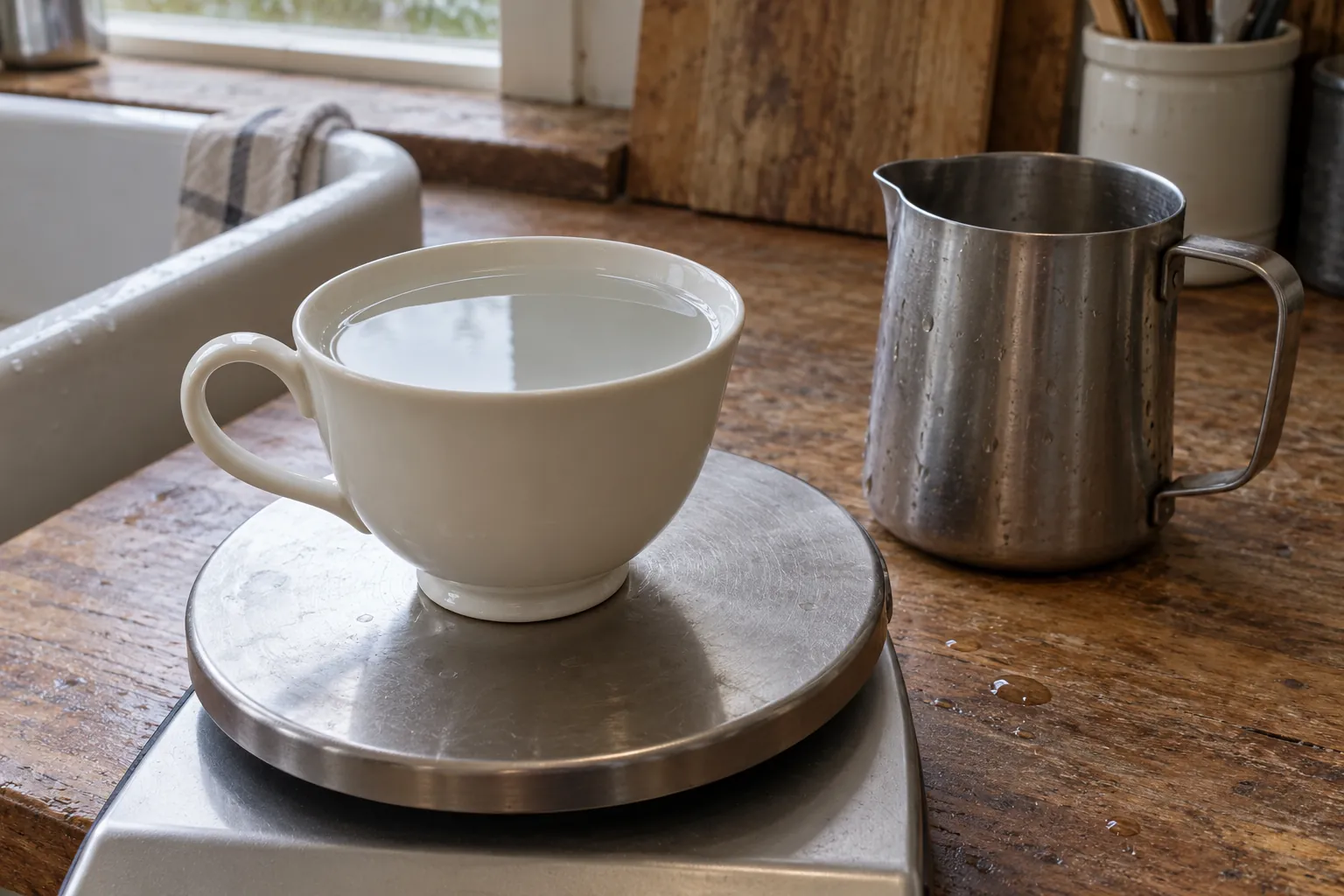
Follow these four steps when building a repeatable kitchen record from an old recipe card:
- Keep the original wording intact. Copy the recipe line word for word before you test anything, following the two-layer transcription workflow in how to preserve family recipes. Never overwrite “1 teacup sugar” or “butter the size of a walnut” with a modern guess inside the original transcript.
- Check any surviving family vessel by water weight. If your family still owns the actual teacup, mug, tumbler, or baking dish named on the card, you can measure its rim capacity using the water-weight method in NIST’s Cookware and Tools guide (updated April 29, 2026). Place the empty vessel on a digital kitchen scale set to grams, press
zeroto tare the scale, and fill the vessel to the rim with tap water without spilling over the edge. Because water has a density of about1 g per mL, the weight in grams gives the vessel’s approximate volume in milliliters (for example,1000 gof water in a baking dish indicates about1000 mLor1 Lof capacity). - Measure the ingredient and weigh the result in grams. For traditional spoon or cup lines—or when scooping with an heirloom cup you still own—measure the ingredient as the recipe directs, tare an empty bowl on your kitchen scale (NIST notes a
5 kgcapacity scale suits most home kitchens), and weigh the measured portion in grams. Remove the bowl from the scale before mixing so you do not damage the load sensor. - Log unknown historical quantities as explicit trial assumptions. When the original teacup is gone, or the recipe calls for “a knob of butter,” “butter the size of an egg,” “a 10-cent can,” or “a moderate oven,” leave the standard conversion column blank. Weigh the modern amount you choose to try on your first batch, mark it as your assumption, and write down how the batter, dough, or sauce behaved.
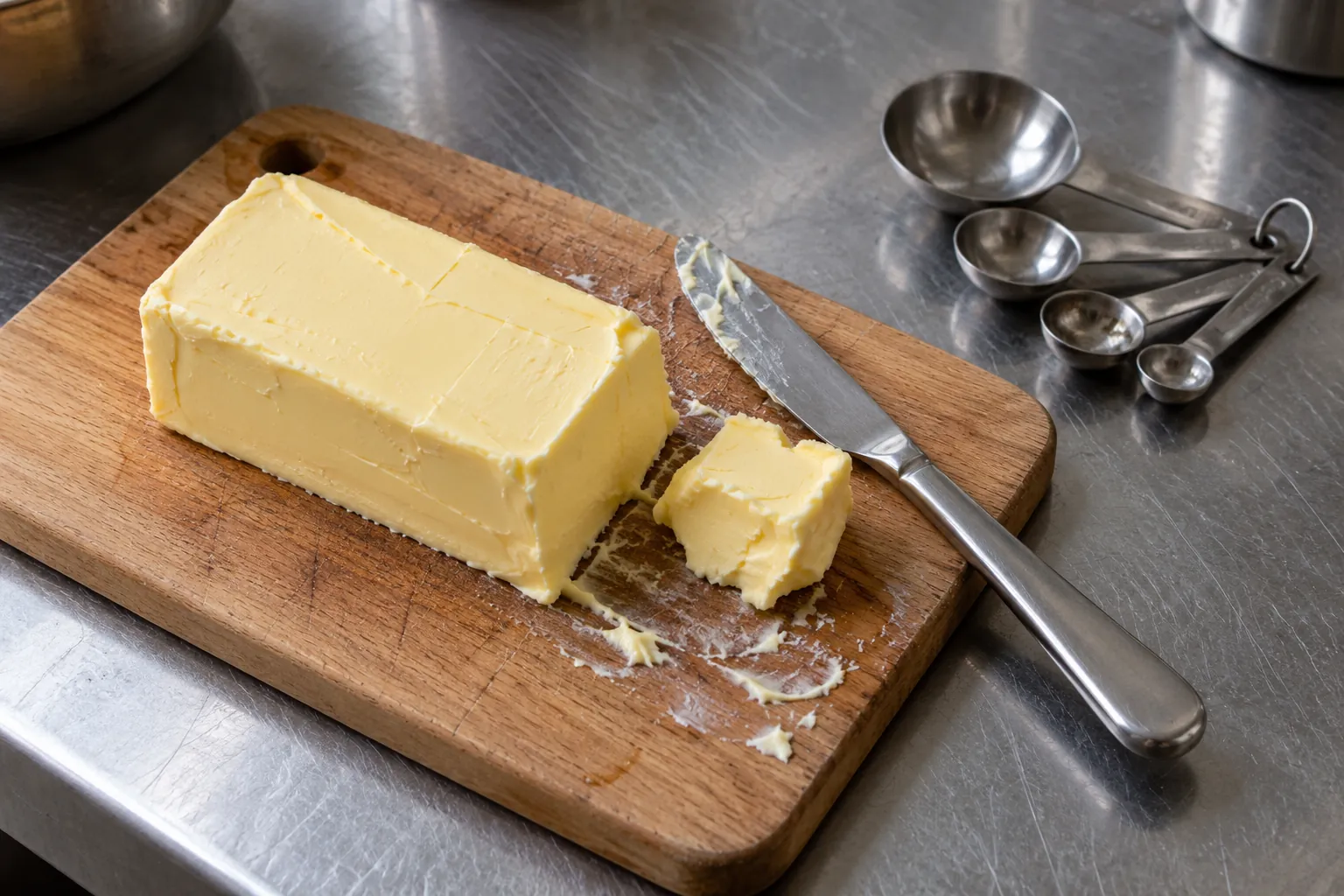
Worksheet: how to log original terms, NIST equivalents, and trial assumptions
Use this seven-column worksheet to separate what a primary source supports from what you chose to test in your kitchen. The filled rows below are illustrative examples showing how the columns work, not kitchen trials conducted by Read-N-Eat or historical proof of what an older cookbook meant.
Scroll horizontally to see all columns.
| Original wording | Region or era | Source or evidence | Convertible? | Modern NIST equivalent | Cook’s weighed trial & assumption | Cooking log & next-time adjustment |
|---|---|---|---|---|---|---|
1 gill milk |
US printed recipe, c. 1910 | NIST SP 430 Table 1 (updated Aug 27, 2025) | Yes (US liquid unit) | 1/2 US cup (4 fl oz, 8 tbsp, 24 tsp, approx. 118 mL) |
Measured 118 mL in a fluid cup on a level surface; weighed 122 g whole milk (illustrative trial entry) |
Batter poured smoothly; keep 122 g for future batches |
1/4 pound butter |
US family card, 1950s | NIST Cooking Measurement Equivalencies (updated Apr 29, 2026) | Yes (US avoirdupois weight) | 4 oz by weight (approx. 114 g) |
Weighed 114 g unsalted butter on digital scale |
Matches one standard US stick; no change needed |
1 fluid dram lemon extract |
US community book, c. 1900 | NIST SP 430 Table 1 (updated Aug 27, 2025) | Yes (US apothecary / kitchen capacity unit) | 3/4 teaspoonful (1/8 fl oz, approx. 3.7 mL) |
Measured 3/4 tsp (3.7 mL) |
Distinct lemon aroma without bitterness |
1 teacup sifted flour |
Handwritten card; original teacup missing | No primary standard for the writer’s cup; NIST Culinary Measurement Tips | No (vessel unknown) | Assumed 3/4 US cup leveled in a dry cup and weighed at 90 g all-purpose flour (illustrative assumption) |
Crumb was slightly wet; try 100 g on Batch 2 and record result |
|
1 teacup sugar (using Grandmother's blue teacup) |
Family cupboard vessel still in kitchen | NIST Cookware and Tools water-weight method (1 g water ≈ 1 mL) |
Vessel only (by direct measurement) | Empty cup tared on scale; held 165 g tap water to rim (~165 mL); filled to rim with granulated sugar and weighed 140 g (illustrative entry) |
Sweetness balanced; note that 140 g applies only to this specific cup |
|
Butter the size of an egg |
Undated clipping | No primary standard for historical lump descriptions | No (visual lump) | Assumed 57 g (4 tbsp) unsalted butter for Batch 1 (illustrative assumption) |
Texture rich; test 45 g next time if edges spread too thin |
|
1 knob of butter |
Handwritten sauce note | No primary standard for a knob | No (visual lump) | Assumed 20 g butter swirled in at the end (illustrative assumption) |
Coated pan well; keep 20 g as house note |
|
1 ten-cent can tomatoes |
US clipping, circa 1900 | Store price varied by year, brand, and region; no primary conversion | No (price-based package) | Tested 14.5 oz (411 g) modern diced tomatoes, drained before weighing (illustrative assumption) |
Stew was thicker than expected; add 60 mL reserved liquid on Batch 2 |
|
Bake in a moderate oven |
Handwritten card without thermostat dial | No primary calibration for the original cookstove | No (uncalibrated heat description) | Tested 350°F (180°C) verified with an oven thermometer, checking 5 minutes early (illustrative assumption) |
Done at 28 minutes; record 350°F for 28 min in cook’s notes |
Blank worksheet template to copy into your recipe notes
Copy these seven fields into your digital recipe file or binder page whenever you adapt an heirloom recipe:
- Original wording (verbatim):
- Region or era (stated on card, or mark “unknown”):
- Source or evidence (NIST table, water-weight check on surviving vessel, or “none”):
- Convertible from a standard table? (Yes / Region needed / No — vessel, lump, or price):
- Modern NIST equivalent (leave blank if not convertible):
- Cook’s weighed trial & assumption (grams, mL, temperature, and date tested):
- Cooking log & next-time adjustment (texture, doneness time, and what to change on Batch 2):
Once a trial amount works reliably, summarize what you changed in two or three plain sentences at the top of the recipe using how to write recipe headnotes, and keep the full seven-column log in the notes section of your family recipe book.
When this worksheet does not apply
Stop and switch to an official food-safety or preservation procedure in two situations:
- Home canning and shelf-stable jars. Never use trial assumptions, heirloom teacup volumes, or unverified package weights to adjust acid, salt, sugar, headspace, jar size, or processing times in home canning. NIST’s kitchen equivalency tables and the worksheet above are for everyday cooking and baking only.
- Leftover cooling, freezing, and reheating limits. Historical recipes often omit refrigeration windows and reheating temperatures. When storing cooked dishes made from an old recipe, follow modern food-safety rules: check how to label leftovers for date tracking and freezing food in mason jars before putting glass in the freezer.
Frequently asked questions
How much is a gill in an old American recipe?
In the US customary system, 1 gill equals 1/2 cupful, 4 fluid ounces, 8 tablespoonfuls, 24 teaspoonfuls, or 1/4 liquid pint (approximately 118 mL), according to NIST SP 430 Table 1. Confirm that the recipe is American first, because customary measures differ across countries.
Why does this worksheet leave teacup, knob of butter, and 10-cent can conversions blank?
A teacup, a knob or egg-sized lump of butter, and a 5-cent or 10-cent store can depended on the dishware in a specific home or the retail prices in a specific town and year. No primary NIST standard fixes a single modern value for them, so any number you test belongs in the trial-assumption column.
Are a pinch, a dash, and a smidgen official measurement units?
No. NIST’s household capacity and cooking equivalency tables do not define a pinch, dash, or smidgen. Modern mini-spoon sets stamped with fractions like 1/8, 1/16, or 1/32 teaspoon reflect novelty spoon manufacturing rather than a historical standard. Weigh or note your own seasoning amount.
What is the safest way to convert volume measurements in a family recipe to grams?
NIST’s Culinary Measurement Tips states that the safest way to convert an ingredient in a traditional American recipe is to measure the ingredient with the traditional measuring tool first, then weigh the measured portion in grams on a kitchen scale. Record that gram weight alongside the ingredient form.
Method and sources
Updated October 17, 2026 for US home kitchens. This guide compiles four primary pages from the National Institute of Standards and Technology (NIST) Office of Weights and Measures, all live-fetched and verified on October 17, 2026: Metric Kitchen: Cooking Measurement Equivalencies (updated April 29, 2026), Metric Kitchen: Culinary Measurement Tips (updated April 29, 2026), Metric Household / NIST SP 430 Table 1 (updated August 27, 2025), and Metric Kitchen: Cookware and Tools (updated April 29, 2026).
Read-N-Eat did not kitchen-test a historical recipe for this guide. Standard conversions are limited to defined US customary and metric units supported by NIST. Where an old recipe names an unverified vessel, lump, price-based package, or uncalibrated oven heat term, the conversion column is intentionally left blank so home cooks can record and refine their own weighed trial assumptions without mistaking a guess for a historical fact.
Explore more in Food Stories & Family Recipes.
Sources
Sources last checked October 17, 2026.
- Metric Kitchen: Cooking Measurement Equivalencies , National Institute of Standards and Technology (NIST), Office of Weights and Measures (accessed October 17, 2026) Approximate home-cooking volume and mass equivalents, updated April 29, 2026. Defines modern US customary and metric values only.
- Metric Kitchen: Culinary Measurement Tips , National Institute of Standards and Technology (NIST), Office of Weights and Measures (accessed October 17, 2026) Guidance on weighing in grams, regional customary differences, liquid versus dry ounces, and converting traditional American recipes by measuring with a traditional tool and weighing the result in grams, updated April 29, 2026.
- Metric Household (NIST SP 430, Household Weights and Measures, Table 1) , National Institute of Standards and Technology (NIST), Office of Weights and Measures (accessed October 17, 2026) Exact US customary kitchen capacity equivalents including fluid drams, teaspoons, tablespoons, fluid ounces, gills, cups, liquid pints, and liquid quarts, updated August 27, 2025.
- Metric Kitchen: Cookware and Tools , National Institute of Standards and Technology (NIST), Office of Weights and Measures (accessed October 17, 2026) Digital kitchen scale tare procedure, 5 kg typical home scale capacity, and water-weight method (about 1 g per mL) for estimating vessel or bakeware capacity, updated April 29, 2026.