
Vacuum Sealer Bags: Embossed Channel Bags vs Smooth Chamber Pouches
Choose bags that match your vacuum sealer, then adjust the process for dry foods, juicy foods or soup. Texture, pouch material and a clean sealing band each do a different job.
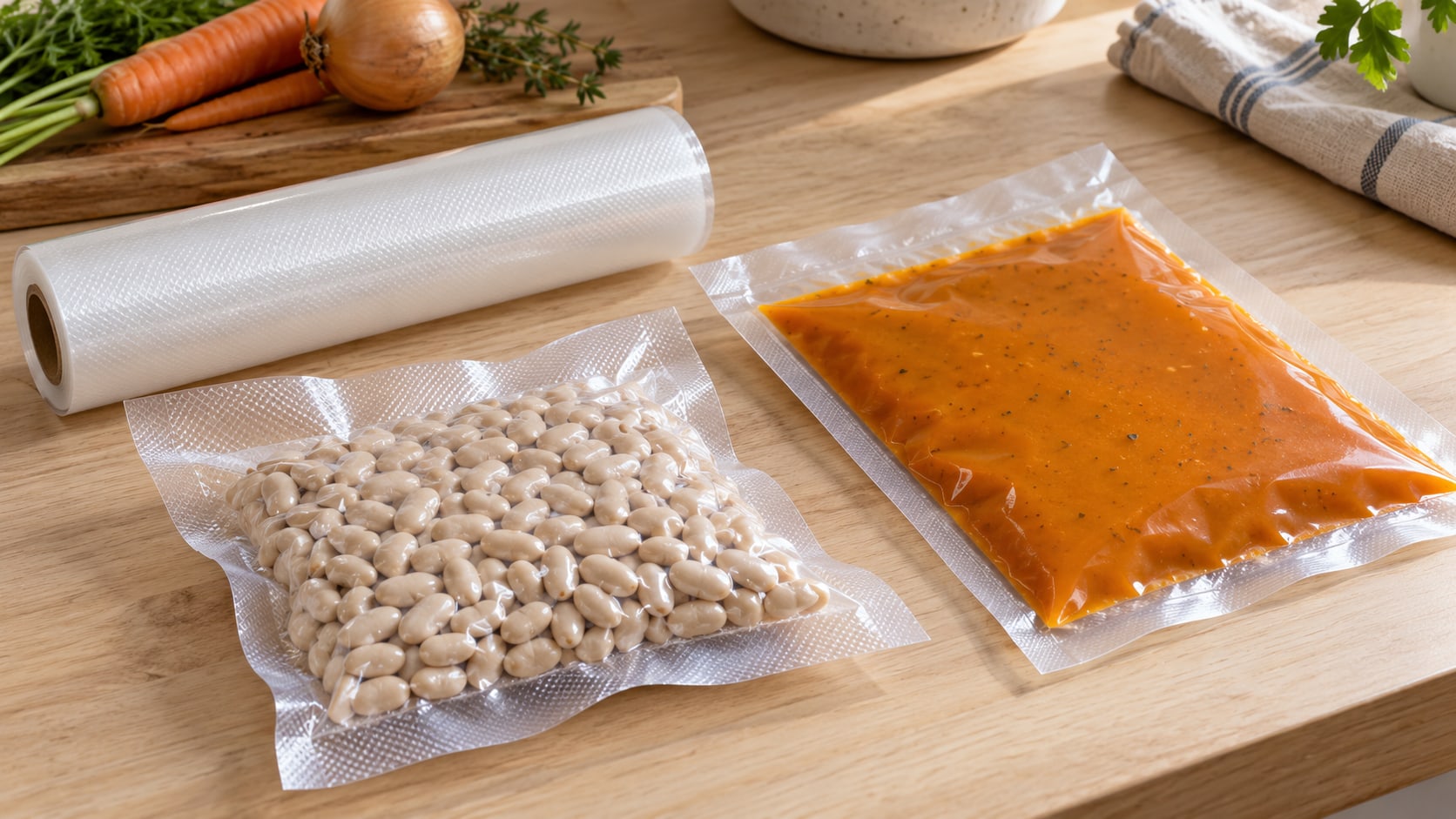
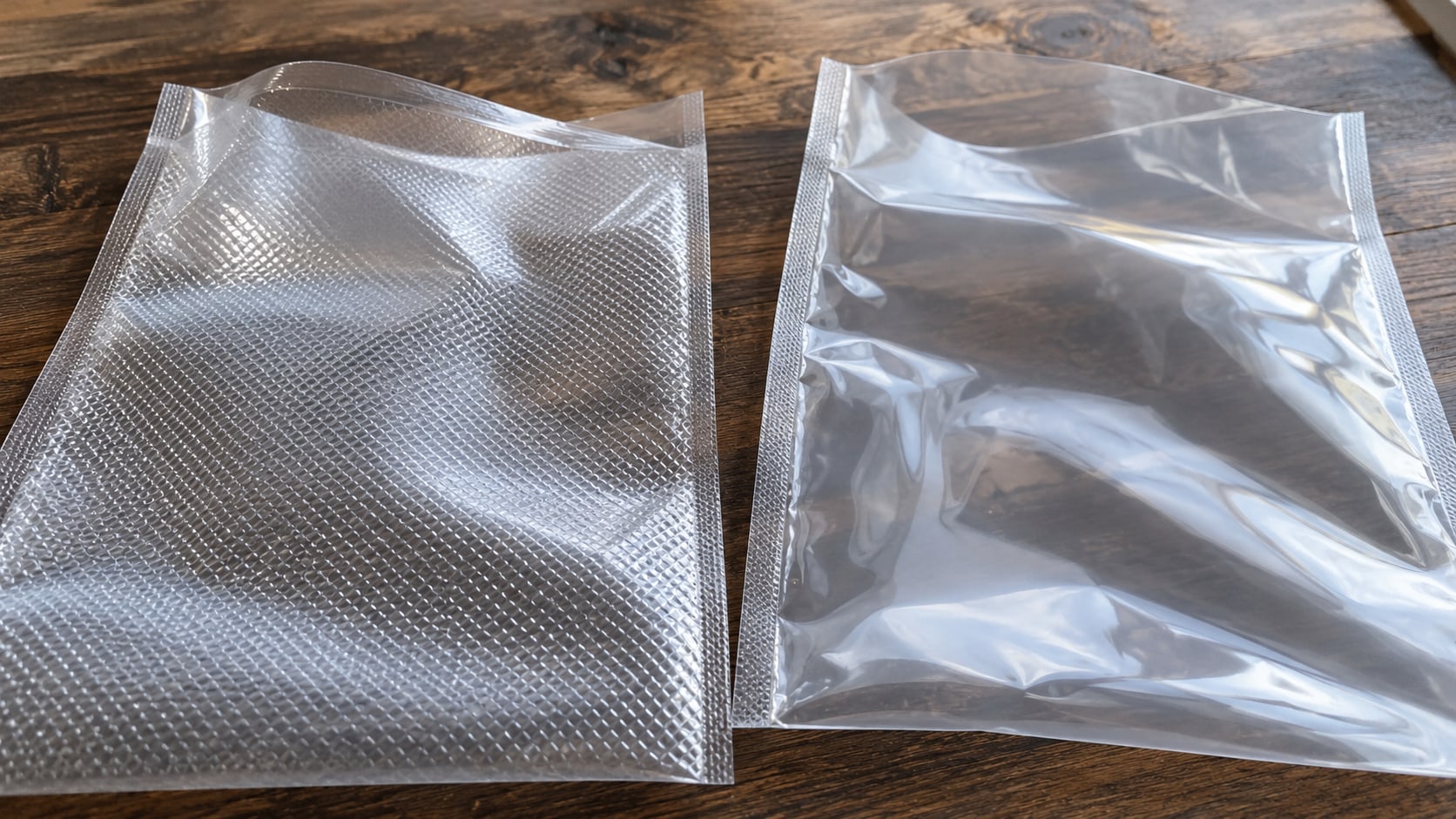
Use embossed channel vacuum sealer bags with an ordinary external clamp sealer; use the specified chamber pouches, commonly smooth, with a chamber machine. For dry and liquid foods alike, that machine match comes first. Soup adds a separate decision: whether your machine’s instructions call for freezing it solid or provide a direct liquid-sealing process.
If you are replacing bags or choosing a roll, start with the machine manual’s compatible-bag description. Then check the food’s condition, the bag’s intended use and its fit. A bag can heat-seal at the mouth yet leave air around the food if it does not provide the air path the machine needs.
Scroll horizontally to see all columns.
| What you are comparing | Embossed channel bag | Smooth chamber pouch |
|---|---|---|
| Surface | Textured film creates small air channels | Flat film without embossed channels |
| Usual machine match | Conventional external clamp suction sealer | Chamber sealer using its approved pouches |
| How evacuation works | Air travels through channels toward the bag opening | Air is removed from the chamber and the open pouch |
| Dry-food choice | Suitable format when specified for the external sealer | Suitable format when specified for the chamber sealer |
| Liquid-food check | Follow the model’s preparation instructions; conventional suction may require freezing first | Keep liquid below the seal bar and use the model’s liquid procedure |
| First failure to prevent | A smooth pouch collapsing shut in an external suction machine | An overfilled or poorly positioned pouch wetting the sealing area |
Match the bag to the machine
Embossing provides an air route for external suction; a chamber machine evacuates the space around the pouch as well. These are different ways of removing air, so the bag’s surface is a compatibility feature, not a quality ranking.
External clamp sealers need the channel path
With an ordinary external sealer, the food stays outside the machine and the open bag mouth sits in its suction area. As air leaves, the flexible bag walls draw together. The embossed texture keeps small routes available for air to move toward the opening. Smooth film can close those routes before the air has been removed.
Ferplast’s 2024 packaging catalogue distinguishes embossed PA/PE bags for external suction machines from smooth pouches for chamber machines. Look for that machine-type match on the bag listing, then check the compatibility instructions for your model. Specialist nozzle machines use another arrangement, so follow their own bag specifications.
Chamber machines evacuate, seal, then vent
The VacMaster VP215 user guide describes a cycle in which the entire pouch sits inside the chamber. Air leaves the chamber and the still-open bag; the machine seals the mouth, then admits air back into the chamber. The returning air presses the sealed pouch around its contents.
This sequence lets a chamber machine use its specified smooth pouches without the channel path an external clamp machine needs. Choose pouches approved for the chamber model, including its sealing requirements. For the broader difference between removing air and simply closing a container, see airtight vs vacuum-sealed storage.
Choose a process for dry foods, juices or soup
Dry food needs a compatible bag; free-flowing liquid also needs a suitable sealing process. A moist piece of food and a pouch of stock can behave very differently as air is removed.
For dry foods such as beans, start with the appropriate bag format and leave the sealing area clear of food. Dry contents do not make a smooth chamber pouch work in a conventional external clamp sealer.
For juicy foods, follow the model’s moist-food preparation instructions and watch the area that will be sealed. Liquid moving toward the opening can wet the sealing band. A thicker pouch or a different embossed pattern does not replace the machine’s liquid-handling instructions.
Soup in a conventional external sealer
The FoodSaver 4800-series manual directs users to freeze liquids such as stock in a container, remove the frozen portion and vacuum package it in a compatible bag. Freezing changes a flowing liquid into a solid portion that can be bagged without drawing soup toward the mouth during that procedure.
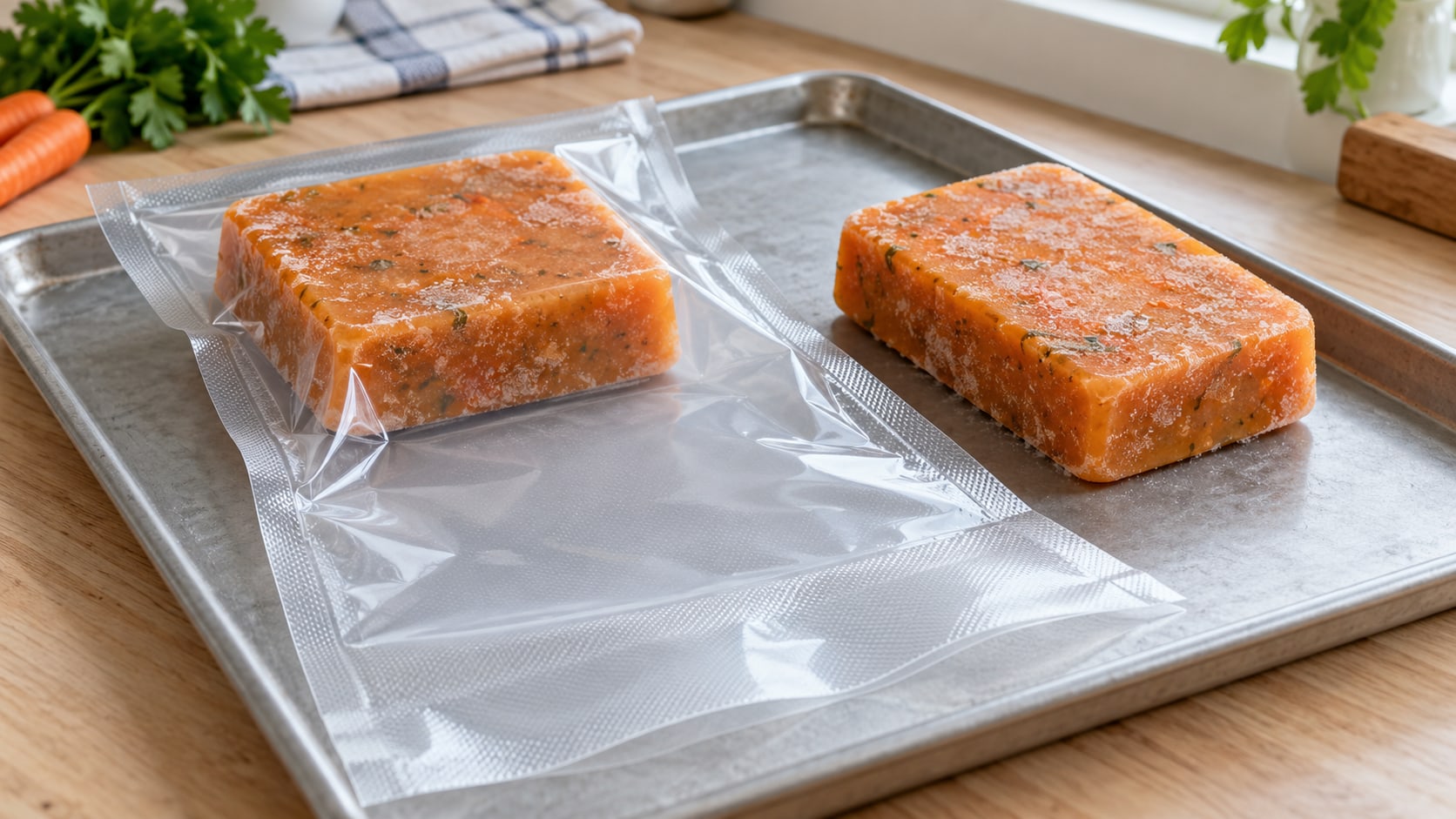
Use the soup portioning and freezing guide for cooling and freezer preparation. If your machine explicitly provides a direct liquid-sealing procedure, use its specified bag, positioning and fill limit. A setting labeled “moist” alone is not a substitute for those instructions.
Soup in a chamber sealer
For the VacMaster VP215 procedure, keep the liquid below the height of the seal bar, lay the pouch mouth flat across the bar and keep the entire bag inside the chamber. These placement checks matter even though the bag and surrounding chamber are evacuated together.
Chamber sealing also requires attention to boiling. Henkelman’s Liquid Control guidance explains that reduced pressure can make liquid boil even when cold; its optional control detects evaporation and moves the cycle to sealing. Use your machine’s liquid settings and temperature instructions, and watch for rising bubbles or foam. Smooth film itself does not prevent overflow.
Read PA/PE as a material description
PA/PE describes the plastics in the pouch, while embossed or smooth describes its surface. Both bag formats can use PA/PE, as the Ferplast catalogue illustrates. Those letters alone therefore do not tell you whether a bag fits your machine.
In the PA/PE structure described in allfo’s product brochure, PA means polyamide, often called nylon, and supplies an oxygen barrier. PE means polyethylene and provides moisture-barrier and heat-sealing properties. Those functions work together in the pouch.
For buying decisions, read the bag’s full specification: machine compatibility, intended food use, thickness supported by the sealer and any storage or cooking limits. Ferplast lists cooking pouches separately from storage pouches. If you plan to heat food in the bag, select a grade explicitly rated for that method, temperature and duration; “PA/PE” or “BPA-free” alone is not a cooking instruction.
Size the pouch and protect the sealing band
Choose enough room for the food and the manual-required empty sealing area, then make that area clean, dry and flat. The opening must fit the machine’s sealing area; in a chamber machine, the filled pouch must also fit completely inside the chamber.
Check fit with the food portion in mind. A pouch that fits while empty can become too bulky to lie correctly once filled. Keep chamber liquids below the seal bar rather than treating the top of the bag as the fill line.
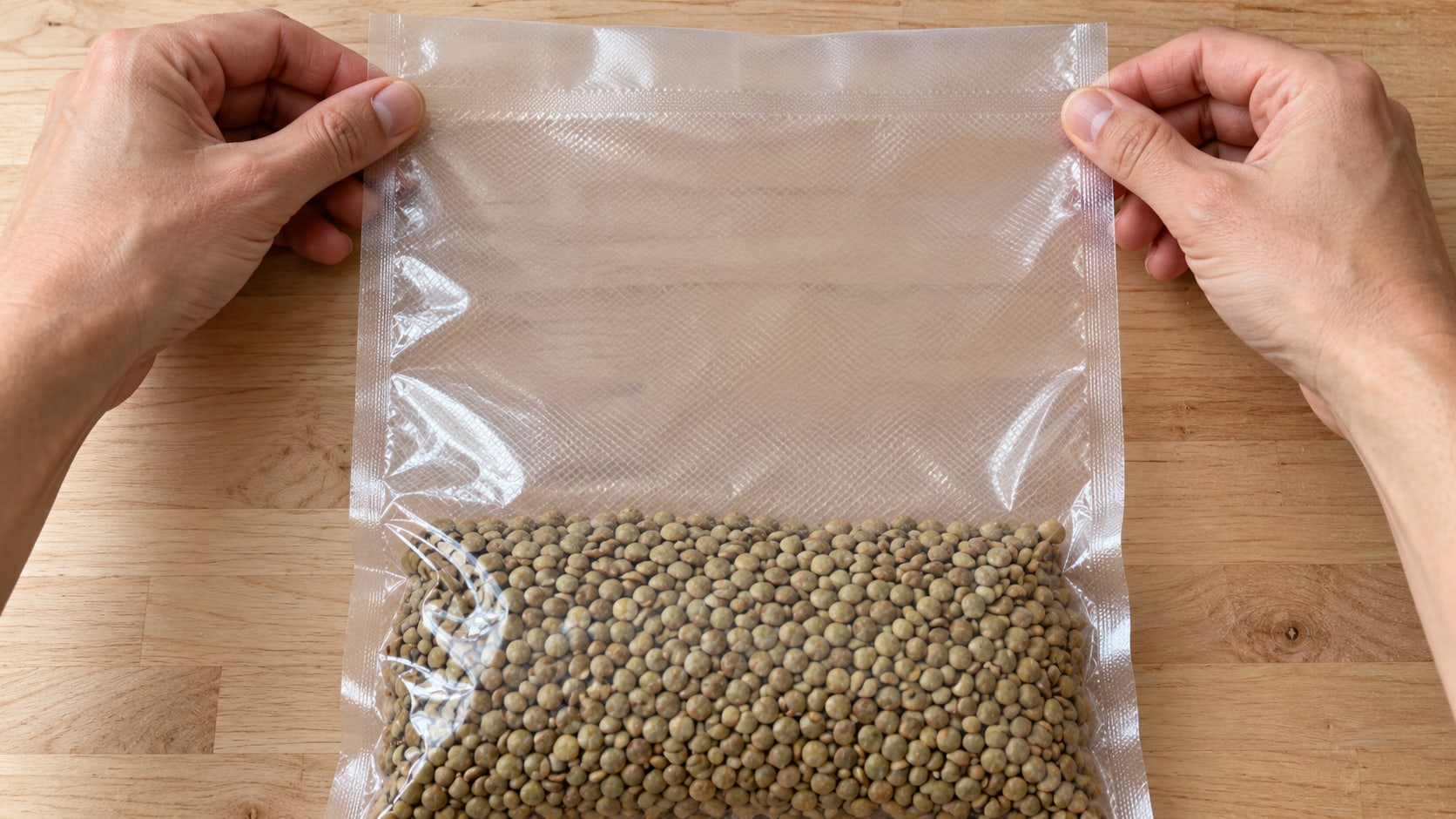
The VacMaster VP215 troubleshooting instructions identify moisture, food particles and wrinkles at the seal as causes of sealing problems. If the package fails to hold its vacuum, inspect the bag and sealing area before changing settings:
- Air remains after an external cycle: check that the bag has the required channel structure and that its opening is correctly placed in the suction area.
- The sealing band is wet or dirty: clean and dry the area; correct the food preparation or fill level before trying again.
- A fold crosses the sealing band: flatten the mouth and reposition the pouch as directed by the manual.
- The pouch is damaged: replace it and check the next filled bag before storage.
An extra seal line does not remove contamination or a wrinkle from the first attempt. Correct the cause and inspect the resulting seal.
Machine × food checklist
Choose the bag from the machine column and the preparation from the food column. Use this table before filling the next pouch.
Scroll horizontally to see all columns.
| Your machine and food | Bag to choose | Preparation and placement check |
|---|---|---|
| Ordinary external clamp sealer + dry food | Compatible embossed bag or roll | Keep food out of the sealing band; position the mouth in the suction area |
| Ordinary external clamp sealer + food with juices | Compatible embossed bag | Follow moist-food preparation; keep liquid away from the sealing band |
| Ordinary external clamp sealer + soup or stock | Compatible embossed bag | Freeze solid first where the manual requires it, then transfer and seal |
| Model with explicit direct liquid instructions + soup | Bag specified for that model | Follow its liquid procedure, bag position and fill limit |
| Chamber sealer + dry food | Approved chamber pouch | Fit the entire filled pouch inside; lay the mouth flat across the bar |
| Chamber sealer + soup | Approved chamber pouch | Keep liquid below the seal bar; follow liquid settings and watch for boiling or foam |
Keep perishable food refrigerated or frozen after sealing. Oregon State University Extension’s home vacuum-packaging guidance explains that reducing oxygen still allows some illness-causing bacteria to grow. A tight pouch does not establish that food is safe or make soup suitable for pantry storage.
For your next purchase, note the machine model, compatible bag format, usable mouth width and intended storage or cooking use. Keep those details with the bag packaging so you can reorder the right grade. For other containers and freezer routines, browse the food-storage guides.
Explore more in Food Storage & Freezer Guides.
Official guidance and sources
Sources last checked October 27, 2026.
- Packaging catalogue, 2024, vacuum bags, p. 48 , Ferplast Embossed bags for external suction machines, smooth chamber pouches and separate cooking grades.
- 4800 Series User Manual, Preparation Guidelines for Liquids, p. 17 , FoodSaver Freezing liquids before vacuum packaging with this machine family.
- VP215 User Guide, How It Works and Operating Instructions , VacMaster Chamber cycle, pouch placement, liquid level and seal troubleshooting.
- Liquid Control, Why Liquid Control? , Henkelman Boiling under reduced pressure and an optional evaporation-detection control.
- Product brochure, side-seal bags, p. 3 , allfo PA/PE barrier and sealing functions.
- Should I Vacuum Package Food at Home? (SP 50-603) , Oregon State University Extension (accessed October 27, 2026) Cold storage remains necessary for perishable vacuum-packaged food.