
Wacky Cake: Chocolate Cake Without Eggs or Milk
A classic chocolate cake with no eggs, butter or milk, mixed right in the baking pan with vinegar and baking soda. Weights and cup measures included.
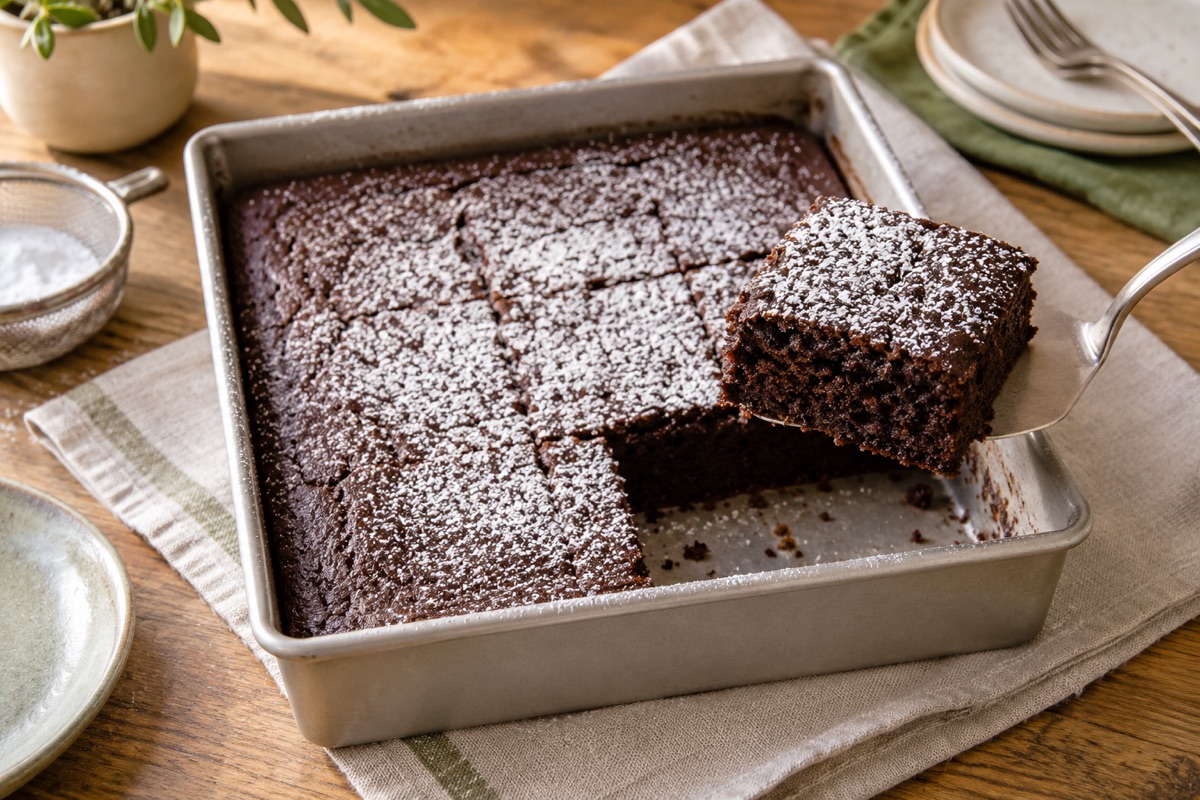
Wacky cake is a chocolate cake made without eggs, butter or milk. You stir the batter directly in the baking pan, where vinegar reacts with baking soda to lift it. The result is a soft, plain chocolate cake that suits a snack, a lunchbox or a simple birthday.
This version makes one 8-inch square cake. Everything is in grams and US cups, followed by why the method works and how to adjust it.
Ingredients
The dry ingredients are all-purpose flour, sugar, unsweetened cocoa powder, baking soda and salt. The wet ones are cold water, a neutral oil, distilled white vinegar and vanilla extract.
Use natural unsweetened cocoa, or Dutch-process cocoa labeled as unsweetened. The batter has no butter or eggs to bring richness, so the cocoa carries the flavor. A cocoa you like in a hot drink is a good choice.
Use plain distilled white vinegar. Its flavor disappears in baking, while the acid does the work. Don’t skip it or swap it for more water.
The full list with weights is in the recipe card. A kitchen scale helps, since the pan is the mixing bowl.
Why these ingredients work
A cake normally gets lift and softness from eggs and butter or milk. Wacky cake replaces those with simple chemistry.
When baking soda meets an acid such as vinegar, it releases carbon dioxide, which makes the batter expand. Without an acid, heat alone releases only about half of the available gas and can leave a bitter, soapy taste and a yellow color. Natural cocoa is mildly acidic, so it helps the soda react too.
The oil coats the flour, which limits gluten formation, and keeps the cake from tasting dry. The cold water thins the batter to a pourable consistency and carries the cocoa and vanilla flavor.
The reaction starts as soon as the wet ingredients meet the soda, so mix promptly and get the pan into the oven. Don’t let the batter sit.
A short history
Wacky cake is another name for depression cake, also called war cake. It was commonly made during the Great Depression with little or no milk, sugar, butter or eggs, because those ingredients were expensive or hard to get. Similar cakes were called “War Cake” as far back as World War I, since they avoided ingredients that were scarce or saved for soldiers. Other names include Boiled Raisin Cake, Milkless Eggless Butterless Cake and Poor Man’s Cake, and boiled raisin cakes of this kind date back at least to the American Civil War. The chocolate version mixed in the pan is a modern depression-style cake. Exact dates and first publications are hard to pin down, so treat any single origin story with caution.
Step-by-step method
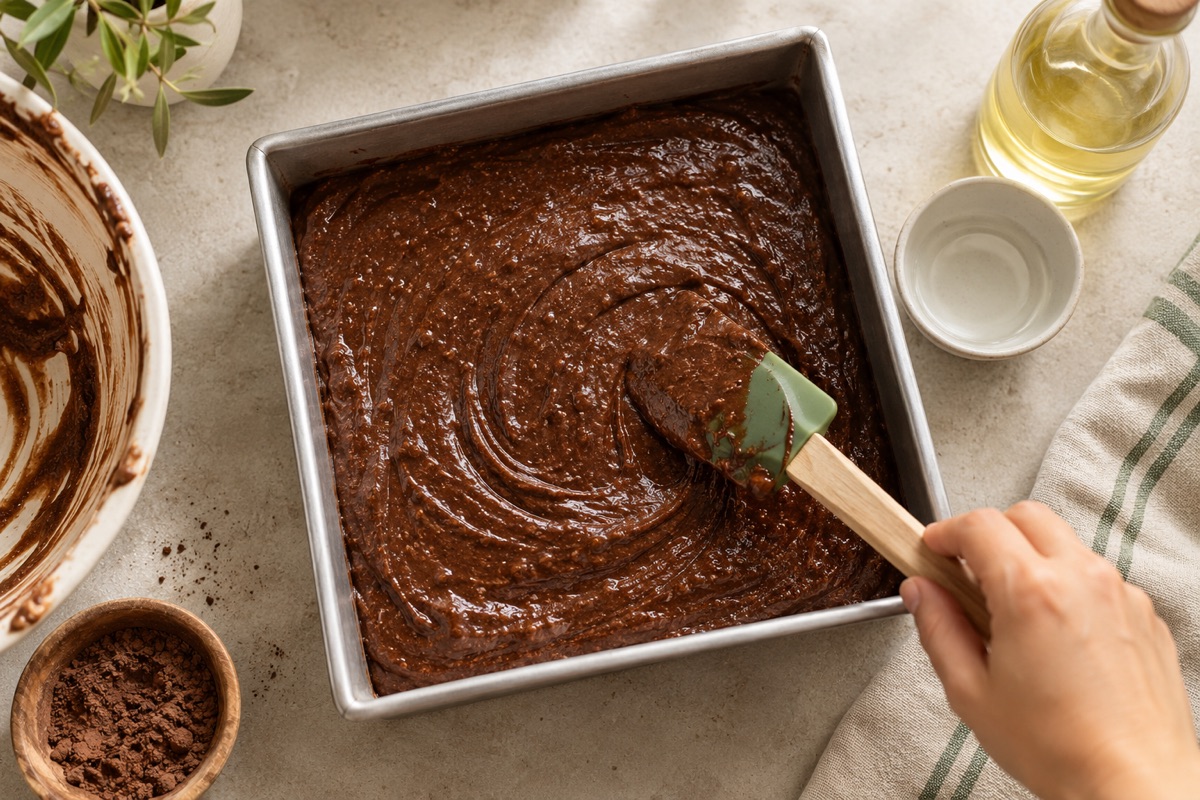
- Heat the oven to 350°F (175°C). Use an 8-inch square metal pan and don’t grease it. A bare pan lets the batter grip the sides as it rises.
- Add the flour, sugar, cocoa, baking soda and salt to the pan. Stir with a fork, breaking up any cocoa lumps, until the color is even.
- Press the back of a spoon into the dry mix to make three small hollows.
- Put the vinegar in one well, the vanilla in another and the oil in the third. Then pour the cold water over everything.
- Stir until smooth, working from the edges toward the center and scraping the corners, where dry flour likes to hide. Stop as soon as no dry pockets remain. Overmixing is not a big risk here, but the batter fizzes as you stir, so keep going steadily.
- Bake in the center of the oven. The cake is done when a toothpick near the center comes out with a few moist crumbs and the top springs back lightly when touched. Start checking a few minutes early, since ovens differ.
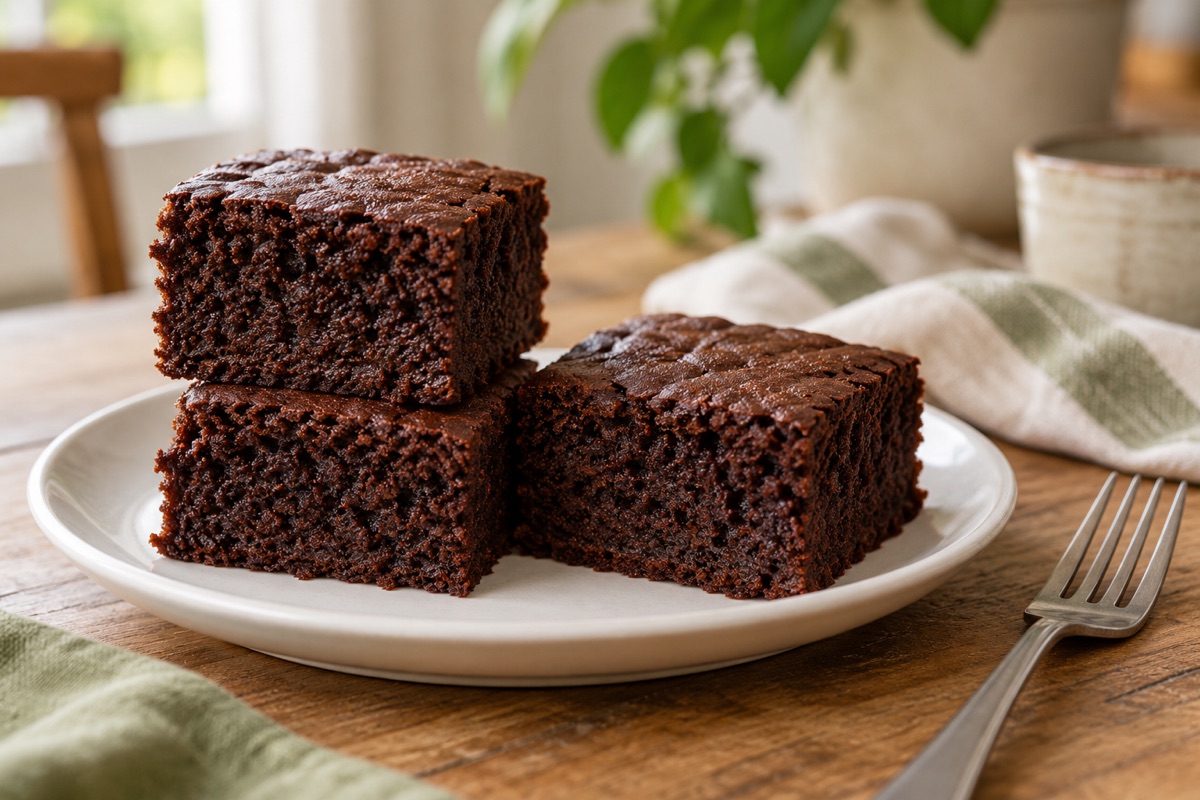
- Cool the cake in the pan on a rack. Cutting a warm cake makes the crumb tear.
If the center sinks, the likely causes are underbaking, an oven that runs cool, or batter that sat before baking. Look for a dry toothpick and a set, springy top before you pull the pan.
Once it has cooled, cut it into nine squares and dust with powdered sugar if you like.
Variations
These are suggestions based on how the batter behaves, not tested results.
- For a coffee flavor, replace part of the cold water with cooled brewed coffee. The cocoa tastes deeper without the coffee taking over.
- Add a pinch of cinnamon to the dry mix for spice.
- For citrus, swap the vanilla for a small amount of zest in the dry mix.
- A simple glaze of powdered sugar and water, or a dairy-free chocolate frosting, keeps the cake egg- and dairy-free. A butter frosting adds dairy.
- A different pan size changes the baking time and the height of the cake. Judge doneness by the toothpick and the springy top, not the clock.
For a richer cake made with eggs and citrus, try this Meyer lemon pudding cake with a soft center. The texture is completely different.
What not to substitute
Baking powder in place of baking soda changes the cake, because the vinegar reaction is the point of the recipe. Lemon juice supplies acid in place of vinegar, but the amount and flavor differ, so expect a different result. Gluten-free flour blends may change the crumb, since the structure comes from wheat flour. Look for a recipe developed for that flour.
Storage and reheating
Cool the cake completely, then cover the pan or move the squares into an airtight container. With no eggs or dairy in the batter, the main concern is staleness, not the risks that come with custard fillings. If you add a frosting or filling that contains dairy or eggs, follow USDA and FoodSafety.gov guidance for that ingredient, and check product labels.
To keep squares for later, wrap them well and freeze them. The details are in this guide to freezing chocolate cake and wrapping it well. Thaw covered so the surface does not dry out.
A few seconds in the microwave softens a refrigerated square. Texture is not a safety test: if the cake has been stored a long time or has a topping that needs refrigeration, go by official storage guidance, not by how the cake looks or smells.
Writing the recipe down
Short, forgiving recipes like this one travel well. To keep it in a form that lasts, see how to preserve family recipes without losing the stories. Write down the weights, the pan size and anything you changed.
Explore more in Recipes for the Home Kitchen.
Wacky Cake: Chocolate Cake Without Eggs or Milk
This recipe card has not been marked as tested yet.
- Yield
- 9 squares (one 8-inch square cake)
- Prep
- 10 min
- Cook
- 35 min
- Total
- 1 hr
Ingredients
- 190 g (1 1/2 cups) all-purpose flour
- 200 g (1 cup) granulated sugar
- 30 g (1/3 cup) unsweetened cocoa powder
- 6 g (1 teaspoon) baking soda
- 3 g (1/2 teaspoon) fine salt
- 240 g (1 cup) cold water
- 80 g (1/3 cup) neutral oil, such as canola or vegetable oil
- 15 g (1 tablespoon) distilled white vinegar
- 5 g (1 teaspoon) vanilla extract
- Powdered sugar, for dusting (optional)
Method
- Heat the oven to 350°F (175°C). Leave an 8-inch square metal pan ungreased.
- Add the flour, sugar, cocoa, baking soda and salt to the pan. Stir with a fork until no streaks of cocoa remain.
- Smooth the dry mixture flat. Make three wells in it with the back of a spoon.
- Pour the vinegar into one well, the vanilla into another and the oil into the third.
- Pour the cold water over everything.
- Stir with a fork or small spatula until the batter is smooth. Scrape the corners and bottom edge.
- Bake until a toothpick inserted in the center comes out with a few moist crumbs.
- Cool the cake in the pan on a rack. Dust with powdered sugar before cutting.
Contains: wheat
Contains no eggs or dairy, but check labels on cocoa and vanilla for shared-equipment warnings if allergies are a concern. Bake time varies by oven and pan, so start checking early. Recipe formulation is standard and has not been tested by our team.
Sources
- Depression cake - Wikipedia , Wikipedia (accessed October 4, 2026)
- Sodium bicarbonate - Wikipedia , Wikipedia (accessed October 4, 2026)