
How to Store Cookies: Soft and Crisp Batches
Soft cookies and crisp cookies need opposite storage. Here is how to cool, contain, layer and freeze each kind, and when to rely on official guidance instead.
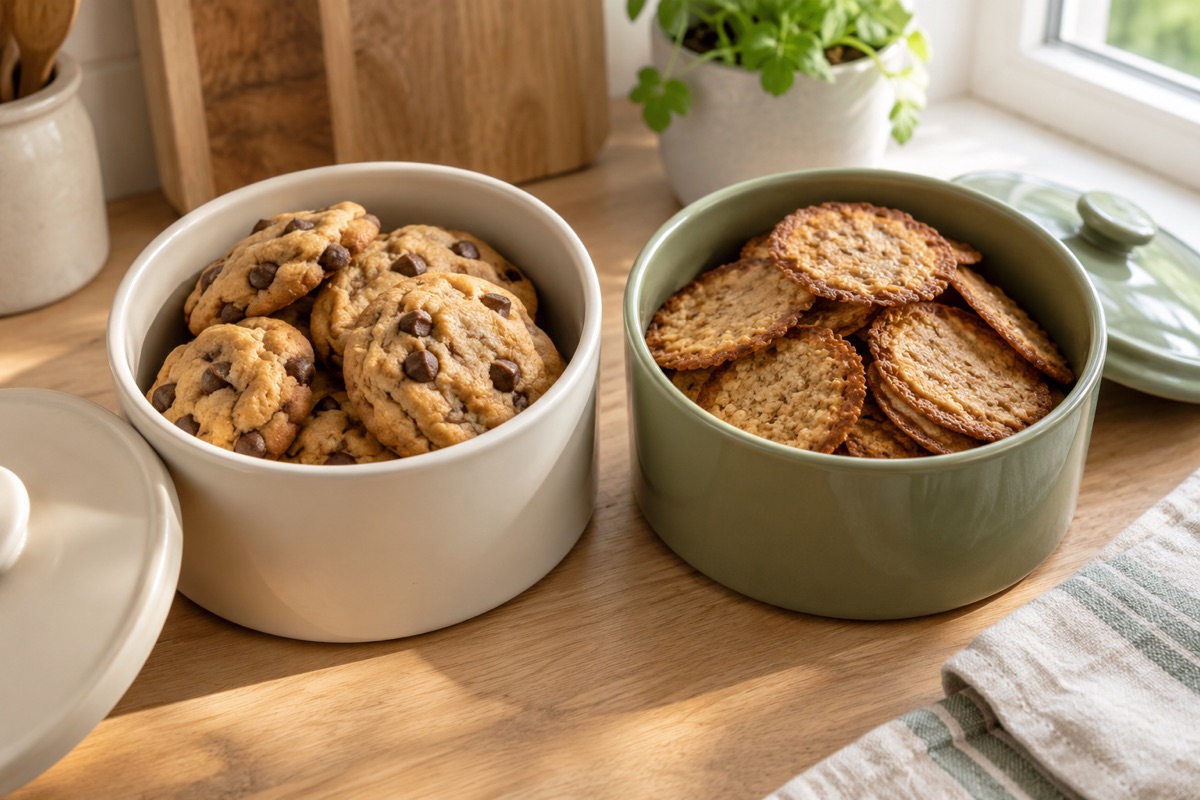
Soft cookies and crisp cookies need nearly opposite storage. Soft cookies keep their texture in a sealed container that holds in moisture, while crisp cookies stay crisp in a dry container that does not trap humidity. For both, cool them completely first, and freeze what you will not finish.
This guide applies to readers in the United States and was last checked against extension sources on October 4, 2026. It describes general principles. Texture observations here are explanations of how moisture behaves, not test results.
Which cookie are you storing?
Ask how much moisture the cookie started with and whether you want to keep it or lose it.
- Soft and chewy cookies (many chocolate chip, oatmeal and molasses cookies) have a moist crumb. Over time they lose moisture to the air, so the goal is to slow that loss.
- Crisp cookies (thin shortbread, sugar cookies, biscotti) are dry. They tend to take up moisture from the air, so the goal is to keep humidity out.
- Frosted or filled cookies add a second concern. Frosting can stick, and cream or custard fillings do not freeze well. The National Center for Home Food Preservation lists cream or custard fillings as separating and turning watery or lumpy after freezing.
A cookie that contains perishable filling, such as cream cheese, needs refrigeration regardless of texture. Follow the guidance linked in the food safety note below for those.
Steps
- Cool completely. K-State Extension says to cool baked goods completely before packing them for the freezer, which prevents condensation from making them soggy. The same applies on the counter: a warm cookie in a closed container releases steam, which softens crisp cookies and can make soft ones damp.
- Keep crisp and soft cookies apart. The moister cookies can pass moisture to the crisp ones.
- Pick a container (below) and fill it without crushing the cookies.
- Layer with parchment or waxed paper if the cookies are frosted, sticky or likely to fuse together.
- Label with the date and the type of cookie.
Containers for soft and for crisp cookies
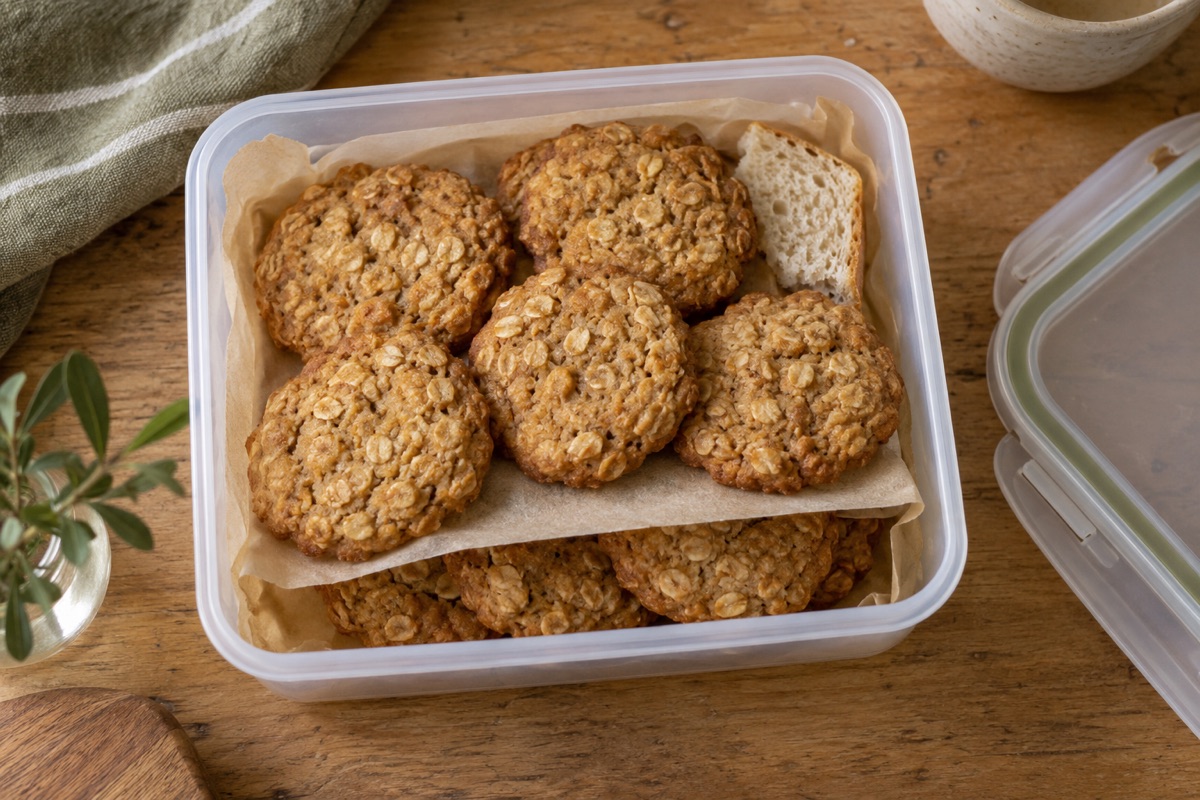
For soft cookies, use a container with a tight-fitting lid, such as a plastic container with a snap lid or a glass jar with a gasket. Layer cookies with parchment between them. Some bakers tuck a small piece of bread into the container to share moisture with the cookies. That is a household custom rather than an official recommendation, so treat it as optional, and remove the bread if it dries out or shows any sign of mold. Loaves have their own needs; see how to store homemade bread.
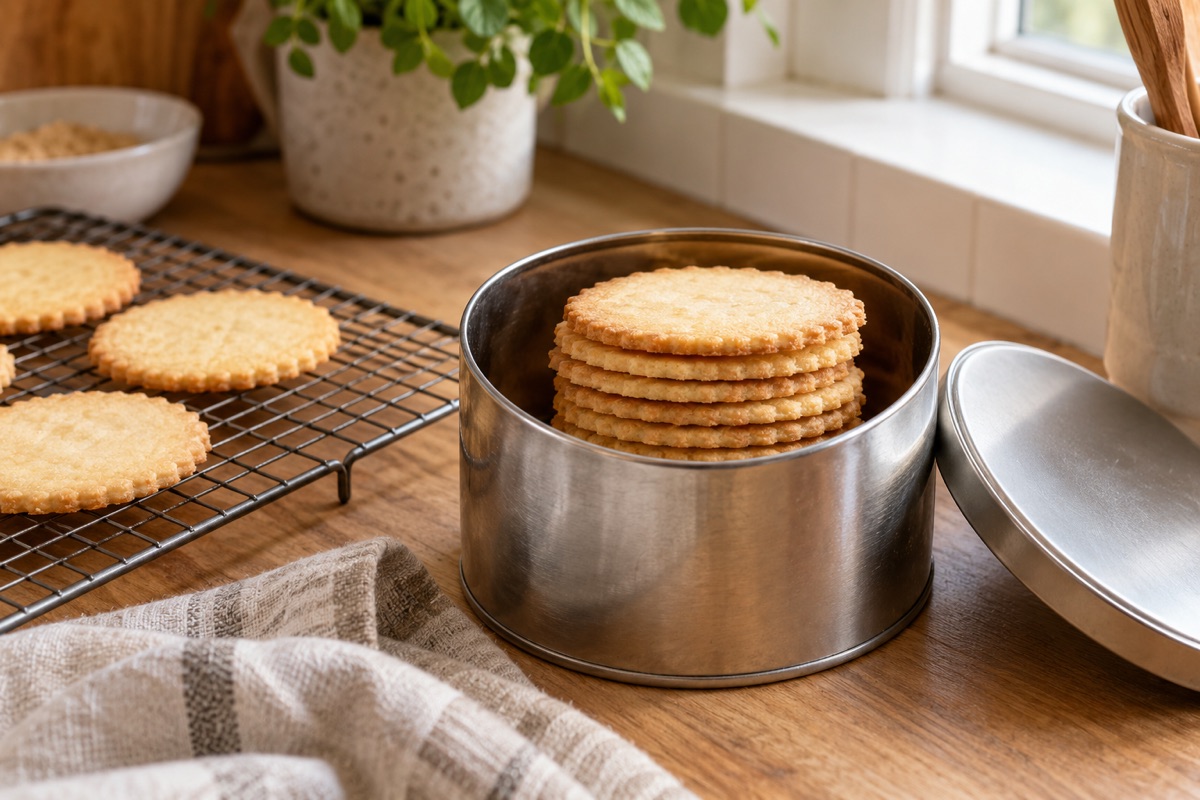
For crisp cookies, use a container you can close but that is not a humidity trap, such as a metal tin or a lidded container kept in a dry cupboard. If crisp cookies go soft, recrisping on a baking sheet in a warm oven is a common remedy. Cool them again before storing so they do not steam in the container.
Whichever container you choose, check that the lid fits well. Airtight containers and vacuum sealing are different tools: vacuum sealing can break delicate cookies, so rigid containers are usually the better fit for fragile ones.
Gift packaging has its own concerns, such as how cookies travel and how they look. See how to package cookies for gifts for those choices. If you sell cookies, labeling, shelf-life claims and packaging rules depend on your state and product, so start with the planning checklist on how to package cookies for sale.
Counter, fridge and freezer
For cookies without perishable filling, an airtight or dry container on the counter is the typical home method. This article does not give a number of days, because no official source gives one for homemade cookies. Use your own date label, and discard cookies that look moldy or have been stored with a perishable filling at room temperature. An off smell or taste is a quality cue, and a normal smell does not prove a food is safe.
For plain cookies the refrigerator is not usually needed, and it can dry soft cookies out. Use it for cookies with cream cheese, custard or whipped fillings, and follow official refrigerator guidance for them.
Freezing is the best way to hold a large batch. K-State Extension says to pack baked cookies in a rigid container to prevent breakage, and that if cookies are frosted before freezing, you freeze them on a cookie sheet first and then layer them with waxed paper in a freezer container. The National Center for Home Food Preservation says freezer packaging should be moisture-vapor resistant, durable and leakproof, so use containers or bags made for freezing.
K-State Extension’s quality guidelines are up to 12 months for unfrosted baked cookies, up to 2 months for frosted cookies, and up to 6 months for unbaked cookie dough. These figures come from one extension handout and are not safety limits. The FDA says food properly stored at 0°F will remain safe, though quality decreases the longer it is in the freezer.
Thawing and refreshing
K-State Extension says to thaw frozen cookies in their container at room temperature. Keeping the lid on lets condensation form on the container, not the cookies. For unbaked dough, K-State says to thaw a rolled dough log in the refrigerator until soft enough to slice, and to bake drop-cookie mounds without thawing, using the recipe’s directions.
Soft cookies can be refreshed briefly in a warm oven or microwave. Crisp cookies can be warmed in an oven to drive off moisture. Follow label instructions for any store-bought dough.
Common questions
Why did my cookies go hard? Moisture left the cookie. A tighter container, parchment between layers and a cool place slow this down.
Why did my crisp cookies go soft? They took in humidity, often from being packed warm or stored with soft cookies. Cool them fully, store them dry and keep them separate.
Can I tell if a cookie is safe by how it tastes or feels? No. Texture and flavor are quality cues, not safety tests. If a cookie has perishable filling that was left out, or shows mold, do not eat it. The FDA says the safest practice is to discard moldy food, and that food can make you sick even when it does not look, smell or taste spoiled.
Does a bakery or gift label override this? Yes. Follow product labels and the maker’s instructions for any packaged cookies.
Official guidance and review date
Reviewed October 4, 2026 for the United States. Sources: K-State Research and Extension (cookie freezing guidance), the National Center for Home Food Preservation at the University of Georgia (packaging, containers and labeling) and the FDA (storage basics). The food safety note below links to FoodSafety.gov for official storage charts. Where any source and a product label differ, follow the label.
Explore more in Food Storage & Freezer Guides.
Official guidance and sources
Sources last checked October 4, 2026.
- Freezing Baked Goods , K-State Research and Extension, Ellis County (accessed October 4, 2026) Cooling, packing, thawing and quality-based freezer guidelines for cookies and dough.
- Packaging and Labeling Foods , National Center for Home Food Preservation, University of Georgia (accessed October 4, 2026)
- Containers for Freezing , National Center for Home Food Preservation, University of Georgia (accessed October 4, 2026)
- Are You Storing Food Safely? , U.S. Food and Drug Administration (accessed October 4, 2026) Used for freezer temperature, the point that frozen food stays safe while quality declines, and the advice to discard moldy food.